
Labaw Donggon Myth Meaning & Symbolism
A demigod hero's epic quest for three celestial brides leads to a cosmic imprisonment, a myth of boundless desire, divine retribution, and ultimate redemption.
The Tale of Labaw Donggon
Listen, and hear the tale that the wind carries from the mountains of Panay. In the time when the world was young and the boundaries between sky, land, and underworld were thin as a spider’s silk, there lived a hero whose name was a thunderclap: Labaw Donggon.
He was born of the union between a mortal woman, Abyang Alunsina, and the deity Datu Paubari. From his first breath, he was extraordinary. He grew not by years, but by deeds. While other infants suckled, he demanded the roar of the Bakunawa for a lullaby. His hunger was not for milk, but for glory. His desire was a fire that could not be quenched, and it fixed upon the most impossible of treasures: the love of three celestial maidens, each more radiant and remote than the last.
First, he desired Abyang Ginbitinan, who lived in the House of the Sun. Donning his magical cape and brandishing his kampilan that sang in battle, he crossed nine mountains and seven seas. He fought guardians of wind and stone, his strength shaking the very roots of the world tree. He won her, and his heart swelled.
But one victory only sharpened his appetite. Next, he set his sights on Abyang Doronoon of the House of the Moon. This journey was through realms of shifting mist and echoing silence, where shadows had teeth. Again, his might prevailed. He subdued the spirits of the twilight and brought the moon-maiden to his side. Two celestial brides, and his pride became a fortress around him.
A third longing awoke, deeper and more dangerous. He heard of Malitong Yawa Sinagmaling, whose beauty was so fierce it was said to be guarded by Saragnayan, a lord whose power was drawn from the very heart of darkness. To win her, Labaw Donggon would have to descend not upwards to the sky, but downwards into the belly of the world. His brothers warned him. The wind whispered caution. But the hero, drunk on his own legend, would not hear it.
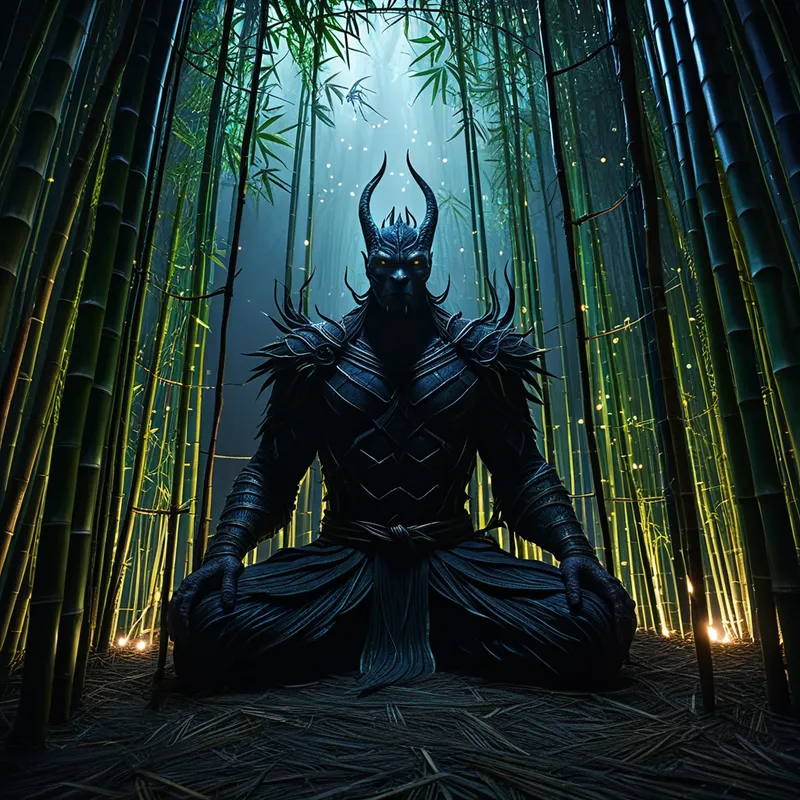
He found Saragnayan and issued his challenge. For three days and three nights, they fought—not with mere blades, but with the raw elements of creation and decay. Saragnayan, whose strength was tied to a single, hidden pamlang (life-stone), proved invincible. On the third day, as the hero’s strength finally wavered, Saragnayan unleashed his darkest magic. The earth opened. Not with a crash, but with a whisper, a grove of enchanted, iron-hard bamboo sprouted around Labaw Donggon, weaving itself into an impregnable cage. The mighty hero, the conqueror of sun and moon, was trapped. His fire was contained. His songs were silenced. He was imprisoned in the underworld, a trophy for the lord of darkness.
There he remained, for years that felt like centuries, while the world above mourned his absence. His story seemed ended, a caution written in bamboo and shadow. It was not his strength, but the love and cunning of his youngest son, Asu Mangga, that would plot a rescue. The son, embodying a wisdom his father lacked, discovered the secret of Saragnayan’s pamlang. Through trickery and sacrifice, he broke the lord’s power, causing the bamboo cage to wither. Labaw Donggon emerged, not as the brash youth who entered, but as a man tempered by darkness, humbled by captivity, and finally, redeemed by a love he did not have to conquer—the filial love that came to set him free.
Cultural Origins & Context
This epic is the heart of the Hinilawod, an oral epic chanted over several nights by the Sulod (or Bukidnon) people of Central Panay. It was not merely entertainment; it was a living scripture, a cosmological map, and a social contract performed by a binukot or a babaylan. The chanting itself was a ritual, invoking the ancestors and aligning the community with the divine order.
The myth functioned as a profound teaching tool. In a culture valuing bravery (isog) and renown (dungog), the story of Labaw Donggon explored the dangerous edge where noble ambition tips into destructive hubris (kahambug). It taught about the limits of even divine power, the importance of cunning (katakus) alongside strength, and the inevitable intervention of fate (palad). Furthermore, it reinforced kinship bonds, showing that the consequences of one man’s actions ripple through generations, and that redemption often comes not from the self, but from the community—embodied here by his son.
Symbolic Architecture
At its core, the myth of Labaw Donggon is a masterful depiction of the psyche’s inflation and its necessary correction. Labaw Donggon represents the untamed libido in its most heroic and reckless form. His three quests are not for love in its relational sense, but for possession, for the incorporation of celestial anima figures (the feminine principle within the male psyche) as trophies to bolster his own identity.
The hero’s journey is not complete when he wins the bride, but when he loses himself. The cage is not a punishment, but a brutal initiation into the reality of the Self beyond the ego.
The bamboo cage is the central symbol of this correction. Bamboo is hollow, yet strong; it grows in communal groves. It represents a natural, organic limit that the hero’s metallic will (his sword) cannot cut. This imprisonment is the encounter with the Shadow, embodied by Saragnayan. The hero is not defeated by a stronger hero, but by the principle of containment itself—the dark lord who says, “This far, and no further.”
His rescue by his son, Asu Mangga, symbolizes the emergence of a new psychic attitude. It is the “son,” the next generation of consciousness, that integrates the lesson the “father” could not learn alone: that true power lies not in direct confrontation, but in understanding the hidden vulnerability (the pamlang), the secret rule of the opposing force.
The Dreamer's Resonance
When this myth stirs in the modern soul, it often manifests in dreams of grandiose projects collapsing, of feeling trapped in a job or relationship of one’s own making, or of a profound, humbling failure following a period of intense success. The somatic feeling is one of constriction—tightness in the chest, a literal feeling of being caged or bound.
Psychologically, this is the process of deflation. The ego, having identified too completely with its successes, its persona of capability and invincibility, meets an immovable obstacle. This is not a random misfortune, but a fateful encounter with one’s own limits. The dreamer experiencing this pattern is undergoing a necessary, if painful, correction. The unconscious is enforcing a boundary that the conscious mind refused to acknowledge. The dream may present images of lush, inescapable greenery (the bamboo), being buried alive, or a brilliant light being swallowed by darkness. It is the psyche’s way of initiating a descent, forcing a confrontation with what has been arrogantly ignored.
Alchemical Translation
The alchemical process mirrored in Labaw Donggon’s saga is the nigredo, the descent into blackness essential for transformation. His epic quests represent the initial, fiery stages of albedo—attempting to purify and elevate the self through glorious deeds (the conquest of the celestial brides as symbolic of spiritual ideals). But this whitening is premature, built on ego, not the Self.
His imprisonment is the true nigredo: the putrefaction of the heroic identity. The proud ego is dissolved in the darkness of the underworld. This is not a failure of individuation, but its crucial, central phase.
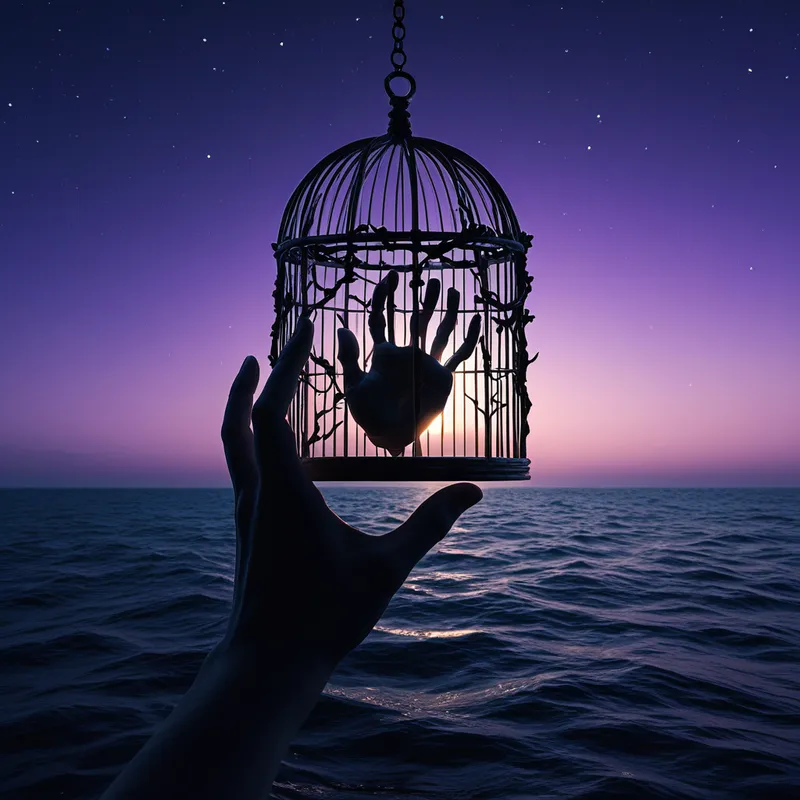
The cage is the alchemical vessel, the sealed place where the old king dies so that the new, conscious king may be born.
Redemption through the son signifies the citrinitas and final rubedo. The rescued Labaw Donggon is not the same man. He has integrated his shadow (Saragnayan, whose power he now understands) and his dependency (his need for rescue). The libido that once drove him outward to conquer is now, potentially, available for inward governance. He returns not to rule as before, but to reign with the hard-won wisdom of the depths. For the modern individual, this myth maps the journey from inflation to humility, from heroic doing to conscious being, teaching that our deepest prisons often contain the key to our most authentic freedom.
Associated Symbols
Explore related symbols from the CaleaDream lexicon:
- Hero — The central archetype of Labaw Donggon, representing the primal drive for glory and conquest, which must ultimately be humbled and re-contextualized to achieve true wholeness.
- Cage — The enchanted bamboo prison symbolizes the necessary, fateful limitation imposed by the psyche or the universe to correct ego inflation and force a confrontation with the Shadow.
- Journey — The hero's three quests represent the outward, expansive movement of the untamed libido, a journey that must eventually turn inward into the underworld of the self.
- Shadow — Embodied by Saragnayan, this is the dark, antagonistic force that holds the hero captive, representing all that the conscious ego has refused to acknowledge or integrate.
- Descent — Labaw Donggon's fall into the underworld is the critical movement of the myth, marking the shift from solar, conscious striving to lunar, unconscious incubation and dissolution.
- Redemption — The rescue by Asu Mangga signifies that salvation from one's own hubris often comes from an unexpected, more integrated aspect of the self or through relational love.
- Pride — The fatal flaw of the hero, the kahambug that blinds him to his limits and directly invites the corrective punishment of fate.
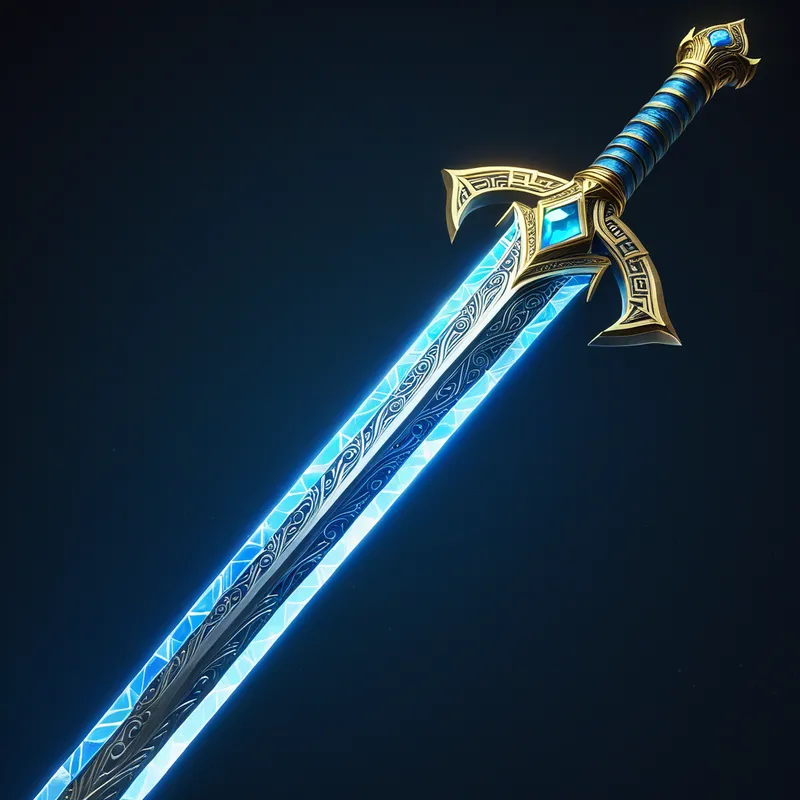
- Sword — Labaw Donggon's magical kampilan represents his will, strength, and cutting consciousness, tools that are ultimately useless against the organic, ensnaring power of the unconscious.
- Bride — The three celestial maidens are anima figures, symbols of soulful completion that the hero seeks to possess, mistaking outer conquest for inner union.
- Father — The archetypal role of Datu Paubari and of Labaw Donggon himself, representing legacy, authority, and the patriarchal consciousness that must be challenged and renewed by the "son."
- Son — Asu Mangga embodies the new consciousness that emerges to solve the problem the father created, representing cunning, filial duty, and the integrative wisdom that rescues the old paradigm.
- Destiny — The inescapable palad that weaves the hero's triumphs and failures into a coherent pattern of learning, ultimately guiding him toward his necessary humiliation and subsequent redemption.