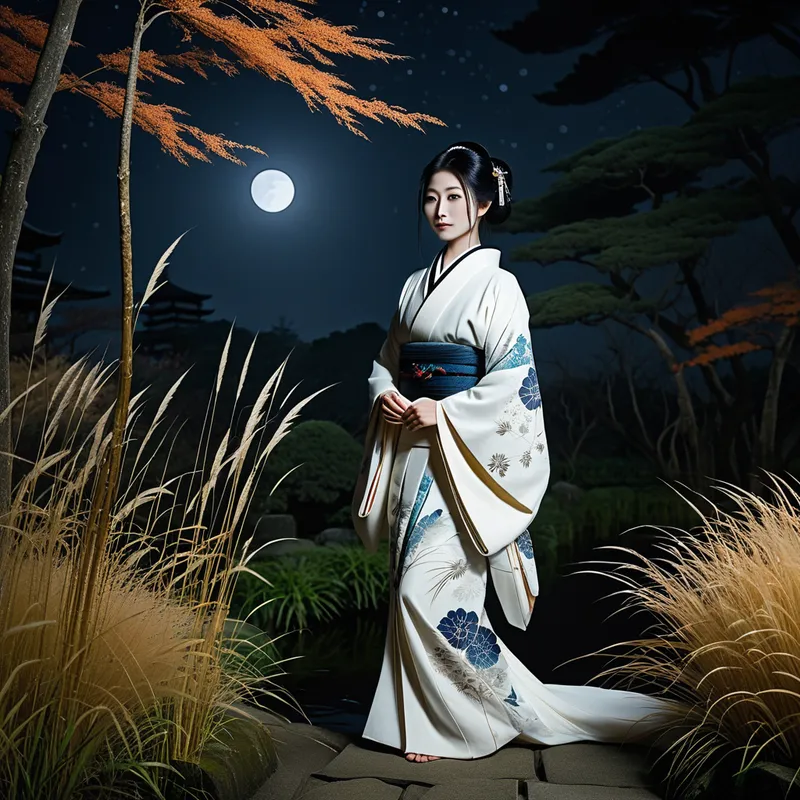
Kuzunoha Myth Meaning & Symbolism
A fox spirit becomes a devoted wife and mother, but her true nature compels a heartbreaking departure, leaving a legacy of wisdom and transformation.
The Tale of Kuzunoha
Listen, and let the tale settle in the space between heartbeats. In the mist-wrapped mountains of Settsu, where the cedars whisper secrets to the wind, there lived a nobleman named Abe no Yasuna. His was a life of quiet study, his heart a scroll yet to be inscribed by profound love. One day, under a sky bruised with the promise of storm, he walked a forest path. A cry, sharp and desperate, pierced the green silence. He rushed toward the sound to find a scene of brutal violation: a hunter, his arrow nocked, aimed at a pair of luminous white foxes. One, a magnificent creature, was already struck.
Yasuna, moved by a compassion deeper than fear, threw himself between the hunter and the remaining fox. In the struggle, he was wounded, his blood staining the moss, but the hunter fled. As Yasuna’s vision dimmed, the unharmed fox—its eyes holding galaxies of ancient knowing—approached. It nuzzled his hand, a touch of cool velvet, then vanished into the deepening shadows of the pines.
He awoke not on the cold ground, but in a soft bed within a humble yet exquisite cottage. A woman of impossible beauty tended to him. Her name was Kuzunoha, she said, her voice like water over stone. Her presence was a balm; she moved with a grace that seemed to blend with the dappled light filtering through the paper screens. Love, swift and deep as a mountain river, carried them. They married, and a son was born to them—Dōshin, later to be known as the legendary Abe no Seimei. The boy was preternaturally gifted, his eyes seeing patterns in the world that others missed.
For years, their life was a idyll. Yet, Kuzunoha would sometimes gaze at the chrysanthemums in their garden with a longing so profound it seemed to bend the air. The wild called to her in the scent of rain on dry earth, in the cry of a distant kite. The final thread of her human disguise began to unravel during an evening of poetry. Captivated by the beauty of trailing hagi blossoms outside, she absently dipped her brush to write. But her hand, guided by an instinct older than ink, traced not characters, but the perfect, elegant shape of a fox’s paw print upon the rice paper.
The truth, once glimpsed, could not be unseen. Yasuna saw the print, and in that moment, saw her—the fox spirit, the kitsune, who had repaid his kindness with a lifetime of devotion. The atmosphere in the room shifted from domestic warmth to the electric silence of a sacred grove. Kuzunoha did not deny it. Her love was real, but so was her nature. With a sorrow that filled the house like incense smoke, she knew her time in this human shape was over. To stay would be to deny her essence, and to deny her son the truth of his own miraculous origin.
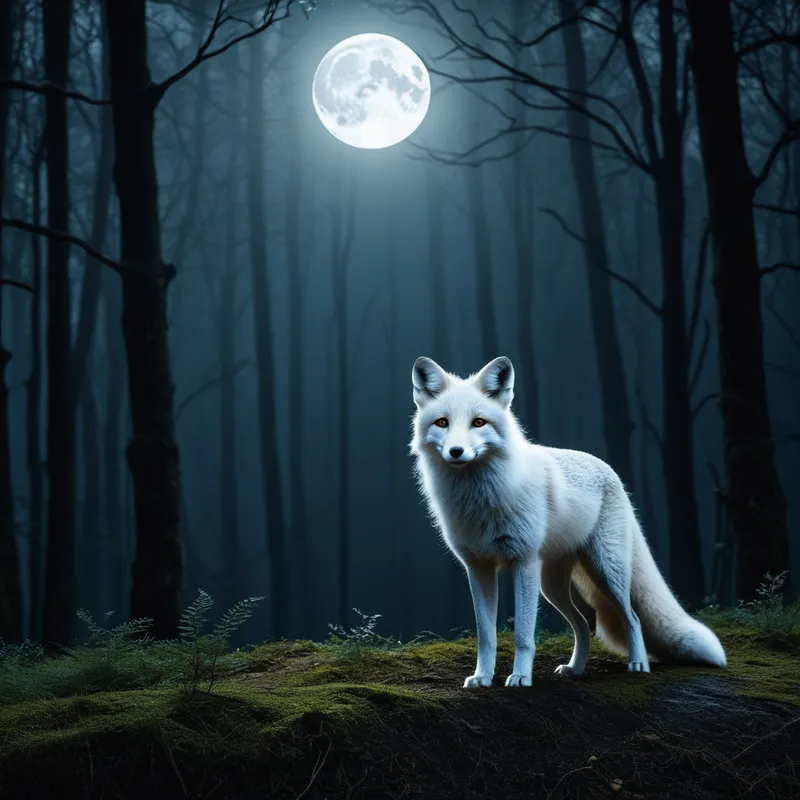
She left a farewell poem, a whisper of ink and regret, and walked toward the forest that had always been her true home. At the treeline, she turned one last time, her form shimmering in the moonlight. The beautiful woman dissolved, and in her place stood the glorious white fox, its coat silvered by the night. One last, long look filled with all the love and pain of two worlds, and then she was gone, a ghost among the bamboo.
Cultural Origins & Context
The tale of Kuzunoha is woven into the rich tapestry of yōkai lore and the cult of the legendary figure Abe no Seimei. It emerged during the late Heian to Kamakura periods, a time when the boundaries between the human and spirit worlds were perceived as thin and permeable. The story was propagated through otogizōshi (companion tales), bunraku, and Noh theater, most famously in the play Kuzunoha or The Fox of Shinoda.
Its societal function was multifaceted. On one level, it served as an etiological myth, explaining the preternatural abilities of the historical Abe no Seimei, the most revered onmyōji in Japanese history, by granting him a supernatural heritage. On a deeper level, it codified the complex cultural relationship with the fox, or kitsune, a creature simultaneously revered as a messenger of Inari and feared as a cunning trickster. Kuzunoha’s story elevates the fox spirit from a mere deceiver to a being capable of profound gratitude, ethical duty, and transformative love, acting as a narrative bridge between the awe-inspiring and the familiar.
Symbolic Architecture
At its core, Kuzunoha’s myth is a profound allegory of the anima—the inner feminine principle in the psyche—and its necessary evolution. Kuzunoha is not a destructive seductress, but an anima figure who appears to guide, heal, and foster creation (in the form of their gifted son, Seimei). She represents the initial, integrated connection to the instinctual and natural world that can catalyze a man’s development.
The wild self first appears not to destroy the domestic world, but to make it possible. Its eventual departure is not abandonment, but the next necessary instruction.
Her true identity as a fox symbolizes the untamed, instinctual layer of the psyche that civilization often seeks to repress. The paw print on the poetry paper is the critical moment of anamnesis—the unforgotten memory of one’s deeper nature breaking through the conscious persona. Her sacrifice is not of her life, but of the integrated human role she played. She sacrifices the containment of her wildness for its truth, forcing both Yasuna and her son to relate to her, and by extension to their own souls, in a new, more conscious way.
The Dreamer's Resonance
When this myth pattern stirs in the modern dreamer, it often signals a profound somatic and psychological crossroads related to identity and belonging. To dream of a loving partner or a nurturing figure who is revealed to be an animal, or who must return to a wild place, points to the integration of one’s instinctual self reaching its limit within a current life structure.
Somatically, this may manifest as a deep, restless longing—a "fox itch"—that no material comfort can scratch. It is the body’s wisdom sensing that a role, relationship, or career, however comfortable, has become a costume that no longer fits the soul’s true shape. The dreamer may feel a sense of exquisite sadness, the grief of Kuzunoha’s departure, which is actually the grief for the simpler, more defined self that must be left behind. The process is one of differentiation: the part of the psyche that served as a bridge (the nurturing fox-wife) must withdraw so that the conscious self can learn to walk between worlds on its own.

Alchemical Translation
The alchemical journey modeled by Kuzunoha is the process of separatio followed by a higher coniunctio. The initial marriage of Yasuna and Kuzunoha represents the first, blessed union of the conscious ego with a helpful aspect of the unconscious—the prima materia of the soul is engaged, leading to the birth of new potential (Seimei’s genius).
However, true individuation requires this initial union to dissolve so that its components can be reconstituted at a higher level of awareness.
The spirit must abandon the form it taught you to love, so that you may learn to love the spirit itself.
Kuzunoha’s departure is the essential separatio. It forces the human partners (Yasuna and, symbolically, the dreamer) to hold the paradox: the love was real, and the beloved was fundamentally other. The task is to internalize the qualities she represented—instinctual wisdom, nurturing grace, connection to nature—without demanding they remain in a domesticated, human-shaped container. The farewell poem is the lapis, the philosopher’s stone of this operation: it is the enduring, symbolic record of the relationship that transcends the literal form it once took. The modern individual undergoing this transmutation moves from seeking a Kuzunoha (an external source of soul-connection) to becoming, in part, their own Kuzunoha—able to access that wild wisdom internally, while also accepting its essential, untamable freedom. The forest does not vanish; it becomes an interior landscape one can consciously visit, having been shown the path by a love that was brave enough to leave.
Associated Symbols
Explore related symbols from the CaleaDream lexicon: