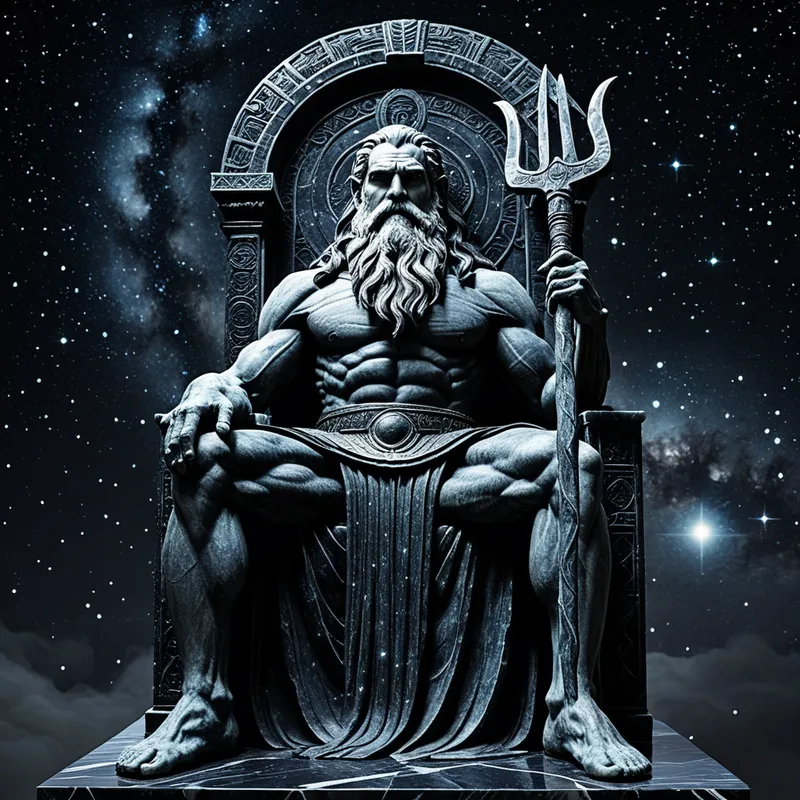
Kronos/Saturn Myth Meaning & Symbolism
The Titan ruler who castrated his father and devoured his children, embodying the relentless cycle of time and the inevitable overthrow of order.
The Tale of Kronos/Saturn
In the beginning, there was a terrible, primal love. Ouranos lay upon Gaia, his starry body smothering her fertile depths, refusing to let her children—the monstrous Hekatoncheires and the mighty Titans—see the light. Gaia groaned in agony, her soil compacted, her mountains straining. From her pain, she forged a weapon of adamant, a sickle with a blade like a crescent moon turned to cold, grey flint.
She called to her children in the dark. “Who will free me? Who will end this tyranny?” Only the youngest Titan, cunning and fierce, answered. His name was Kronos. He took the sickle, its edge humming with his mother’s rage. When Ouranos next descended in his starry passion, Kronos struck. A scream tore the fabric of the cosmos. Ouranos recoiled, his essence bleeding into the sea, giving birth to Aphrodite. The sky was severed from the earth, and space was born.
Kronos claimed the throne. With his sister-queen Rhea, he ruled a Golden Age, where time flowed like honey and men knew no toil. But a curse echoed in his ears, the dying prophecy of his father: “You too shall be overthrown by your own child.” The prophecy became a worm in the fruit of his reign. Fear, cold and metallic, seeped into his heart, tainting the gold.
When Rhea bore their first glorious child—Hestia—Kronos looked not upon her with love, but with the terror of endings. He opened his vast maw and swallowed her whole, imprisoning her in his eternal belly. So it went with Demeter, Hera, Hades, and Poseidon. One by one, the future was consumed to preserve the present. Time devoured its own potential.
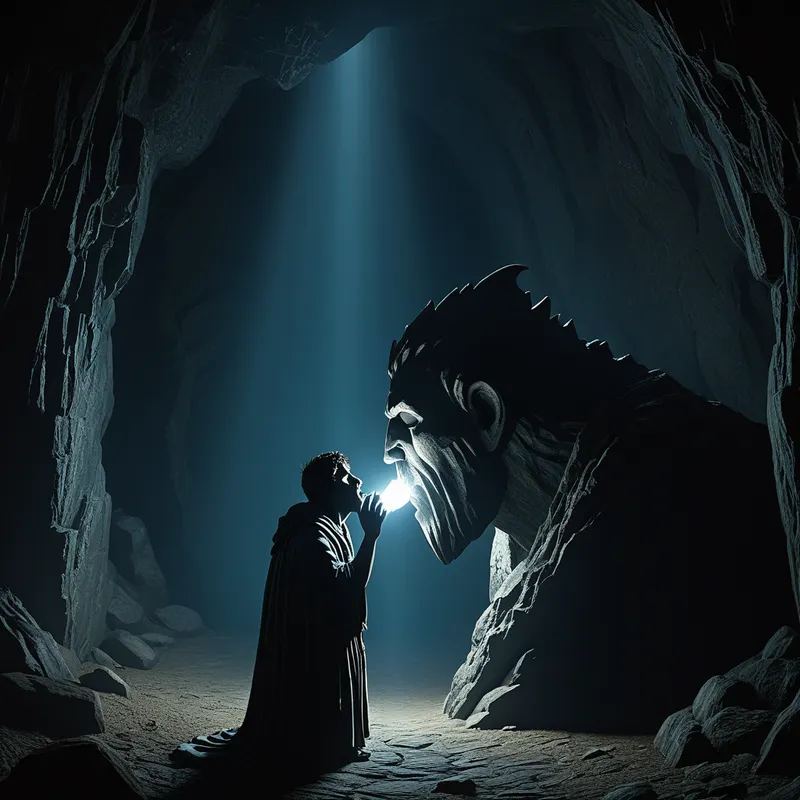
Rhea’s grief became a mountain. When she was heavy with her sixth child, she fled to the wild, dark caves of Crete. There, attended by dancing Curetes whose clashing shields drowned the infant’s cries, she gave birth to a son. She named him Zeus. To Kronos, she presented a stone wrapped in swaddling clothes—a deception as hard as the adamant sickle. The Titan, blind with his ritual of fear, consumed the stone, and the future was saved.
Zeus grew strong on the milk of the goat Amaltheia and the wisdom of the earth. When his hour came, he returned. With a potion of honey and mustard, crafted by the Titaness Metis, he caused his father to disgorge his swallowed siblings, whole and shining, ready for war. Then began the Titanomachy, a cataclysm that shook the pillars of the world. Kronos and the old Titans fought from Mount Othrys, while Zeus and the new gods fought from Mount Olympus. The cosmos itself was the prize.
Victory was decided not by brute strength alone, but by the release of the imprisoned past. Zeus freed the Cyclopes and the hundred-armed Hekatoncheires from Tartarus. With thunderbolts forged by the Cyclopes and the overwhelming force of the Hekatoncheires, the old order was shattered. Kronos and his allies were cast down into the deepest gloom of Tartarus, bound in chains, guarded by the very monsters he had once left imprisoned. The reign of time, which sought to consume all things, was itself bound by eternity.
Cultural Origins & Context
The myth of Kronos is not a singular story but a foundational layer in the complex strata of Greek religious thought, primarily preserved in Hesiod’s Theogony (c. 700 BCE). This epic poem systematized the chaotic genealogy of the gods, providing a divine justification for the supremacy of the Olympian order worshipped in the city-states. The tale likely contains echoes of far older, pre-Greek deities of harvest and time, absorbed and transformed by the invading Hellenic peoples. Kronos’s association with the harvest sickle suggests an agrarian origin, where the god who cuts down the crop is also the lord of the seasonal cycle.
In the Greek imagination, Kronos represented a necessary but superseded stage of cosmic evolution. His Golden Age was a nostalgic paradise, a time before the hardships of the human condition, yet it was an age maintained through horrific, unnatural violence. The myth served a critical societal function: it explained the painful necessity of change, the inevitability of succession (from father to son, from king to king, from era to era), and the brutal cost of maintaining a stagnant paradise. It was a story told to validate the present Olympian order by showing the monstrous instability of the regime it replaced.
Symbolic Architecture
Kronos is the archetypal principle of Chronos—linear, devouring time. He is not merely a symbol of harvest, but of the harvest’s finality: the scythe that cuts, the jaw that consumes, the boundary that ends.
He is the psychic law that the known, however flawed, feels safer than the unknown potential, leading the psyche to consume its own future to preserve a familiar past.
His act of swallowing his children is the ultimate image of repression. Potentialities, new possibilities, and future selves are ingested and held in a state of suspended animation within the dark belly of the unconscious. The swallowed stone, Omphalos, is a brilliant paradox: the densest, most inert object becomes the vessel for salvation. It symbolizes the hardened, petrified truth that the ego cannot digest—the undeniable reality that eventually forces a crisis.
The overthrow by Zeus represents the inevitable rebellion of the repressed contents. What is swallowed must be regurgitated; what is buried in the unconscious will erupt into consciousness, often with volcanic force (the Titanomachy). The cycle of castration—Kronos against Ouranos, Zeus against Kronos—speaks to the painful but necessary severing from the source of one’s being to achieve independent existence and consciousness.
The Dreamer's Resonance
When the pattern of Kronos stirs in the modern dreamscape, it manifests as a profound somatic and psychological experience of constriction, burden, and cyclical entrapment. The dreamer may experience:
- Images of Being Swallowed: Dreams of sinking into quicksand, being consumed by a vast, dark space, or trapped inside a cavern or stomach. This is the somatic echo of a potential self or feeling being "eaten" by an overbearing internal structure—a rigid identity, a paralyzing fear, or an outdated life pattern.
- The Heavy Stone: Dreaming of being forced to carry an impossibly heavy, smooth stone, or of trying to swallow one. This is the weight of a truth the dreamer’s psyche knows but the conscious ego refuses to acknowledge—a duty, a betrayal, a limitation that feels indigestible.
- The Frozen Golden Age: Recurring dreams of a beautiful, static, yet eerily silent paradise from which there is no exit. This reflects a part of the psyche clinging to a past state of comfort or success, a "golden age" that is now a gilded cage, preventing growth.
These dreams signal that the psyche’s natural progression has been halted. A Kronos-complex is at work, where an internal "ruler" is sacrificing future wholeness for the security of present, known limits. The emotional tone is one of deep, melancholic burden, a Saturnine heaviness where time feels like a prison sentence.
Alchemical Translation
The myth of Kronos provides a stark but essential map for the alchemical process of psychic transmutation, or individuation. The first, brutal operation is Nigredo—the blackening. This is the reign of Kronos: the acknowledgment of the shadow, the devouring patterns, the swallowed children (our disowned talents, passions, and potentials) festering within.
The individual must first become the tyrannical Kronos, fully conscious of their own capacity to suppress life out of fear, before they can become the liberating Zeus.
The act of disgorging the stone and the siblings is the Albedo—the whitening. It is the painful, cathartic release. The ego, like Kronos, must be made to vomit up its contents. This is therapy, crisis, breakdown, or any profound confrontation that forces the hardened, petrified truths (the stone) and the long-imprisoned potentials (the sibling gods) back into the light of awareness. It is rarely graceful; it is a violent, messy, and humiliating process.
Finally, the Titanomachy and binding represent Rubedo—the reddening, or coagulation of a new order. The released potentials (now conscious skills, acknowledged emotions, integrated complexes) must be organized. They must fight the entrenched, automatic habits of the old regime (the Titans) and, with the help of once-feared primal forces (the Cyclopes as creative fire, the Hekatoncheires as immense capacity for feeling), establish a new, more conscious sovereignty.
To integrate Kronos is not to defeat time, but to make peace with its laws. It is to accept limitation, structure, and necessity (Saturn’s gifts) not as a tyrant’s chains, but as the vessel that gives form to life. The liberated children become the governing faculties of a mature psyche. The individual moves from being a slave to time—desperately consuming moments to avoid an end—to becoming a steward of their own chronology, building a meaningful life within the bounded, precious field that the sickle of Saturn has carved out for them.
Associated Symbols
Explore related symbols from the CaleaDream lexicon: