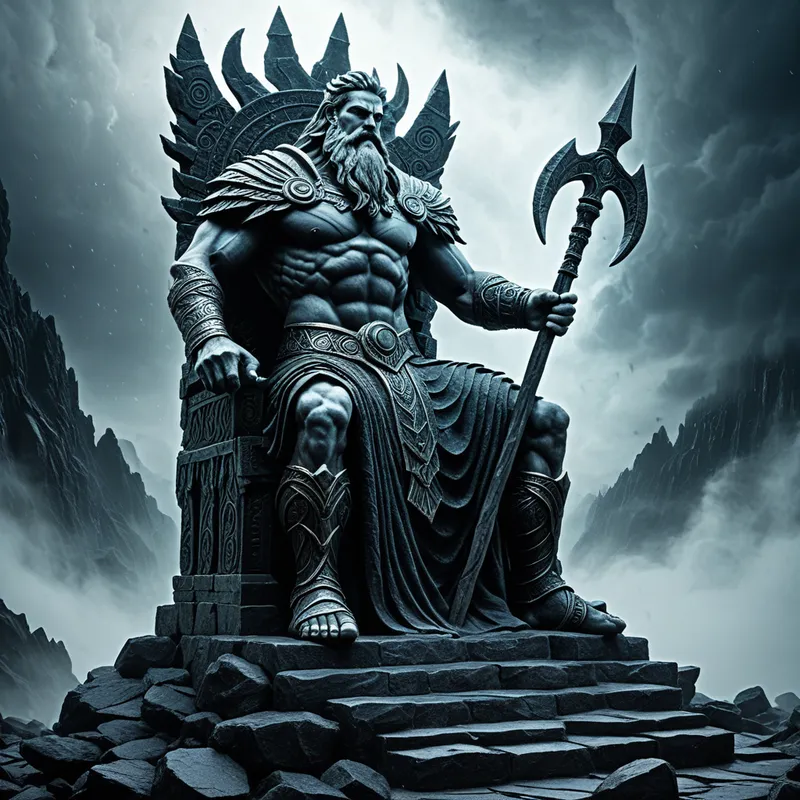
Kronos Myth Meaning & Symbolism
The Titan Kronos castrates his father Ouranos to rule, then swallows his own children to prevent his prophesied overthrow, until Zeus forces his regurgitation and rebellion.
The Tale of Kronos
Before the gods of Olympus, there was a raw, churning age of Titans. The universe was young, and its laws were written in pain and passion. From the formless Chaos sprang Gaia, the wide-bosomed earth, and she bore Ouranos, the starry sky. He became her husband, and together they filled the world with their children—monstrous beings of deep earth and towering mountains.
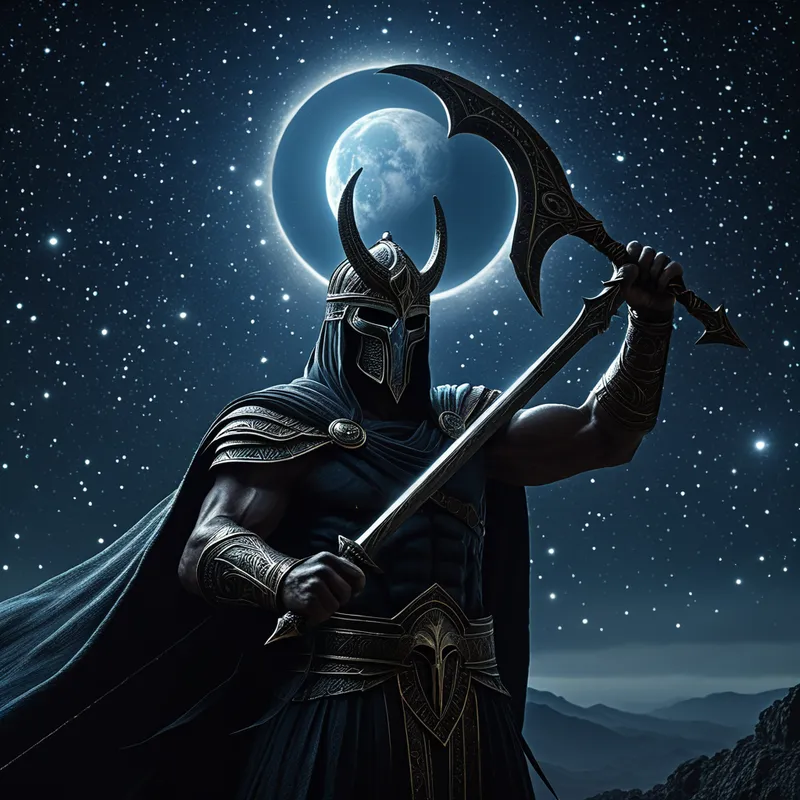
But Ouranos was a jealous tyrant. He hated his offspring, the Hekatoncheires and the Cyclopes, and as each was born, he forced them back into Gaia’s dark womb, causing her immense agony. The earth groaned under the weight of this imprisoned potential. In her torment, Gaia forged a weapon of grey adamant, a sickle with teeth like jagged lightning. She went to her other children, the Titans, and asked who would wield it.
Only the youngest, Kronos, had the cunning and the cold resolve. He lay in ambush when Ouranos descended, driven by desire to cover Gaia once more. In that moment of cosmic intimacy, Kronos struck. With a single, terrible sweep, he severed his father’s generative power and cast it into the sea. From the blood that fell upon the earth sprang the Erinyes and the ash-tree nymphs; from the foam that gathered around the severed flesh in the sea, Aphrodite was born. Ouranos reeled back, cursing his son, prophesying that Kronos too would be overthrown by his own child.
Thus began the Golden Age of Kronos. He ruled with his sister-queen Rhea, and for a time, the world knew peace without toil or old age. But the prophecy festered in his mind like a hidden rot. When Rhea bore their first child, the goddess Hestia, Kronos’s fear overcame him. He took the infant and, opening his vast maw, swallowed her whole. So it went with each new life: Demeter, Hera, Hades, Poseidon—each consumed, held captive in the dark prison of their father’s belly.
Rhea’s grief turned to fierce cunning. When her sixth child was due, she fled to a hidden cave in Crete. There, she gave birth to Zeus. She wrapped a stone in swaddling clothes and presented it to Kronos, who, without hesitation, devoured it. The true infant Zeus was raised in secret, nourished by the goat Amalthea. When he came of age, armed with a potion from the Titaness Metis, Zeus confronted his father. He forced the draught upon Kronos, who convulsed and vomited forth first the stone, and then his children, whole and grown. The liberated Olympians, led by Zeus, waged a war that shook the foundations of the cosmos—the Titanomachy. Victorious, they cast Kronos and the old Titans into the deepest pit: Tartarus. The age of the Titans was consumed, and the reign of the new gods began.
Cultural Origins & Context
The myth of Kronos is a foundational stratum in the complex geology of Greek mythology, preserved primarily in the epic poetry of Hesiod’s Theogony (c. 700 BCE). This was not mere entertainment but a sacred narrative explaining the origin and structure of the cosmos, the divine succession of power, and the establishment of cosmic order (dike) over primordial chaos. It was a story told in ritual contexts, likely by bards and priests, to affirm a cultural understanding of time itself: that progress often requires violent, necessary ruptures with the past.
Kronos’s rule was nostalgically remembered as a lost Golden Age—a time of effortless abundance. This reflects a common human tendency to idealize a past before the complexities of civilization and morality. Yet, the myth simultaneously reveals the dark underbelly of that age: it was a peace maintained by the absolute, devouring control of the sovereign, a stasis that refused the future. The story served as a divine justification for the Olympian order worshipped by the Greeks, framing Zeus’s reign as a necessary evolution from a static, tyrannical time into a dynamic, if more complicated, era of justice, law, and human destiny.
Symbolic Architecture
Kronos is not merely a cruel father; he is the archetypal embodiment of Chronos—Time itself. His myth maps the terrifying, paradoxical nature of temporal existence.
To create a future, one must often sever the binding power of the past. Yet, the act of creation contains the seed of one's own dissolution.
The castration of Ouranos represents the necessary differentiation—the cutting apart of the primordial unity of Sky and Earth (Ouranos and Gaia) to create a space for life and individuation to flourish. Kronos, as the agent, initiates this separation, becoming the lord of the bounded, cyclical time of seasons and harvests.
His subsequent act, swallowing his children, symbolizes time’s most feared attribute: its all-consuming nature. Potential futures, new possibilities, the next generation—all are devoured by the relentless present moment, held in stasis to preserve the status quo. Kronos is the ruler who cannot tolerate succession, the ego that cannot integrate the unconscious, the present that fears the future.
The stone (Omphalos) given to Kronos is a profound symbol. It is the undigestible, mineral truth—the hard, unyielding core of reality that cannot be assimilated by the ego’s control. It is this stone, this irreducible fact, that becomes the pivot for revolution. Zeus, the new consciousness, does not destroy time; he forces it to disgorge, to release what it has imprisoned. The past must be revisited, its contents retrieved and integrated, not left to fester.
The Dreamer's Resonance
When the pattern of Kronos emerges in modern dreams, it speaks to a profound psychological process of containment and potential release. To dream of being swallowed, or of holding something precious inside that feels trapped, often points to a part of the self—a talent, a trauma, a nascent identity—that has been “eaten” by an internalized ruling principle. This could be a parental complex, a rigid self-image, or the crushing weight of responsibility that prevents new growth.
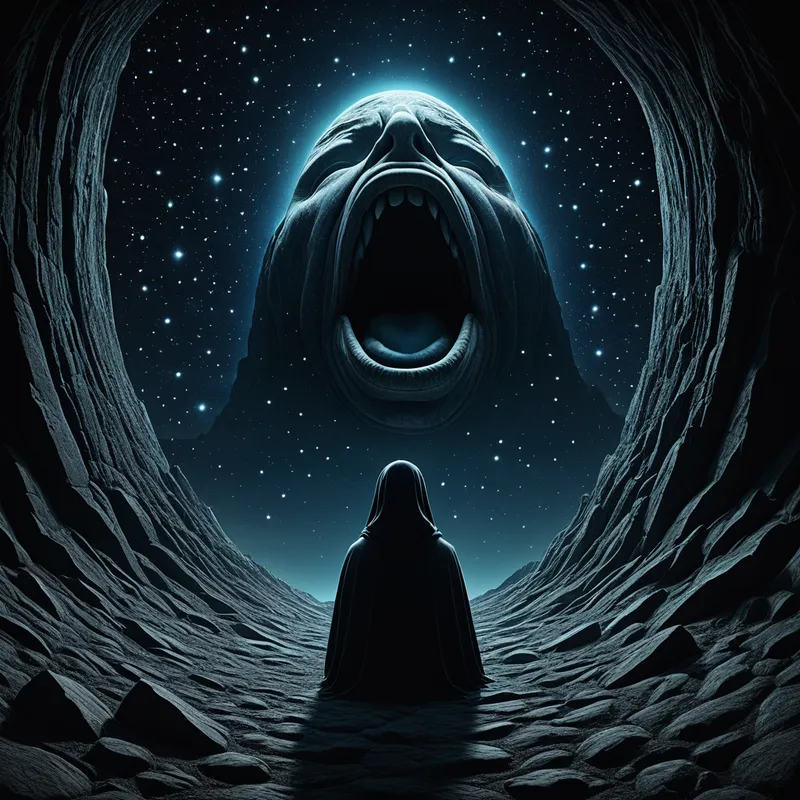
Dreams of a vast, dark interior space (a cave, a stomach, a vault) may symbolize this inner Tartarus where our creative or emotional potentials are bound. The somatic feeling is often one of constriction, heaviness, or silent panic. Conversely, a dream of violent regurgitation or of freeing captives from a dark place signals the beginning of a psychic rebellion. It is the Zeus-force within stirring, demanding the liberation of swallowed aspects of life. The dreamer is in the throes of a necessary, if tumultuous, process of retrieving what was sacrificed to maintain an old, outworn order of the psyche.
Alchemical Translation
The myth of Kronos is a brutal but precise map for the alchemical process of psychic transmutation, central to individuation. The initial state is the prima materia: the undifferentiated union of Ouranos and Gaia, representing an unconscious, enmeshed state of being.
The first great work is the separatio: the courageous, often painful act of cutting oneself free from the overwhelming influence of the parental or cultural unconscious (the castration of Ouranos). This establishes the ego (Kronos) as a ruling principle.
But this new ruler immediately falls into the trap of identification with the ego. It seeks to perpetuate itself indefinitely, swallowing all emerging contents from the deeper Self (the children) to avoid change. This is the nigredo, the blackening—a state of depressive stasis, where life feels consumed by its own patterns.
The turning point is the intervention of the feminine (Rhea) and the trick of the stone. This represents a wisdom deeper than the ego’s fear—the cunning of the unconscious itself providing the undigestible truth that will break the cycle. The potion of Metis (whose name means “cunning wisdom”) forced upon Kronos is the solutio, the dissolving. It is the painful but necessary flooding of consciousness with what has been repressed.
The final stage is the coniunctio on a new level. The liberated siblings—the diverse aspects of the psyche (sovereignty, the underworld, the emotional depths, the domestic sphere)—unite under a new, more conscious ordering principle (Zeus). The old Titan-time is not destroyed but imprisoned, meaning the compulsive, devouring aspect of the ego is depotentiated, made to serve a larger psychic economy. The individual no longer is consumed by time, but learns to move within time, having retrieved and integrated the futures they once feared.
Associated Symbols
Explore related symbols from the CaleaDream lexicon: