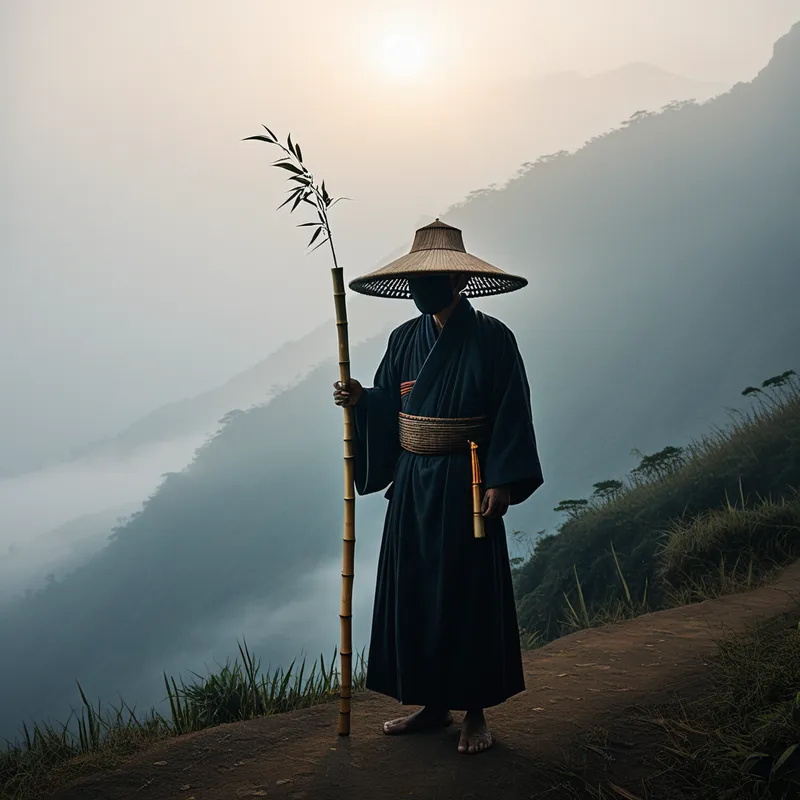
Komuso Monks Myth Meaning & Symbolism
Wandering mendicant monks who renounced identity beneath basket hats, playing the shakuhachi flute to sound the emptiness at the heart of existence.
The Tale of Komuso Monks
Listen, and let the wind carry the tale. It does not begin with a bang of creation, but with a whisper of dissolution. In the age of warring states, when the land bled and identity was a banner to die under, a different kind of warrior walked the dusty roads and mountain paths. They were men who had taken the most radical vow: to become no one.
They called themselves Komuso. Their armor was not lacquer and steel, but a robe of simple black or grey. Their helmet was the tengai, a basket of woven reeds so deep it swallowed the head whole, casting the world into a twilight of narrow vision and the face into absolute shadow. They carried no sword, but a length of bamboo—the shakuhachi.
They were ghosts in plain sight. When they entered a village, they did not speak. They would stand at a crossroads, or beneath a great pine, and lift the flute to where their lips should be, hidden in the dark basket. And then, the sound. Not a melody for dancing, but a single breath drawn out into the world—a breath that was a sigh, a question, a cry stripped of words. It was the sound of the wind in a hollow bamboo, the sound of a river over stones, the sound of a man emptying himself out until only the universe remained inside.
Their pilgrimage had no temple as its end. The road itself was the temple. The act of walking, of breathing into the bamboo, was the prayer. They begged not for alms, but for the opportunity to offer their silence, their sonic emptiness, in exchange for a bowl of rice. To look upon a Komuso was to look into a void that looked back, not with eyes, but with a resonance that vibrated in your own hollow places. They were living koans, a question mark given human form and breath. Where are you when your face is gone? Who plays the flute when the player is anonymous? Their entire existence was the answer, sounded one aching, profound note at a time.
Cultural Origins & Context
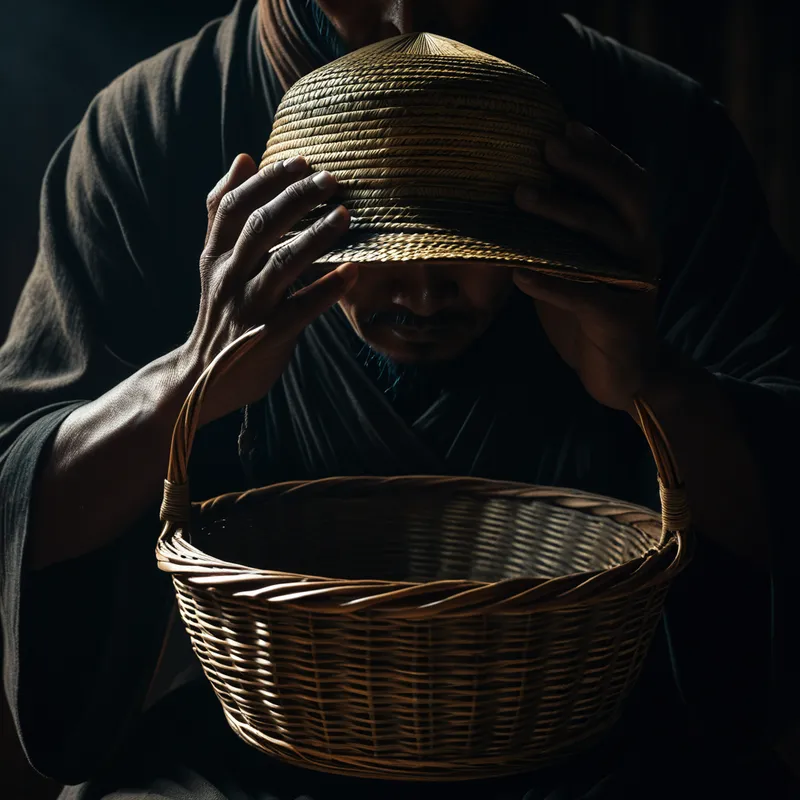
The historical Komuso emerged from the chaotic Sengoku Jidai and into the strict social order of the Edo period. They were officially linked to the Fuke sect of Zen Buddhism, which uniquely embraced the playing of the shakuhachi as a form of meditation called suizen. The government granted them extraordinary privileges: the right to travel freely in a time of restricted movement, and the right to wear the concealing tengai.
This historical reality is layered with mythic resonance. While some were genuine ascetics, the ranks also included ronin seeking refuge, spies, and men simply escaping the rigid caste system. The tengai, therefore, was not just a spiritual tool but a social alchemist’s crucible. Beneath it, a lord and a peasant were equal—both were mu-nin. The myth of the Komuso is thus a story born from a societal pressure cooker, a sanctioned path out of the self that culture had constructed. They were the living embodiment of a societal shadow—the necessary, wandering emptiness that defined, by contrast, the period’s obsession with status, name, and duty.
Symbolic Architecture
The Komuso myth is a masterclass in symbolic negation, a path to wisdom not through acquisition, but through radical subtraction.
The tengai is the primary symbol. It is the annihilation of the persona—the social mask we consciously wear. But it goes further; it annihilates the individual face, the seat of identity and ego. One does not hide behind the basket; one disappears into it. The world is seen through a fragmented, woven grid, a literal reframing of perception. The wearer becomes a vessel, a walking shadow.
To wear the basket is to enter the womb of anonymity, where the self is dissolved so that the Sound of the Source may be born.
The shakuhachi is the complementary symbol. Bamboo is hollow by nature—it is already empty. The human breath moving through this emptiness creates the note. This is the alchemy: the ego (the breath) is not destroyed; it is transmuted by passing through the vessel of emptiness (the bamboo, the cultivated inner void). The music is not “his” music; it is the sound of the relationship between breath and emptiness, between the individual and the cosmos. The suizen practice turns meditation inside out, making the internal state of sunyata audible to the world.
Together, hat and flute symbolize the complete psychic operation: first, the containment and emptying of the conscious ego (the basket), followed by the creative expression of that very emptiness (the flute). The wanderer has no home because his task is to be the space through which the world moves.
The Dreamer's Resonance
When the Komuso pattern arises in modern dreams, it signals a profound psychological process of de-identification. The dreamer is not necessarily called to literal renunciation, but is in the throes of shedding a worn-out identity.
Dreaming of wearing a mask or helmet that cannot be removed, or of having a blurred or absent face, directly mirrors the tengai. This is the psyche’s somatic signal that the current persona—perhaps the “Professional Self,” the “Caregiver Self,” the “Successful Self”—has become a prison. The ego feels trapped, anonymous, and yearns not for a new mask, but for the liberation of having none. There may be anxiety, a fear of being nobody.
Conversely, hearing a solitary, mournful, yet beautiful flute note in a dream points to the emergence of the shakuhachi principle. It is the sound of the authentic self, not as a solid thing, but as a unique vibration emerging from the newly created inner space. It is the call of the core, stripped of biography. The dreamer may be on the cusp of finding their “note”—their true mode of expression that comes not from performing an identity, but from channeling what remains when identities fall away.

Alchemical Translation
The Komuso myth models individuation as a path of via negativa—the way of negation. In a world that screams for us to “find ourselves” and “build our brand,” the Komuso whispers: “Lose yourself. Unbuild.”
The first alchemical stage is Putrefaction, symbolized by the donning of the tengai. This is the conscious, often painful, decision to let an old self die. We enter a period of intentional ambiguity, withdrawing the projections and identifications that once defined us. We become “nobody” in our own story. This is not depression, but a sacred dissolution.
The most profound creativity is first an act of destruction—the clearing of the psychic field so the native grain of the soul can be seen.
The second stage is Sublimation, embodied in the suizen of the shakuhachi. From the fertile void of the putrefied ego, a new form of expression sublimates. This is not a new persona, but a function—like the flute’s function to make sound from breath and emptiness. The individual discovers their unique “note”: perhaps it is a genuine vocation, an artistic voice, or simply a quality of presence that is effortlessly their own. They no longer play a role; they sound their being.
The Komuso therefore teaches that true self-realization is not about becoming someone great, but about becoming transparent enough for the great mystery to sound through you. The goal of the journey is to become the clear, hollow bamboo, through which the wind of the world sings its one, endless song.
Associated Symbols
Explore related symbols from the CaleaDream lexicon: