Komorebi Myth Meaning & Symbolism
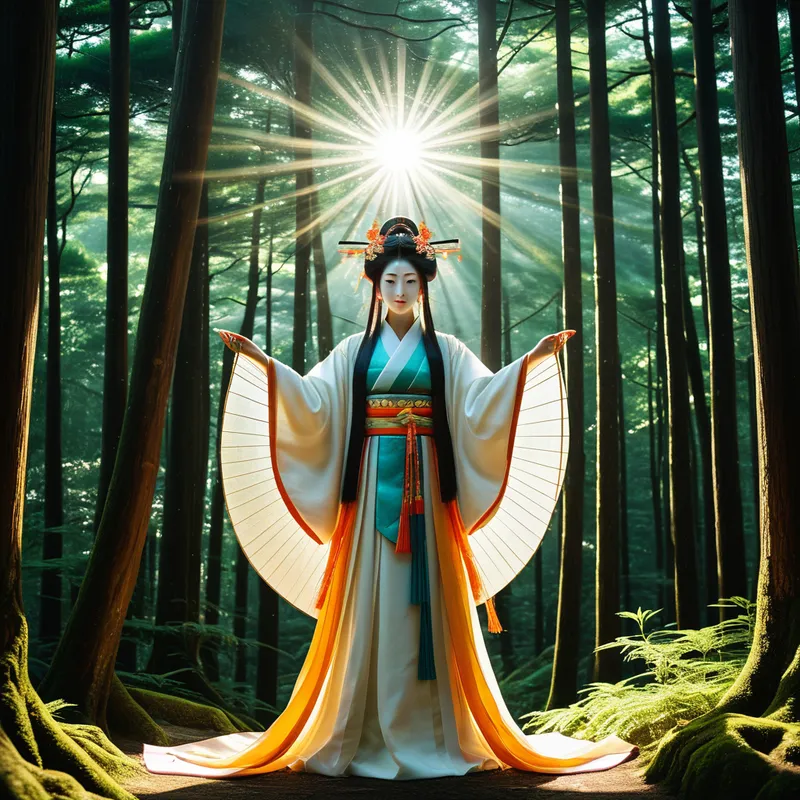
A myth of the Sun Goddess Amaterasu and the forest, where light and shadow reconcile, teaching that beauty is born from the interplay of presence and absence.
The Tale of Komorebi
In the time before time, when the world was raw silk stretched upon the loom of creation, the great Amaterasu Ōmikami shone with an undivided light. Her gaze was a relentless, golden truth that left no room for mystery. Every stone, every river, every blade of grass lay exposed in her brilliant judgment. The world was a perfect, static painting, beautiful yet suffocating in its clarity.
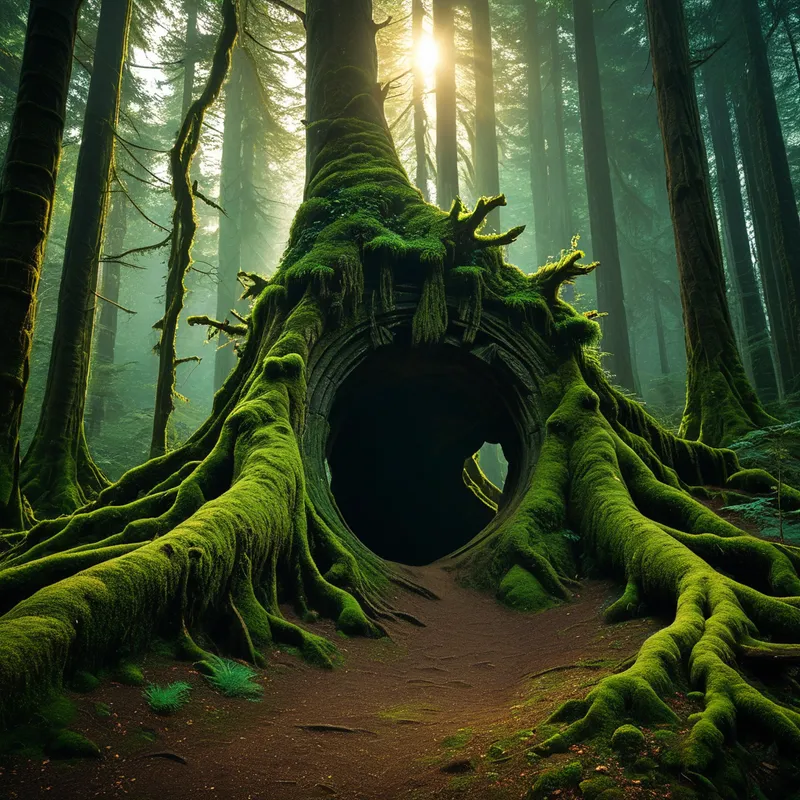
Beneath this unwavering gaze grew the first forests, children of the mountain gods. They were realms of deep, tangled shadow, places where secrets pooled and whispers took root. Their deity was not a single form, but a murmuring consciousness known as Kodama, the echo of the wood. The trees, in their quiet defiance, reached upward, weaving a living lattice against the sun's dominion. They did not seek to extinguish the light, but to converse with it.
A great sorrow then befell Amaterasu. A betrayal in the heavenly plain caused her to retreat into the Ama-no-Iwato, plunging all creation into desolate night. The world grew cold and still. In this darkness, the forests mourned most deeply, for they understood the nature of absence. Their leaves, without light, forgot the purpose of their green.
When the other gods finally lured Amaterasu forth, her light returned to the world not as a conqueror, but as one chastened by darkness. She looked upon the waiting forests anew. This time, as her radiance approached the canopy, she did not command it to part. Instead, she offered her light as a guest.
And the forest, through the spirit of Kodama, accepted. The leaves, countless and varied—the broad fan of the momiji, the sharp needle of the sugi, the tender bud of the sakura—became not a barrier, but a sacred sieve. They caught the sun's unified beam and, in a act of profound alchemy, shattered it into a million dancing fragments. The light, once absolute, now learned to bend, to dapple, to play. It painted the forest floor in shifting coins of gold, revealed the velvet texture of moss on stone, and made the very air visible, thick with swirling motes like distant galaxies.
In that moment, Komorebi was born. It was not the sun's light, nor the forest's shadow. It was the child of their reconciliation—a living, breathing phenomenon born from respectful interplay. Amaterasu saw that her truth was made more beautiful, more profound, when filtered through another's being. The forest learned that shadows gained depth and meaning only when graced by light. Together, they authored a new language of beauty, written in the silent, shimmering dialogue between presence and absence.
Cultural Origins & Context
Komorebi, as a named and cherished phenomenon, is not anchored to a single, canonical myth recorded in the Kojiki or Nihon Shoki. Its power lies in its status as a living myth—a poetic, cultural understanding woven directly from the sensory and spiritual experience of the Japanese archipelago. It is a myth perceived, not just told.
It emerged from the spiritual framework of Shintō, where the divine (kami) resides in natural phenomena. The sun is Amaterasu, the ultimate kami; the forest is inhabited by Kodama and other spirits. Komorebi is the visible sacrament of their interaction. It was passed down not by bards in courts, but by farmers walking mountain paths, monks in forest temples, and poets gazing from verandas. It lives in the waka and haiku tradition, where poets like Bashō would capture the fleeting, sublime moment of light piercing the woods. Its societal function was, and is, pedagogical: it trains the eye and soul to perceive the sacred in the everyday interstice, reinforcing core cultural values of harmony (wa), impermanence (mujō), and attentive appreciation (mono no aware).
Symbolic Architecture
Psychologically, Komorebi is a master symbol of consciousness itself. The undifferentiated light of the sun represents the ego in its raw, unrefined state—brilliant, full of potential, but often blinding in its certainty. It is pure, unmediated awareness that can scorch as easily as it nourishes.
The forest symbolizes the personal and collective unconscious—dense, complex, seemingly dark, and teeming with unseen life (instincts, memories, archetypes, the shadow). It is the necessary structure that gives shape to the formless light.
Komorebi, then, is the birth of conscious insight. It is the moment the ego's light agrees to be filtered, broken down, and patterned by the complexities of the inner world.
The dancing beams are not a dilution of truth, but its refinement. They represent differentiated thought, nuanced feeling, and creative inspiration—the fragmented yet beautiful understandings that emerge when we allow our bright, conscious selves to engage respectfully with our inner depths. The shadow is not banished; it becomes the essential partner that creates contrast, depth, and meaning.
The Dreamer's Resonance
To dream of Komorebi—of sunlight filtering through a dense canopy in a profound, arresting way—signals a somatic and psychological process of filtering and integration. The dreamer is likely in a state where a powerful new awareness or truth (the light) has emerged, but it feels too intense, too overwhelming, or too simplistic to integrate directly.
The dream presents the psyche's natural resolution: the light must pass through the internal forest. This can manifest somatically as a feeling of relief, a deep breath, or a release of tension in the body, as if a harsh glare has been softened. Psychologically, it indicates the unconscious is actively at work, taking a monolithic insight—a life decision, a traumatic memory, a burst of creativity—and breaking it into manageable, beautiful fragments that can be assimilated over time. The dream is an affirmation from the deep self that you do not need to stare directly at the sun; you can, and must, appreciate its light through the leaves of your own experiences and complexities.

Alchemical Translation
The myth of Komorebi models the alchemical stage of solutio (dissolution) followed by coagulatio (coagulation), but in a gentle, natural cycle. The individuation process often begins with an ego identified with a singular, solar truth. To grow, this rigid consciousness must be dissolved—not destroyed, but allowed to permeate the darker, unknown matter of the psyche (the forest).
The triumph is not the victory of light over dark, or consciousness over the unconscious. It is the triumph of relationship over isolation.
The alchemical gold produced is not a final, perfect self, but the ongoing, dynamic capacity to generate meaning from the interplay of opposites.
For the modern individual, this translates to the practice of holding our certainties lightly. It is the act of allowing our convictions to be challenged and complexified by our emotions, our shadows, and our embodied experiences. It is finding the wisdom not in the answer itself, but in the beautiful, dappled pattern the answer creates when it interacts with the questions we are afraid to ask. The goal is to become the sacred grove where this divine interplay can eternally occur, where every moment of clarity is rendered more humane, more connected, and more tragically beautiful by the very shadows it illuminates. We become both the forest and the witness to the light, participants in our own endless, gentle becoming.
Associated Symbols
Explore related symbols from the CaleaDream lexicon: