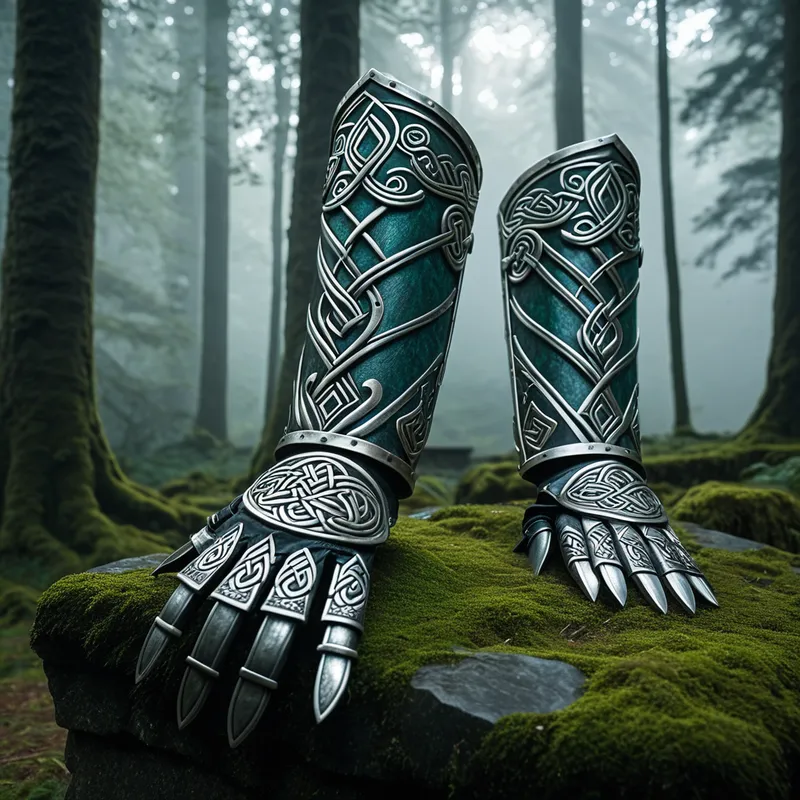
Knights' Gauntlets Myth Meaning & Symbolism
A forgotten knight's gauntlets, forged in a sacred vow, become the crucible for his soul's final test, weighing honor against the weight of the world.
The Tale of Knights' Gauntlets
Listen, and hear the tale not of a sword, but of the hand that wields it. In the years when Arthur’s reign was a young sapling, there walked a knight named Galahad the Unproven. Not yet the grail-seeker of later legend, he was a man of fire and doubt, his heart a battlefield of ambition and fear. He sought a token, not of glory, but of certainty—an armor for his spirit.
He journeyed beyond the Perilous Forest to the Isle of Glass, where the last of the old Briton smiths dwelled. Her forge was not of coal, but of geyser-steam and moonlight. "I would have gauntlets," Galahad declared, "that will never let my grip falter, that will make my hand true in battle and in oath."
The smith, her eyes like deep wells, replied, "The metal is not mine to give. It is yours to offer. Forge them yourself, with this: swear a vow upon your most sacred truth, and hold that truth in your hands as you work the ore."
Galahad, thinking of his loyalty to Arthur, swore upon his honor. He labored for seven days and nights. As he hammered, he felt not heat, but a cold clarity. The iron drank his vow, and when they were quenched in the spring of the isle, the gauntlets emerged—not shining, but dark like river stone, etched with whorls that seemed to move in the corner of the eye. They fit his hands as if they had grown there.
He returned to Camelot, and his deeds became legend. His grip was unbreakable, his sword-stroke sure. Yet, with each passing season, the gauntlets grew heavier. Not a physical weight, but a profound density in his soul. The vow he had forged them with—his honor—began to curdle into pride, the need to be seen as honorable above all else.
The crisis came not in war, but in peace. A humble farmer, wronged by a lord who was Galahad’s own kinsman, came to the Round Table seeking justice. The law and his loyalty demanded Galahad defend his kin. But the truth in his heart, the deeper honor beneath the performative one, cried out for the farmer’s redress. That night, in his chambers, he tried to remove the gauntlets to pray. They would not budge. They had become one with the paradox of his vow.
In despair, he rode again to the Isle of Glass. The smith was waiting. "The metal remembers," she said. "It holds the shape of your first truth. To be free, you must forge it anew."
Before the ancient anvil, Galahad did not raise a hammer. Instead, he placed his gauntleted hands upon the stone and spoke, not a vow of honor, but a confession of its corruption. He spoke of his pride, his fear of being seen as weak, his loyalty twisted into blindness. As he spoke, a true fire—born of shame and courage—ignited within the dark metal. The gauntlets grew white-hot, not burning him, but burning through him. With a sound like a sigh, they fell away, leaving his hands bare, scarred, and startlingly light.
From the cooled metal remained not gauntlets, but two simple, perfect rings. The smith nodded. "The first forging was a shell. The second is a lens. Now you may truly see what your hands must do." He returned to Camelot, and without a word, gave one ring to the wronged farmer as a pledge of his advocacy, and wore the other as a reminder that true strength is held in an open hand.
Cultural Origins & Context
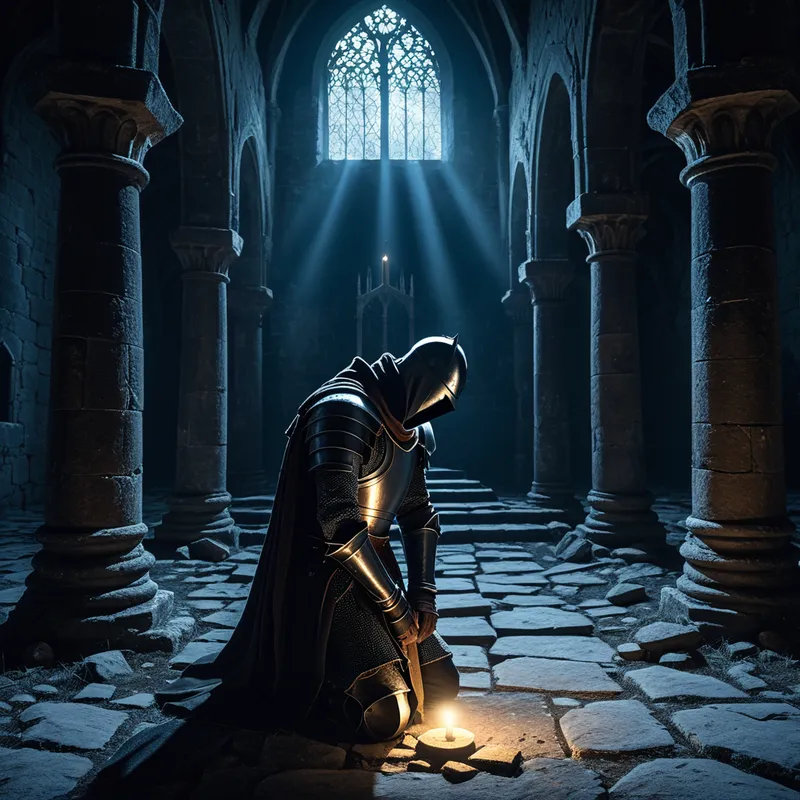
The motif of the Gauntlets as a transformative object is a subtle thread within the vast tapestry of Arthurian romance. Unlike the explicit magic of Excalibur or the Holy Grail, tales of enchanted armor, and gauntlets specifically, often appear in more peripheral lays and bardic fragments. These stories likely served a didactic function for the knightly class, moving beyond chivalric manuals to address the inner conflict of the warrior.
Passed down by bards and cyfarwyddiaid (Welsh storytellers), such tales were not mere entertainment at feasts. They were psychological tools for a society built on oaths, fealty, and violent action. The gauntlet, the piece of armor that mediates between the weapon and the heart, was a perfect symbol for this interface. The story of Galahad’s gauntlets (a prelude to his Grail quest) would have been told to illustrate that the greatest battle is not against dragons or rival knights, but against the ossification of one’s own virtues into rigid, soul-crushing armor. It functioned as a cultural dream, questioning what happens when the symbol of protection becomes the agent of imprisonment.
Symbolic Architecture
The gauntlet is the symbol of agency, will, and touch. It is the mailed fist that grasps the sword, the shielded hand that offers mercy or takes a pledge. In this myth, the gauntlets represent the persona—the adaptive, protective identity we forge to function in the world, especially in roles demanding strength and resolve (like a knight, a leader, a protector).
The persona, like the gauntlet, is necessary armor. But when it is forged from a vow untested by shadow, it fuses to the skin, confusing the tool with the self.
Galahad’s initial vow of "honor" is pure but abstract. It is an ideal, not an integrated virtue. The gauntlets’ increasing weight symbolizes the psychological burden of living an idealized image—the exhausting performance of being the "perfect knight." The metal that "remembers" is the unconscious, which faithfully holds the original, flawed shape of our intention. The inability to remove them signifies a state of psychic inflation; he has become identified with his role. The final, fiery confession at the anvil is the confrontation with the shadow. By acknowledging the pride and fear hidden within his "honor," he brings the persona into contact with the rejected parts of himself. This psychic heat transmutes the rigid armor (the persona) into a flexible symbol (the rings).
The Dreamer's Resonance
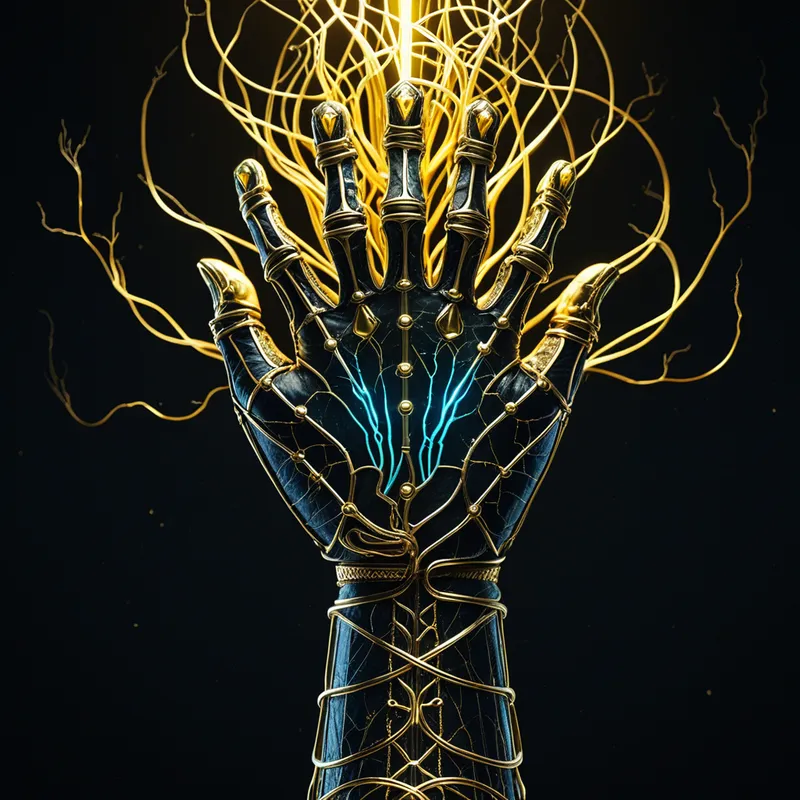
When this myth appears in modern dreams, it rarely manifests as literal medieval gauntlets. The dreamer may find themselves unable to remove a tight ring, a glove, or a surgical brace. Their hands may feel heavy, clumsy, or encased in concrete. They may be trying to grasp something vital—a key, a child’s hand, a lifeline—but find their grip slick or unfeeling.
Somatically, this points to a profound disconnect between intention and action, between the will and the capacity to handle one’s life. The psychological process is one of over-identification with a role: the relentless caregiver whose hands are always busy but never receptive; the executive whose grip on control is so tight it paralyzes innovation; the artist whose technique has become a sterile shell, stifling true touch. The dream is a message from the body, via the image of the hand, that the adaptive identity forged for survival is now inhibiting authentic contact and agency. The heaviness is the weight of a lived lie, however noble its origins.
Alchemical Translation
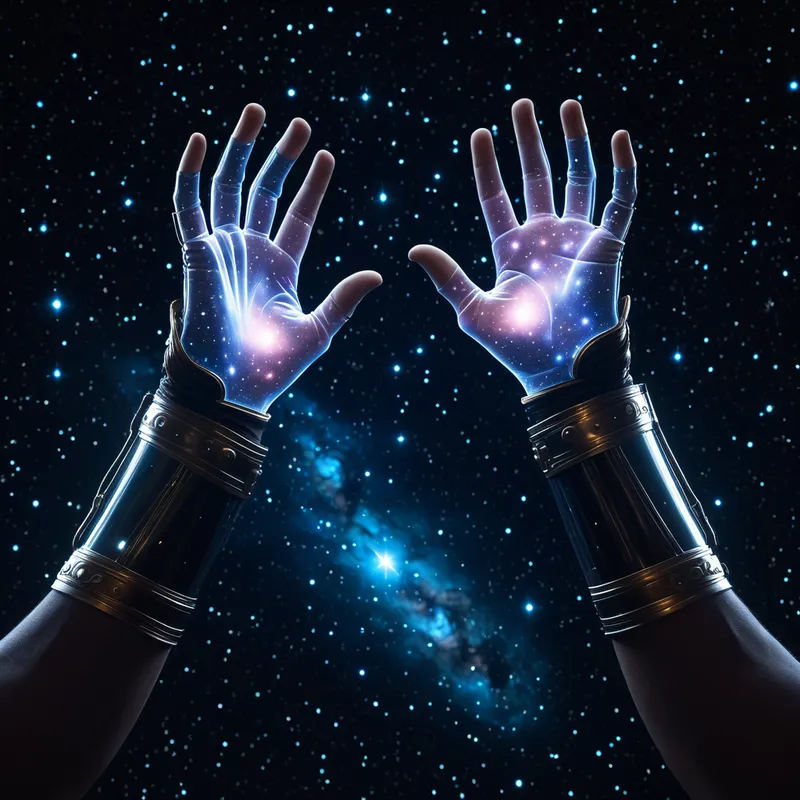
The myth of the Knights’ Gauntlets is a precise allegory for the alchemical stage of mortificatio and calcinatio, leading to individuation. The process begins with the prima materia of the knight’s raw ambition and doubt. His vow is the first coagulation, creating a functional but flawed form (the persona-gauntlets).
Individuation does not mean perfection, but integrity. It is the transformation of a crushing weight into a conscious weight, a burden carried not on the shoulders, but in the understanding heart.
The subsequent years of burden represent the necessary nigredo—the darkening, the depression, and the feeling of being trapped by one’s own life choices. The crisis with the farmer is the arrival of the lapis, the philosopher’s stone in its rough, disruptive form: an undeniable truth that conflicts with the persona. The return to the forge is the conscious undertaking of the opus. The confession is the fire of calcinatio, which does not destroy the self but burns away the dross of self-deception. What remains—the simple rings—symbolize the lapis philosophorum in its completed form. No longer a tool for grasping or striking, the ring is a symbol of connection (the given pledge) and reflection (the worn reminder). The gauntlet, which separated him from the world through defense, becomes the ring, which connects him to the world through conscious promise. The modern individual undergoes this same alchemy when a midlife crisis, a failure, or a moral dilemma forces them to shed the armored identity of "the successful one," "the strong one," or "the good one," to discover the more vulnerable, complex, and authentic human being underneath—whose hands, though bare and scarred, can finally feel, and finally hold, what is truly theirs.
Associated Symbols
Explore related symbols from the CaleaDream lexicon: