
Kintu and Nambi Uganda Myth Meaning & Symbolism
The foundational myth of the Baganda people, where the first man Kintu must prove his worth to marry the sky goddess Nambi, securing humanity's fate.
The Tale of Kintu and Nambi Uganda
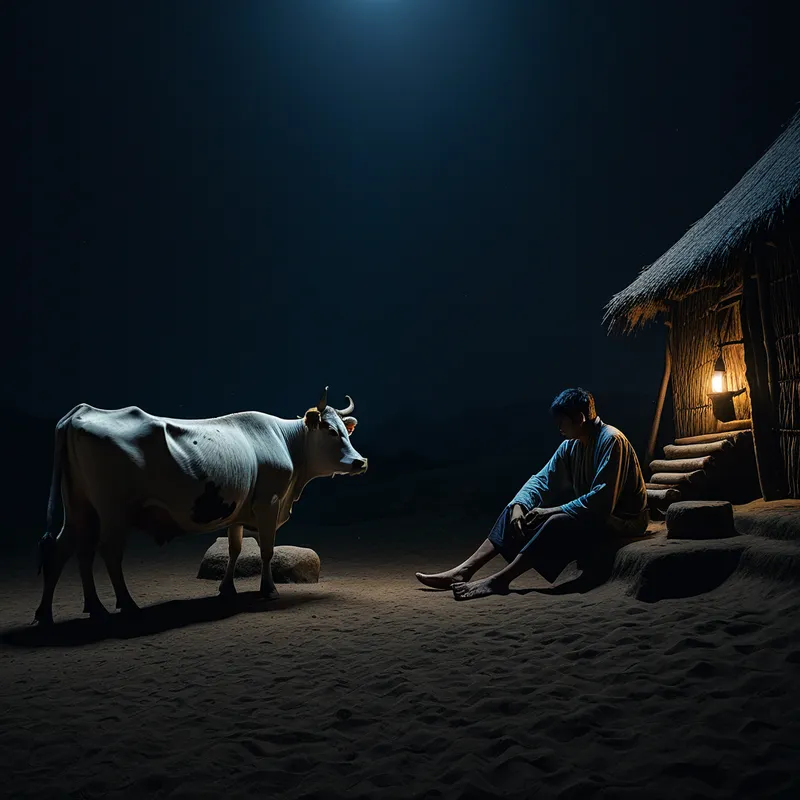
In the time before time, when the sky was a living vault and the earth was a lonely, silent thing, there was a man. He was the only man. His name was Kintu. He lived alone on the vast, green plains, with only a single, loyal cow for company. He drank her milk, and it was enough. He knew no hunger, no thirst for more, for he knew no other life. The sky, however, was a bustling kingdom. Ggulu ruled from his celestial palace, surrounded by his many children—the wind, the rain, the lightning, and his daughters, the beautiful goddesses.
One day, Nambi, the most compassionate and curious of Ggulu’s daughters, descended to the earth. She found Kintu in his simple solitude. She saw not a lonely creature, but a being of profound peace and self-sufficiency. Love, swift and undeniable as a lightning strike, blossomed in her celestial heart. She returned to the sky, but her heart remained below. She pleaded with her father. "Let me return to the earth. Let me marry Kintu, for he is complete in himself, and my heart is with him."
Ggulu, lord of all above, was wary. How could a creature of dust wed a daughter of the sky? To test this earth-man, he set forth impossible tasks. First, he commanded Kintu to come to the sky and feast with the gods—but he must eat an entire banquet meant for a hundred. Kintu, guided by Nambi’s whispered wisdom, hid the food in a magical bag that never filled. Next, Ggulu demanded Kintu fetch water in a pot riddled with holes. Nambi gave him grass to plug the holes, and he succeeded. Finally, in a cruel twist, Ggulu demanded Kintu identify his one true cow from a herd of thousands that were its perfect doubles. In despair, Kintu sat, but a bee—another secret gift from Nambi—landed on the horn of his own beloved beast, showing him the way.
Impressed yet still reluctant, Ggulu gave his blessing but a grave warning. They must leave the sky at once, and on no account return for anything. Their journey to earth must be swift and final. As they descended the ladder from heaven, Nambi remembered she had forgotten the grain of millet for her chickens. Against all counsel, she turned back. This single act of return unleashed catastrophe. Her vengeful brother, Walumbe (Death), who had been forbidden to follow them, seized his chance and clung to her, following her back to earth.
Thus, Kintu and Nambi became the first parents of the Baganda people, founding a lineage of kings. But with them came Walumbe. Death had entered the world, not as a punishment from a spiteful god, but as the shadow of a forgotten thing, the price of a backward glance, the inevitable companion of mortal life and love.
Cultural Origins & Context
This is the foundational myth of the Baganda people of the Buganda kingdom in present-day Uganda. It is not merely a story but the cosmic charter for their existence, recited and remembered by oral historians known as Abalongo. It was traditionally told during important rituals, coronations, and gatherings to explain the origins of the people, the divine right of their kings (the Kabaka, who are considered descendants of Kintu), and the most profound human conditions: life, love, and death.
The myth served multiple societal functions. It established a sacred covenant between the people, their ruler, and the divine. It explained the agricultural basis of their society (the millet). Most importantly, it provided a non-moralistic, deeply tragic explanation for mortality. Death is not a flaw in humanity’s character, but a structural part of the deal made at the dawn of time—a stowaway on the journey of life itself, accepted as part of the package of consciousness and community.
Symbolic Architecture
The myth is a perfect symbolic map of the psyche’s initial journey from unconscious wholeness into conscious, flawed, and creative existence. Kintu begins in a state of primal, pre-conscious unity with nature—the uroboric state. He is alone with his cow, a symbol of nurturing, self-contained sustenance. Nambi represents the anima, the soul-image, the call from the world of spirit and differentiation that lures the ego-consciousness (Kintu) out of its solitude.
The hero’s task is not to conquer a monster, but to prove he is worthy of receiving the gift of complexity, which includes its inherent shadow.
The impossible tasks set by Ggulu are initiatory trials. They are not tests of brute strength, but of craft, wisdom, and connection. Kintu cannot succeed alone; he must accept help (from Nambi, the bee). This symbolizes the necessity of relating to the unconscious, to the intuitive and helping aspects of the psyche, to achieve conscious realization. The final, fatal return for the millet is the myth’s psychological core. The millet represents culture, cultivation, the desire to bring order and future sustenance. But the attempt to make the transition from heaven to earth perfectly complete, to leave nothing behind, is impossible. The shadow—Walumbe (Death)—must follow.
The Dreamer's Resonance
When this myth pattern stirs in the modern dreamer, it often manifests as a profound transition. You may dream of being given an impossible test at work or in a relationship, feeling utterly unprepared. You may dream of finding a perfect love or a sublime creative idea (Nambi), only to have a looming, limping figure or a pervasive sense of dread (Walumbe) appear immediately after. You may dream of frantically returning to a house you’ve already left to retrieve one small, seemingly vital item.
Somatically, this can feel like the anxiety of a new beginning—the excitement of a marriage, a career move, a spiritual awakening—tinged with an inexplicable grief or fear. It is the body knowing what the mind resists: that every choice for greater life and consciousness inherently chooses a form of death for what came before. The dream is not a warning to stop, but a deep somatic initiation into accepting the paradoxical package of your own expansion.

Alchemical Translation
The alchemical process modeled here is the individuation journey in its earliest, most critical phase: the conjunctio, or sacred marriage, and its immediate consequence. Kintu’s journey is the ego’s agreement to engage with the soul. The tasks are the nigredo, the difficult, confusing work of confronting one’s limitations and relying on non-rational guidance.
The marriage of sky and earth within one psyche is the birth of the individual, but it midwives its own twin: the conscious acknowledgment of mortality, limitation, and flaw.
The triumphant return to earth with Nambi is the albedo, the joyous union and illumination. But the true alchemical gold, the rubedo, is found in the acceptance of Walumbe. The psychic transmutation is complete not when we achieve perfect, deathless light, but when we consciously integrate the fact of our shadow, our finitude, and our inevitable losses into our sense of self. The modern individual’s "triumph" is to build a life, a family, a work (the kingdom of Buganda) knowing that Death walks in the garden. It is to create meaning not in spite of mortality, but in a profound relationship with it. This is the ultimate sacrifice and the ultimate destiny: to live fully, love deeply, and rule your inner kingdom with the wisdom that its foundations include a pact with the dark.
Associated Symbols
Explore related symbols from the CaleaDream lexicon:
- Journey — The central action of the myth, representing the necessary movement from a state of unconscious solitude into the complex, perilous, and fertile world of relationship and destiny.
- Sacrifice — The implicit cost of becoming human; Kintu sacrifices his perfect, self-sufficient isolation, and humanity forever sacrifices freedom from death in exchange for love, progeny, and culture.
- Cow — The symbol of Kintu’s initial, nurturing self-containment and the basis of his survival, which later becomes the object of the final test of true connection and identity.
- Sky — The realm of the gods, spirit, potential, and the anima (Nambi); it represents the unconscious in its celestial, ordered, yet distant form.
- Earth — The realm of manifestation, physicality, and human life; the destination of the conjunctio where spirit becomes embodied.
- Door — The critical, one-way threshold between the sky and the earth; crossing it signifies an irreversible change in state and the impossibility of returning to a previous mode of being.
- Goddess — Embodied by Nambi, she is the active principle of love, curiosity, and connection who descends to initiate the entire human drama, representing the soul's call to the ego.
- Death — Walumbe, the stowaway shadow; not an evil force but an inevitable archetypal companion that enters the world as a consequence of desire, memory, and the attempt to make life complete.
- Millet — The grain Nambi returns for, symbolizing cultivated sustenance, future planning, and the domestic concerns that, while vital, can inadvertently invite the shadow.
- Bee — A tiny, instinctual guide and helper from the natural world; symbolizes intuitive wisdom, a message from the unconscious that provides clarity in a moment of overwhelming duplication and confusion.