
Khuvsgul Lake Spirit Myth Meaning & Symbolism
A myth of a celestial being who becomes a vast, sacred lake, embodying eternal sacrifice and the union of sky and earth for the life of the land.
The Tale of Khuvsgul Lake Spirit
Listen, and let the wind carry you to the Roof of the World, where the sky is a vast, inverted bowl of deepest blue and the earth stretches its bones toward the heavens. Here, in the ancient north, there was a time of great thirst. The grasslands, once emerald seas under the Tengri, turned to brittle gold and then to dust. Rivers shrank to whispers. The people and their herds grew thin, their songs replaced by the dry rasp of the wind.
High above, in the palace of the stars, lived a celestial maiden, a daughter of the sky spirits. Her name is lost to the ages, but her nature was pure compassion. From her heavenly perch, she watched the suffering below. She saw the cracked earth, like a great wound, and heard the silent prayers rising with the dust. Her heart, a vessel of luminous empathy, could not bear it.
One fateful night, as the moon hung like a silver ger in the sky, she made her choice. She began to weep. But these were not ordinary tears. They were the tears of the sky itself—liquid starlight, condensed sorrow, and selfless love. She wept and wept, her body dissolving into a river of celestial sorrow that poured from the firmament.
Down, down it fell, a cascade of silvery light. It struck the parched earth with a sound like a thousand bells, not of shattering, but of profound meeting. The land drank deeply, desperately. The celestial stream did not stop; it flowed from her very essence, filling the great hollow between the mountains. Her form unraveled, her spirit mingling with the waters, her consciousness expanding to touch every shore, every pebble, every depth.
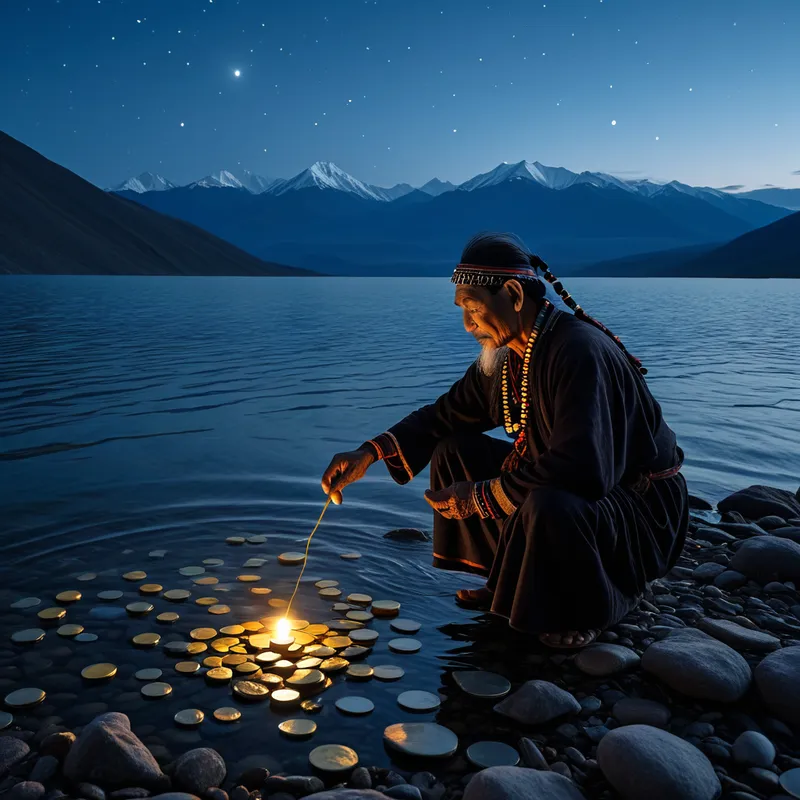
Where she fell, a lake was born. Not a mere lake, but a sea of fresh water so deep and so clear it was said to hold the reflection of the soul. Khuvsgul Nuur—the Dark Blue Pearl. Her body became its boundless waters; her breath became the mist that cloaks the peaks at dawn; her watching eyes became the light dancing on the waves. She had not died. She had become. She exchanged her singular, heavenly form for an eternal, earthly presence. The great thirst was quenched. Grass returned, rivers fed from her bounty, and life flowed back into the land. The people came to her shores, not to mourn a lost goddess, but to honor the ever-present Spirit who had given herself to become the source of all life.
Cultural Origins & Context
This myth springs from the heart of Tengriism and the nomadic worldview of Mongolia. It was not a story confined to parchment but one carried on the wind, told by elders beside crackling fires, and invoked by shamans during rituals of gratitude and supplication. Khuvsgul Lake itself, one of the largest freshwater reservoirs in Asia, is a literal lifeline in an arid landscape. The myth explains its sacred origin and enforces a code of ecological and spiritual respect.
The tale served a crucial societal function: it encoded a sacred covenant between the people and the land. The Lake Spirit was not a distant, indifferent deity but a transformed, immanent one. This demanded reciprocity. Offerings of milk, the first drops of airag (fermented mare's milk), or blue ceremonial scarves (khadag) were cast upon the waters, not as payment, but as acknowledgment of the eternal sacrifice. The myth taught that the greatest spirits are those who serve, and the greatest resources are gifts born of profound compassion, to be treated with reverence, not entitlement.
Symbolic Architecture
At its core, the myth is a profound allegory of the psyche's capacity for transformative empathy. The celestial maiden represents a pristine, unmanifested potential—a state of being that is whole but disconnected from the suffering of the "earthly" realm of embodied experience.
The ultimate sacrifice is not a loss of self, but a dissolution of the ego's boundaries to become a vessel for a greater, life-sustaining reality.
The parched earth symbolizes a state of psychic aridity, a life devoid of meaning, connection, or emotional nourishment. The maiden's tears are the alchemical fluid of conscious feeling—the willingness to fully engage with pain, both personal and collective. Her transformation into the lake is the key symbol: the individuated self (the spirit) consciously merging with the vast, unconscious matrix (the waters of life) to become a source. She is no longer a subject looking at an object (the suffering land); she becomes the very medium in which life regenerates.
The Dreamer's Resonance
When this myth stirs in the modern dreamer, it often signals a profound call from the psyche toward a selfless, yet self-actualizing, offering. To dream of a vast, deep, and impossibly clear lake—especially one that evokes both awe and a sense of sacred duty—may point to this archetypal pattern.
Somatically, one might feel a deep, pulling sensation in the chest or a welling of emotion that feels both personal and transpersonal. Psychologically, this is the process of the "caregiver" archetype moving from a personal complex (e.g., feeling drained by others' needs) to a sacred function. The dream asks: What part of your essential being are you being called to "weep" into the world? What arid landscape within your life or community needs the waters of your unique compassion? The conflict is between the safety of a detached, celestial identity and the vulnerable, messy, yet infinitely generative act of pouring oneself out.
Alchemical Translation
The myth models the stage of individuation where the ego's development culminates not in greater isolation, but in conscious participation in the world's soul. The "celestial palace" is the inflated state of spiritual or intellectual idealism, removed from the grit of reality. The "descent" is the necessary, painful incarnation of spirit into matter, of principle into practice.
Individuation is not about climbing to a solitary peak, but about becoming a fertile valley where the waters of the unconscious and the light of consciousness can mingle to create an ecosystem of meaning.
The alchemical operation here is solutio—dissolution. The fixed, heavenly identity is dissolved in the waters of empathy to create the aqua permanens, the permanent water that is the solvent of all transformation. For the modern individual, this translates to the sacrifice of a rigid self-concept. It is the artist whose style dissolves to serve the truth of the subject; the leader whose authority dissolves to empower the group; the healer whose knowledge dissolves to truly meet the patient. One becomes a "lake"—a stable, deep container that gives life without depletion, because its source is the eternal cycle of giving and receiving, fed by the deep springs of the Self.
Associated Symbols
Explore related symbols from the CaleaDream lexicon:
- Spirit — The core entity of the myth, representing a consciousness that transcends physical form to become an immanent, life-giving presence.
- Water — The primary element of transformation, symbolizing the fluid of emotion, compassion, and the generative, nourishing depths of the unconscious.
- Sacrifice — The central act of the myth, not as a loss but as a metamorphosis where one state of being is willingly given up to create a greater, sustaining reality.
- Lake — The ultimate symbol of the transformed spirit: a vast, deep container of life, reflecting the sky above while nurturing the earth below.
- Mirror — Khuvsgul Lake is renowned for its clarity, acting as a mirror to the soul and the heavens, symbolizing self-reflection and the union of opposites.
- Healing — The direct result of the spirit's sacrifice, representing the restoration of wholeness, balance, and vitality to a parched and wounded system.
- Mother — The Lake Spirit embodies the archetypal nurturing Mother, who provides unconditional sustenance and protection from her very essence.
- Grief — The celestial maiden's tears are the sacred, transformative expression of grief that bridges the gap between heaven and earth, leading to new creation.
- Dream — The myth itself operates like a collective dream, presenting a symbolic narrative that guides the culture's relationship with the sacred and the ecological.
- Sky — Represents the realm of origin, spirit, and potential (Tengri), which must descend and unite with the earth to manifest life and meaning.
- Earth — Symbolizes the realm of manifestation, suffering, and physicality, which calls for and receives the nourishing sacrifice of the spirit.
- Heart — The internal catalyst for the entire myth; the compassionate heart that cannot remain detached from suffering and thus initiates the alchemical transformation.