Khangarid the Eagle Myth Meaning & Symbolism
A myth of a celestial eagle, born from divine light and ancestral spirit, who becomes the eternal guardian of the Mongolian people and their sacred land.
The Tale of Khangarid the Eagle
Listen. The wind on the steppe does not just carry the scent of sage and snow. It carries a memory, older than the first horse, deeper than the roots of the sacred mountains. It carries the tale of the One Who Watches, born not of egg, but of necessity.
In the time when the world was raw and the sky was a bowl of endless blue pressing down on the green earth, the people were strong but scattered. Their spirits were of the land, but their gaze was upon it, and they knew not what watched from above. A great shadow passed over them—not of cloud, but of a loneliness so vast it threatened to swallow the songs from their throats and the fire from their hearts. They had no protector in the high, thin air where spirits travel and fate is woven.
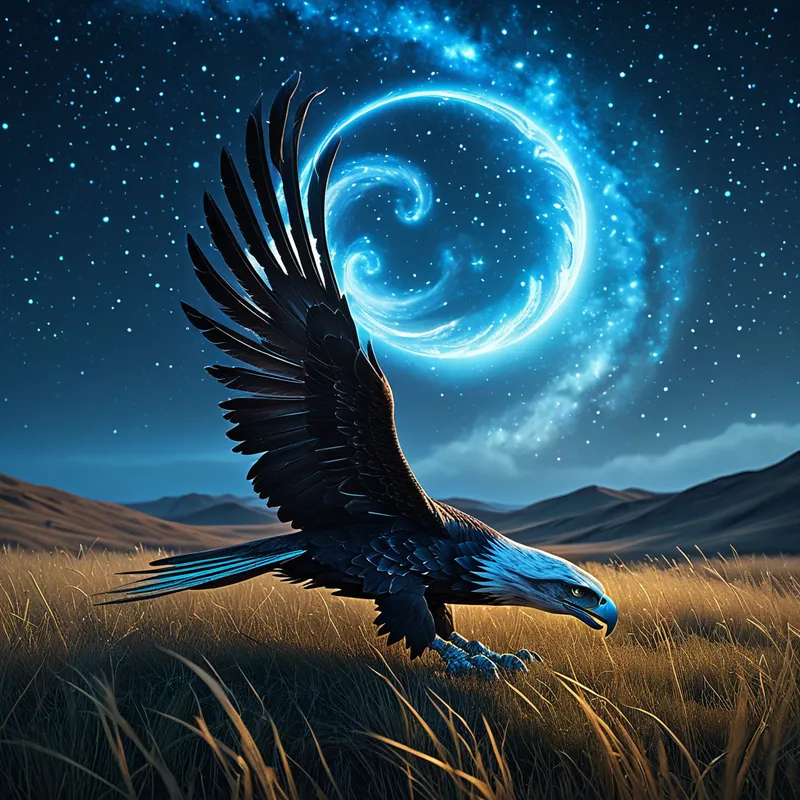
Then, from the meeting place of the Tengri and the crown of the world, a light coalesced. It was not the harsh light of the sun, nor the cool light of the moon. It was the first light of a new dawn, pulled from the very fabric of the sky and mixed with the whispered prayers of the first shamans. This light did not fall; it chose. It spiraled down, a vortex of azure and gold, and upon the highest peak of the Khangai, it took form.
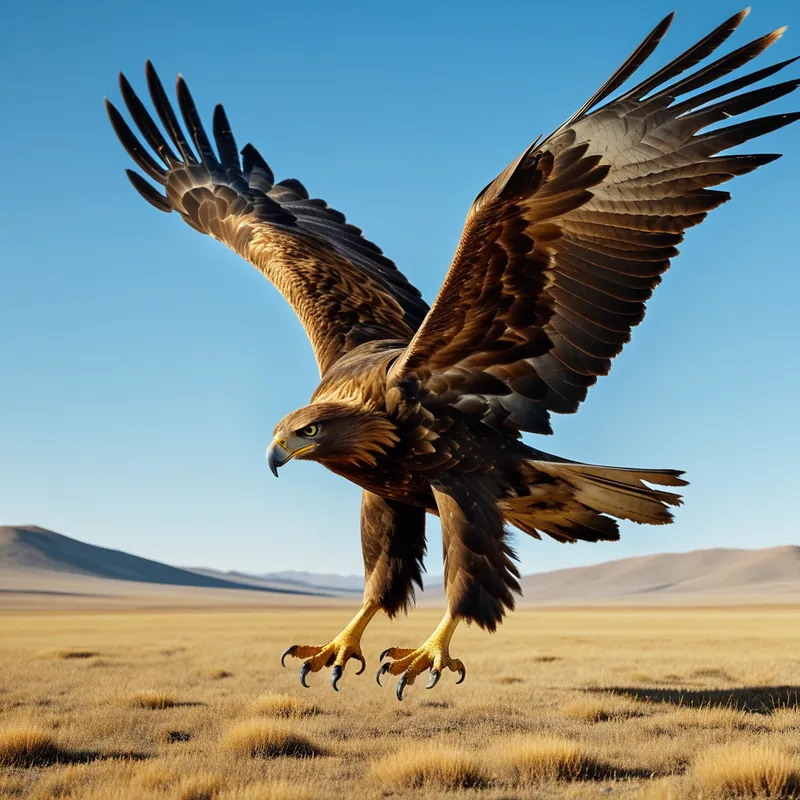
The air itself cracked with the sound of unfolding majesty. Wings broader than the grasslands of ten thousand herds stretched out, each feather a blade of shadow and a sliver of captured sky. His eyes opened—twin suns of ancient amber that saw not just the land, but the soul of the land, the trembling spirit-lines that connected wolf to rock, river to horse, human to heaven. This was Khangarid. He did not cry out; his presence was the cry, a silent vibration that resonated in the marrow of every living thing.
He saw the people below, small and brave. He saw the wolves that circled, the droughts that cracked the earth, the silent despair that could freeze a nation. And he made his covenant. He would not rule them from a throne. He would be the eye in their blind spot, the strength in their moment of fracture. When a lost child stumbled from the ger, an updraft would gently guide the search party. When a blizzard descended with murderous intent, a powerful wind would carve a path to shelter. His shadow was not one of fear, but of immense, sheltering presence.
He became the bridge. His wings beat the rhythm between earth and Tengri. His flight was the visible proof of the connection. The people learned to look up, not in pleading, but in recognition. They felt his gaze upon their journeys, and in that feeling, they found a courage that was both fierce and serene. Khangarid did not conquer a monster; he became the answer to the silent question of a people’s place in the vast, terrifying, beautiful world. He is there still, in the gust that rights a faltering rider, in the high, sharp call that punctuates the deep silence of the night steppe—the eternal guardian, woven into the very wind and destiny of the land.
Cultural Origins & Context
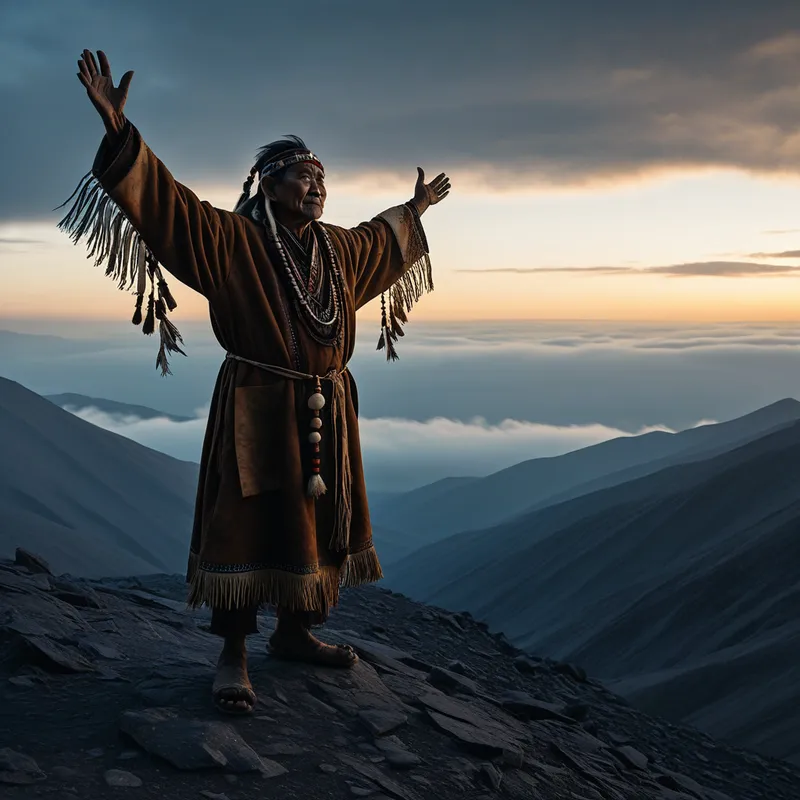
The myth of Khangarid is not a singular story bound in a book, but a living presence woven into the nomadic consciousness. Its origins are inseparable from Tengriism and the practice of Böö (shamanism). It was passed down not by bards for entertainment, but by elders and shamans as sacred knowledge, a psychic map of the Mongolian relationship with the cosmos.
The eagle, particularly the golden eagle (Bürgüd), holds a paramount place in this culture. Falconry is more than sport; it is a spiritual partnership, a microcosm of the covenant between humanity and the celestial. Khangarid is the mythic amplification of this relationship. The myth served a critical societal function: it provided a collective psychic anchor. For a people perpetually in motion across a landscape of overwhelming scale, Khangarid symbolized a fixed point of protective consciousness. He embodied the idea that the nation, though dispersed, was perpetually watched over by a unifying, transcendent spirit. He was the symbol of national identity and spiritual sovereignty, a reminder that their strength was not just of the earth, but granted and reflected by the heavens.
Symbolic Architecture
At its core, Khangarid represents the archetype of the Guardian Spirit. He is not a god to be worshipped from afar, but an active, intelligent principle of protection and connection. Symbolically, he is the embodiment of heightened awareness—the "eye" of the collective.
The guardian does not fight the battles you see; it holds the space in which you discover you can fight them yourself.
His birth from the light of Tengri signifies his nature as a mediated divine force. He is not the ultimate source, but its direct, focused manifestation into the worldly realm. The Khangai Mountains, his perch, represent the axis mundi—the central pillar of the world. Thus, Khangarid physically and spiritually occupies the connecting point between realms. Psychologically, he symbolizes the sovereign function of the Self—that part of the psyche which can observe the entirety of one's inner landscape (the steppe of emotions, the mountains of complexes) from a detached, yet profoundly connected, perspective. He is the ability to see one's own life not just as a series of events, but as a meaningful whole under a protective, purposeful gaze.
The Dreamer's Resonance
When the image of Khangarid—or a powerful, overseeing eagle—appears in a modern dream, it often signals a critical moment of psychic re-orientation. The dreamer may be feeling spiritually exposed, lacking guidance, or overwhelmed by the vast, uncharted territories of their own life or psyche.
Somatically, this dream might be accompanied upon waking by a feeling of expansion in the chest, a sharpening of vision, or a curious sense of being "seen" or "known" in a non-threatening way. Psychologically, it marks the emergence or activation of the inner guardian. The process is one of moving from a state of vulnerability and fragmentation to one of integrated watchfulness. The eagle's high perspective in the dream offers the dreamer a way out of the tangled undergrowth of a problem, suggesting that a broader, more detached view is available. It is the psyche's way of constructing its own Khangai peak within—a place from which the Self can observe and begin to orchestrate the disparate elements of the personality.
Alchemical Translation
The myth of Khangarid models a specific alchemy of the soul: the transmutation of raw, existential anxiety into grounded, sovereign confidence. The initial state is the "scattered people on the steppe"—the ego-consciousness feeling alone, vulnerable, and disconnected from any transpersonal source of meaning or protection.
The alchemical nigredo, or darkening, is the recognition of this profound need. The conjunctio, or sacred marriage, is the descent of the celestial light (transpersonal energy, the Self) to meet the earthly need (the ego's cry). Khangarid is the product of this union—the tertium quid that is neither purely divine nor purely human, but the functional bridge between them.
Individuation is not about becoming a god, but about building a stable perch within oneself where the godlike perspective can land and make its covenant.
For the modern individual, the "alchemical translation" is the internal process of building a relationship with this inner guardian. It is the cultivation of a witness consciousness—the part of you that can observe your own fears, passions, and failures without being completely identified with them. This is not dissociation, but empowered integration. The struggle is to consent to the gaze, to allow oneself to be seen by one's own highest Self. The triumph is the realization that you are both the people on the steppe and the eagle above it. You are the one who journeys, and the eternal, protective awareness that makes the journey meaningful and safe. The covenant is made within, and the wind that guides you is your own breath, aligned with a purpose greater than your momentary worries.
Associated Symbols
Explore related symbols from the CaleaDream lexicon:
- Eagle — The primary symbol of Khangarid, representing sovereign consciousness, transcendent perspective, and the mediating spirit between heaven and earth.
- Sky — The domain of Tengri and Khangarid’s origin, symbolizing the infinite, the divine, and the realm of pure potential and spirit.
- Mountain — The Khangai peak as the axis mundi, representing stability, sacred center, and the meeting point between different realms of existence.
- Guardian — The core function of Khangarid, symbolizing protective oversight, the watchful Self, and the psychic structure that provides safety for growth.
- Journey — The perpetual motion of the nomadic people under the eagle’s gaze, representing the soul’s path through life, guided and witnessed by a higher awareness.
- Destiny — The covenant between Khangarid and the people, symbolizing a pre-ordained or deeply aligned purpose that is watched over and facilitated by guardian forces.
- Giant Eagle — The mythic, amplified form of the eagle, representing an overwhelming, transpersonal protective power that operates on a collective or archetypal level.
- Eagle's Shadow — The protective presence of the guardian, not as an oppressive force, but as a comforting, overseeing influence that provides relief and orientation.
- Eyes of the Eagle — Symbolizing the penetrating, all-seeing awareness of the guardian spirit, which perceives truth, pattern, and soul-depth beyond surface appearances.
- Light — The celestial substance from which Khangarid is born, representing divine emanation, conscious awakening, and the illuminating power of spirit entering form.
- Spirit — The essential nature of Khangarid as a non-corporeal, intelligent force of protection and connection, binding the material world to the unseen.