
Kaulu the Trickster Myth Meaning & Symbolism
The myth of the Hawaiian trickster god whose chaotic, cunning journeys through the heavens and underworld model a profound path of psychic liberation.
The Tale of Kaulu the Trickster
Listen, and let the trade winds carry you back. In the time when the gods walked the islands and the ocean’s breath was the only law, there lived a being of irrepressible spirit: Kaulu. He was not born of grand ceremony but emerged from the raw, fecund earth, a brother to the rocks and the restless sea. He was small, often overlooked, a flicker of motion at the edge of vision.
His story begins not with a quest for glory, but with a hunger—a deep, gnawing curiosity about the secrets held by the great ones. The heavens were the domain of Kāne, a realm of perfect, unchanging order. Its bounty, the miraculous ‘Aumakua, was hoarded, its life-giving waters denied to the world below. Kaulu watched the people struggle, their thirst a silent song on the dry air. He did not put on the cloak of a solemn hero. Instead, a sly smile touched his lips. Chaos was his method.
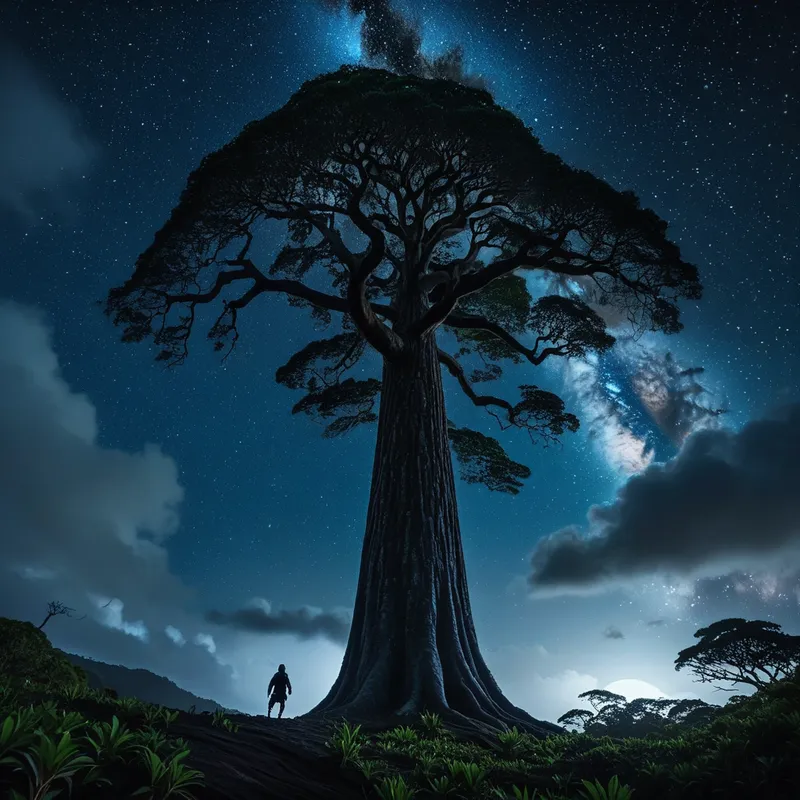
His first trick was one of audacious theft. He sought out the great tree Kāne‘āpua, whose trunk was a road to the sky. The climb was endless, a journey through cloud and silence. In the celestial realm, he found not a fortified vault, but a place of serene assumption, where gods believed their authority was as immutable as the stars. With the guile of a child and the precision of a master, Kaulu did not fight the guardians; he confused them. He became a question where there was only certainty, a paradox in their perfect logic. He seized the ‘Aumakua, the very source of divine sustenance, and with a laugh that echoed like breaking waves, he cast it down to earth. Life-giving water and food erupted upon the land, a gift delivered not through prayer, but through glorious, disruptive larceny.
But the gods of death, Milu and his sister, held a tighter grip. They had stolen the breath, the mana, from Kaulu’s brother. This was a darker theft, a crime against the very spark of being. Kaulu’s journey now turned downward, into the mist-shrouded pits of Milo. Here, trickery took on a sacred, terrifying dimension. He did not battle specters with a club. He engaged the lords of the dead in a contest of fundamental knowledge—a game of ‘ulu maika, the rolling stone disc. He did not win by sheer force. He won by understanding the hidden grooves in the field, the unseen currents of fate. He won by rolling his stone with a perfect, inevitable truth that even death could not deny. And from the silent, grey halls of Milo, he led his brother’s spirit back into the world of light, restoring what was lost through a cunning deeper than despair.
His final act was one of sublime, terrifying creation. The great lizard Kuna blocked the life-giving waters of a stream, threatening a goddess. Kaulu did not merely slay the beast. He engineered its destruction through the elements themselves. He heated stones in a fire of his own making, stones that held the concentrated heat of the sun, and dropped them into the water. The river boiled. The great lizard, a creature of stagnant power and obstruction, was cooked in its own domain. From this act of elemental trickery, the stream flowed freely once more, and the first ānuenue arched across the sky—a covenant of color born from steam and struggle.
Cultural Origins & Context
The stories of Kaulu belong to the rich oral tradition of Kanaka Maoli. These narratives were not mere entertainment but functional cosmology, history, and social instruction, preserved and performed by skilled storytellers and chanters (haku mele). Kaulu’s tales likely served multiple purposes. On one level, they explained natural phenomena—why rainbows appear after a storm, why certain streams have particular properties. On a societal level, Kaulu functioned as a necessary corrective. In a culture with a highly stratified, kapu (sacred law)-based social structure, Kaulu’s exploits provided a psychic pressure valve. He was the embodiment of the clever, seemingly insignificant individual who could, through wit and a refusal to accept unjust limitations, challenge even the highest gods. He modeled a form of agency that existed outside of prescribed rank and ritual, reminding listeners that the established order, while powerful, was not infallible.
Symbolic Architecture
Kaulu is the archetypal principle of disruptive intelligence. He is not the hero who reinforces the system by conquering a monster for it; he is the force that questions the system itself. His theft from heaven is not greed, but a redistribution of resources hoarded by a stagnant authority. His journey to the underworld is not a conquest, but a negotiation with the ultimate shadow, retrieving life from the grip of finality through superior understanding.
The trickster does not destroy the world to end it, but to break the vessel so a new one can be formed.
His tools are never brute strength, but cunning, paradox, and a deep attunement to the hidden flows of reality—the groove in the game field, the heat within the stone. He represents the psychic function that dismantles rigid complexes, the part of the self that can outwit internalized "gods" of perfection or "lizards" of blockage. Kaulu is the embodiment of mana that flows through adaptability and cleverness, not just through lineage or solemn ritual.
The Dreamer's Resonance
When the spirit of Kaulu stirs in the modern dreamscape, it often manifests as dreams of hilarious, unsettling sabotage. You might dream of expertly disassembling a meaningless but demanding machine at work, or of playfully confusing an authority figure until their power seems absurd. These are not dreams of violence, but of deconstruction. The somatic sensation is often one of latent energy—a mischievous smile itching at the corners of the mouth upon waking, a feeling of lightness as if a weight of unnecessary solemnity has been lifted.
Psychologically, this signals a confrontation with what Jung called a "negative father complex"—an internalized authority that demands rigid compliance, hoards psychic energy (the ‘Aumakua), and stifles vitality. Kaulu-dreams indicate the psyche’s innate intelligence beginning to outflank this inner tyrant, not through rebellion (which still acknowledges its power) but through re-framing, trickery, and the introduction of chaotic, creative possibility.

Alchemical Translation
The individuation process is not a straight, respectful climb up a sanctioned ladder. It is, in part, a trickster’s journey. Kaulu models the essential alchemical stage of solve—the dissolution of outmoded structures. His path is the psychic transmutation of stagnant order into fluid potential.
First, one must "steal the ‘Aumakua from heaven"—that is, reclaim one’s own vitality and nourishment from internalized ideals of perfection or distant, judgmental gods (parental complexes, societal shoulds). This is an act of sacred theft from the superego. Next, one must "descend to Milo and win at the game." This is the shadow work: engaging with the repressed, the "dead" parts of the self, not to battle them, but to outmaneuver their hold through deeper self-knowledge. It is winning back lost spirit from the complex that says "this part of you must remain dead."
The final creation, the rainbow, only appears after the obstructive lizard in the stream of life is cooked by its own element. Liberation comes when the very thing that blocks us is transformed by the heat of our engaged consciousness.
The ultimate goal is not chaos for its own sake, but the freedom that allows for the true, authentic flow of life—the cleared stream, the arch of promise. The individual who integrates the Kaulu principle learns to use cunning self-inquiry to break personal kapu, to roll the stone of fate with intentionality, and to turn obstructive energies into the very steam that gives rise to their own unique rainbow.
Associated Symbols
Explore related symbols from the CaleaDream lexicon:
- Trickster — The archetypal embodiment of chaos, cunning, and necessary disruption that Kaulu perfectly represents, challenging stagnant order to enable new growth.
- Water — The life-giving element Kaulu liberates from the gods, symbolizing emotional and psychic nourishment that must flow freely for vitality.
- Journey — Kaulu’s vertical travels to heaven and the underworld model the internal quest to confront both lofty ideals and deep shadows.
- Chaos — The creative, disruptive force Kaulu wields, which is not mere destruction but the fertile ground from which new order can emerge.
- Death — The realm of Milo that Kaulu enters not to conquer, but to negotiate with, representing the confrontation with psychic endings and what is repressed.
- Rebirth — The restoration of Kaulu’s brother from the underworld, symbolizing the retrieval of lost vitality and the return of life after a symbolic death.
- Tree — The great Kāne‘āpua that Kaulu climbs, representing the axis mundi or world tree, a pathway between realms of consciousness.
- Fire — The elemental tool Kaulu uses to boil the river and defeat Kuna, representing transformative energy, passion, and alchemical heat.
- Bridge — Kaulu’s actions create connection between separated realms (heaven/earth, life/death), mirroring the psyche’s need to integrate opposites.
- Shadow — Kaulu himself operates from the overlooked, marginal space, and his journey to the underworld is a direct engagement with the psychological shadow.
- Goddess — The divine feminine (often Hina) whom Kaulu aids by defeating Kuna, showing the trickster’s role in protecting and restoring creative, life-giving forces.
- Rainbow — The ānuenue created from the steam of his victory, symbolizing the covenant, promise, and beautiful synthesis that follows successful struggle and transformation.