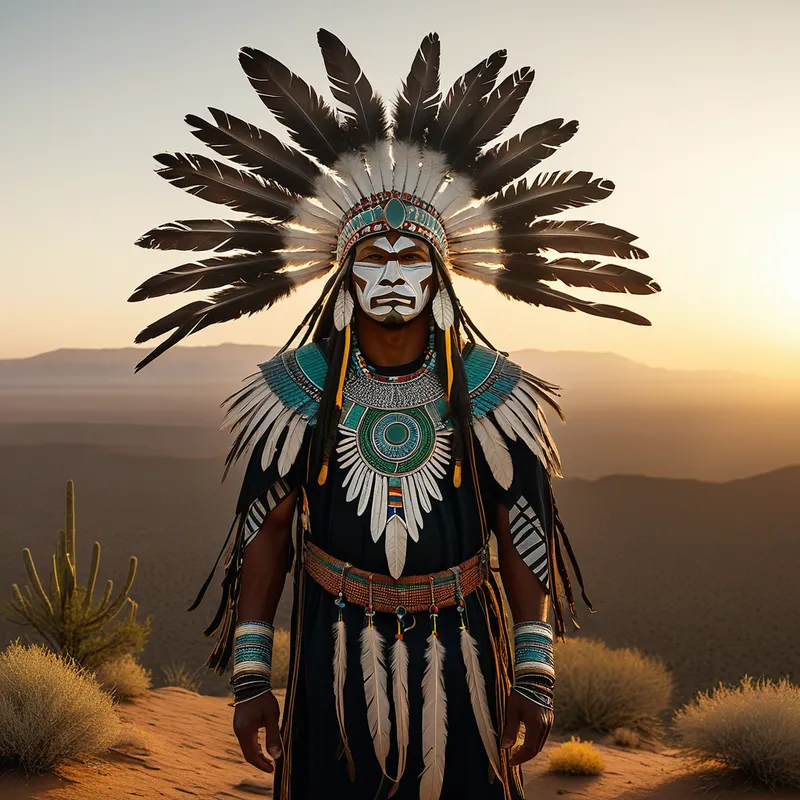
Katsinam Myth Meaning & Symbolism
Sacred spirit messengers descend from the peaks to bring rain, blessings, and teachings, embodying the vital connection between the Hopi people and the cosmos.
The Tale of Katsinam
Listen. The world is dry. The breath of the sun lies heavy on the red earth, and the corn in the fields whispers a thirsty prayer. The people look to the San Francisco Peaks, those blue-grey sentinels on the horizon where the sky meets the stone. They are waiting.
From those high places, where the pines touch the clouds, they come. They are not born of woman, but of intention. They are the Katsinam. Some arrive with the rumble of thunder in their footsteps, their bodies painted with the symbols of storm: zigzag lightning, pooling rain. Others move with the silent grace of the hunt, wearing the visage of the antelope, the wolf, the crow. There are those who are severe, with long black snouts and eyes of shell, carrying yucca whips to chastise and correct. And there are those who are gentle, their masks blooming with the colors of the flower world, their hands scattering blessings like seeds.
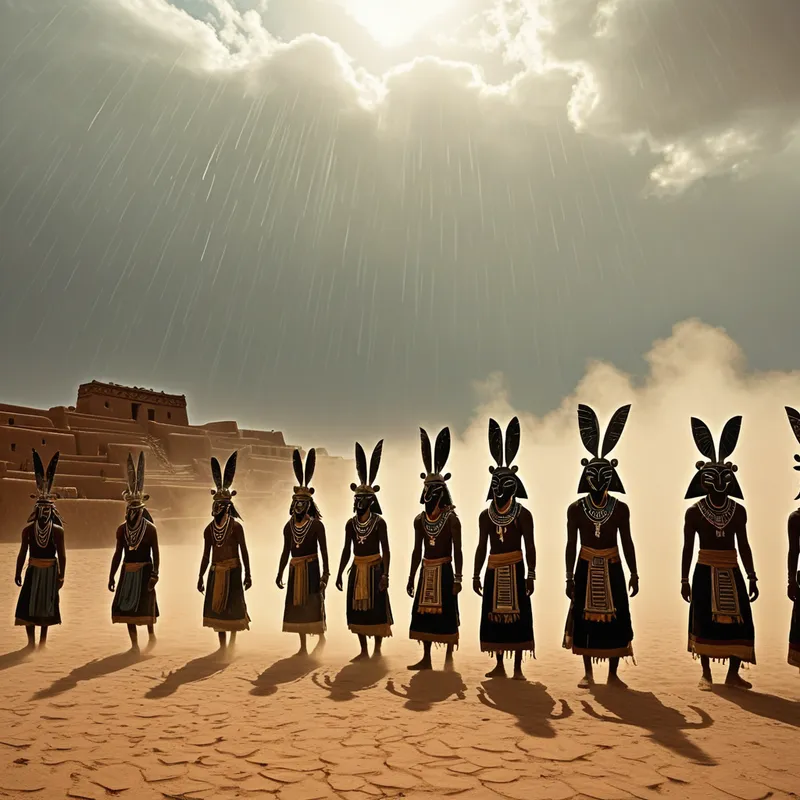
For half the year’s turning, they dwell among the people. They descend not as ghosts, but in full presence, embodied by initiated men who have shed their individual selves to become vessels. In the great plaza, under the vast bowl of the sky, the dance begins. The rhythmic stamp of feet on packed earth is the heartbeat of the world itself. The gourd rattles sing the sound of falling rain. The low chant is a rope, pulling moisture from the heavens.
The dance is not a performance; it is a work. A sacred labor. Through the precise, repetitive motion and the focused will of the dancers, a bridge is built. The Katsinam walk this bridge from their home in the peaks and the clouds to the heart of the village. They bring not just the promise of rain, but the substance of life: discipline for the young, order for the community, continuity for the ancestors. They teach through action, through story, through the palpable energy that thickens the air until you can almost taste the coming storm.
Then, as the sun’s path shifts and the season of growth wanes, the time of departure comes. The people make prayer offerings—pahos—fine-spun feathers carrying hopes skyward. The Katsinam gather these prayers. In a final, powerful ceremony, their spiritual essence is sent back, riding the prayers to the mountain homes. They depart, but they leave behind their carved likenesses, tithu, for the children—a tangible memory, a seed of understanding planted for the future. The connection is maintained. The people have done their part; the Katsinam have done theirs. The world is in balance, for now.
Cultural Origins & Context
The Katsinam tradition is the living spine of Hopi spiritual and social life, a complex system believed to have been received in the misty time of emergence and migration. It is not merely a “myth” told once, but a cyclical, participatory reality enacted from winter solstice until the summer ceremonies. The knowledge is esoteric, passed down through male societies within each Hopi pueblo. It is a sacred trust, with specific Katsinam, songs, and rituals belonging to specific clans.
The societal function is multifaceted. It is a cosmological map, defining the Hopi relationship with the natural and supernatural worlds. It is an educational engine, where the appearance and actions of hundreds of distinct Katsinam (over 400 are recognized) teach ethics, natural history, and clan histories. It is a system of social regulation, where certain Katsinam, like the Nataskas, visit homes to question children on their conduct. Ultimately, it is a technology of reciprocity—the core Hopi principle of nami’nangwa. The people perform the dances with pure hearts; the Katsinam respond by mediating for rain, health, and balance. The myth is lived, breathed, and danced into being every year.
Symbolic Architecture
At its heart, the Katsinam mythos symbolizes the necessary and sacred dialogue between the visible and invisible worlds. The Katsinam themselves are not ultimate gods, but intermediaries—messengers, personifications of natural forces, and deified ancestors. They represent the aspect of the cosmos that is attentive, responsive, and willing to engage.
The bridge between worlds is not built of stone, but of disciplined attention and communal longing.
The physical village represents the human realm of community, effort, and need. The distant peaks represent the realm of spirit, potential, and source. The Katsinam are the dynamic force that travels between, transforming potential (rain clouds) into manifestation (life-giving water) through the conduit of ritual. Psychologically, they symbolize those potent archetypal forces that descend into our conscious awareness from the unconscious—not to possess us, but to inform and nourish us, provided we meet them with proper respect and preparation (the dance).
The tithu, or Katsina doll, is a profound symbol in itself. It is not an idol, but a vessel of memory and relationship. Given to children, it is a tangible link to the intangible, a way to internalize the archetype. It represents the process of taking a transcendent, overwhelming experience (the powerful, masked dancer) and integrating a manageable, knowable aspect of it into one’s personal world.

The Dreamer's Resonance
When this mythic pattern stirs in the modern dreamer, it often signals a profound moment of psychic intermediation. To dream of a masked figure of great presence, especially one that feels neither fully human nor wholly alien, points to the emergence of a powerful content from the unconscious seeking recognition.
The somatic feeling is crucial. It may be the awe and slight fear of witnessing something majestic and otherworldly (the arrival). It could be the rhythmic, trance-like sensation of participating in or observing a deliberate, patterned dance (the integration). Or it may be the bittersweet feeling of a powerful presence departing, leaving behind a meaningful gift or token (the tithu). This dream pattern suggests the psyche is attempting to broker a relationship between a deep, instinctual, or spiritual need (the dry, thirsty land of the ego) and the inner resources needed to address it (the rain-bringing spirits of the unconscious). The dream asks: What "dance"—what disciplined, focused action or attitude—must you perform to invite this nourishment? What mask must you respectfully wear, not to hide, but to serve a role greater than your personal identity?

Alchemical Translation
The alchemical process modeled here is the transmutation of potential into nourishment through ritualized relationship. For the individual on the path of individuation, the Katsinam myth teaches that the treasures of the unconscious do not fall upon us passively. We must build the plaza and learn the steps.
First, one must recognize the "dryness"—the conscious attitude that is barren, rigid, or thirsty for meaning. This is the call. Then, one must turn attention toward the "peaks"—the inner heights of the Self, the realm of archetypes and latent potential. The descent of the Katsinam represents the willing engagement of these archetypal energies. We "dance" them through active imagination, creative work, or disciplined introspection—the conscious acts that give form to the formless.
Individuation is not a solitary conquest of the unconscious, but a ceremonial exchange with it.
The final, critical phase is the departure and the gift. We cannot, and should not, be permanently possessed by an archetypal force. To stay in a state of permanent inflation or identification with the spirit is a kind of spiritual hoarding. The energy must be allowed to return to its source, leaving behind its integrated essence—the tithu. This is the acquired wisdom, the new capacity, the solidified insight that remains as a permanent, guiding part of the personality. The cycle completes, having transformed both the individual (who receives nourishment and wisdom) and the relationship with the Self (which has been successfully petitioned and honored). One learns to be both the diligent villager and the respectful vessel for the sacred messenger, in an endless, life-giving dance of reciprocity.
Associated Symbols
Explore related symbols from the CaleaDream lexicon: