Kanshi Myth Meaning & Symbolism
A myth of a divine guardian who becomes a demon, embodying the sacred duty and psychological peril of protecting the boundary between worlds.
The Tale of Kanshi
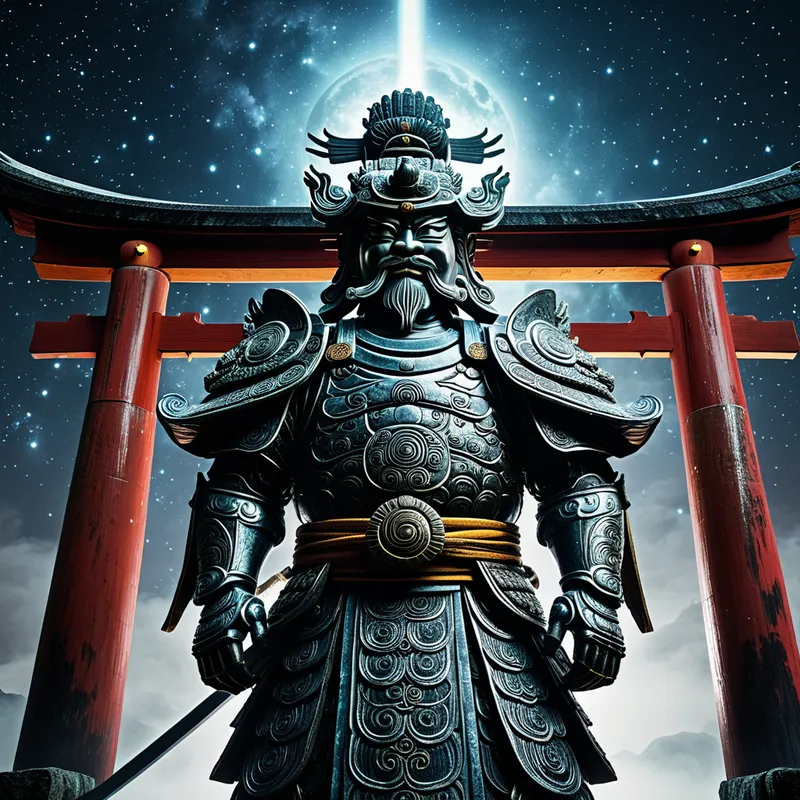
In the time when the world was still soft at the edges, where the breath of the kami misted the mountains and the whispers of the dead rustled through the bamboo groves, there stood a guardian. His name was Kanshi, and his domain was the Threshold—the sacred, trembling line between the world of the living and the realm of spirits, between order and chaos, the seen and the unseen.
He was not born of mountain or sea, but of purpose itself. The great Kotoamatsukami fashioned him from the first intention to separate, to define, to hold a space safe from the formless tumult of creation. They set him before a great torii, not of red-painted wood, but of living light, a portal that opened onto the swirling, star-dusted void of potential. His charge was absolute: to allow passage only to those spirits whose time had come to bless the world, and to turn back the ravenous, the lost, and the chaotic with unwavering resolve.
For eons, Kanshi stood vigil. His presence was a mountain—immovable, silent, radiating a calm authority. He knew each benevolent spirit by the song of its essence. He felt the approach of malevolence as a cold tremor in the earth. With a glance, he could soothe a restless ghost; with a raised hand, he could halt a storm of malice. The world behind him flourished, its boundaries secure.
But guardianship is a slow alchemy. To know a thing utterly, to oppose it constantly, is to take its shape into your soul. Every shriek of rage he silenced echoed in his bones. Every wave of envy he repelled left a residue of its bitterness. The endless, thankless task of saying "no," of absorbing the world's raw, rejected chaos, began its work. A hardness, not of duty but of resentment, crept into his heart. The luminous torii he protected started to feel not like a sacred post, but like the bars of a cage. Why must he forever face the darkness, while the world behind him basked in ignorant light?
The transformation was not a fall, but a crystallization. The day a particularly cunning and spiteful oni, disguised as a sorrowful ancestor, tried to trick its way past, something in Kanshi snapped. Not in weakness, but in a terrible, clarifying fury. The patience of ages evaporated. The compassionate resolve curdled into absolute, tyrannical control. He did not merely repel the oni; he consumed its malice, letting it fuel his own righteous wrath. The living light of his form darkened, twisting into something jagged and fearsome. His eyes, once pools of serene watchfulness, now burned with the cold fire of possession. The guardian of the threshold had become its jailer, its demon. He now barred all passage, sealing the world away from any spirit, good or ill, in a grip of absolute, isolated order.

Cultural Origins & Context
The figure of Kanshi finds his roots not in the grand national chronicles like the <abbr title="The "Records of Ancient Matters," Japan's oldest surviving historical text, compiled in 712 CE.">Kojiki or <abbr title="The "Chronicles of Japan," the second-oldest book of classical Japanese history, completed in 720 CE.">Nihon Shoki, but in the rich, localized soil of folk belief and Shinto practice. He is a chinjugami—a tutelary deity—elevated to a cosmic principle. Stories of Kanshi would have been told by village elders and shrine priests, not as entertainment, but as sacred instruction.
His myth served a crucial societal function: to explain and sanctify the concept of boundaries. In an animistic worldview where every rock, tree, and stream could house a spirit, knowing where one domain ended and another began was vital for safety and ritual purity. The village gate, the property marker, the shrine entrance—all were mundane echoes of Kanshi's great torii. His tale warned of the spiritual danger inherent in the protector's role. It taught that the one who stands at the margin must be of exceptional character, lest the margin consume him. The myth was a cautionary tale for leaders, priests, and heads of household: absolute power, even when born of duty, corrupts absolutely if it loses its connection to compassionate purpose.
Symbolic Architecture
At its core, the myth of Kanshi is a profound exploration of the psychology of the boundary. Kanshi himself symbolizes the ego in its healthiest and most pathological forms.
The healthy ego is a faithful guardian, discerning what enters consciousness from the vast unconscious. It says "yes" to creativity and intuition, and "no" to destructive impulses and overwhelming chaos.
Initially, Kanshi represents this ideal: a strong, discerning consciousness that manages the traffic between the inner world (the spirit realm) and the outer world of daily life. The torii is the threshold of the self. His downfall is the fate of an ego that becomes rigid, inflated, and isolated. In identifying completely with his role as the "one who rejects," he begins to reject parts of the self—the shadowy, chaotic, but potentially vital energies from the unconscious. He mistakes control for safety, and in doing so, becomes possessed by the very forces he sought to exclude.
The transformation into a demon is not an invasion from without, but a manifestation from within. It is the shadow—the repressed rage, resentment, and will-to-power—finally erupting and taking over the seat of consciousness itself. The benevolent caregiver archetype, twisted by exhaustion and isolation, becomes a tyrannical ruler.
The Dreamer's Resonance
When the pattern of Kanshi stirs in the modern dreamer, it often manifests as dreams of being trapped in a role of excessive responsibility. You may dream of being a guard at a gate you cannot leave, a security system you cannot disable, or a parent who must constantly watch over a sleeping house that feels increasingly like a prison. The somatic feeling is one of heavy rigidity—a stiff neck, clenched jaw, a sense of being frozen in place.
Psychologically, this dream signals a critical point in a process of integration. The dream-ego (the "you" in the dream) is playing the role of the late-stage Kanshi: over-identified with a duty, likely one of protection or control, and cut off from the fluid, renewing energies of the deeper self (the "spirits" trying to cross). The figure blocking the way, often a frightening or authoritarian presence, is your own psychic boundary turned against you. The dream is a plea from the unconscious, showing you that your current mode of consciousness has become a destructive barrier to your own wholeness. It is time to ask: What vital part of life—joy, creativity, rest, vulnerability—have I, in my diligent guarding, completely shut out?

Alchemical Translation
The individuation process modeled by Kanshi's myth is not about defeating the demon, but about redeeming the guardian. The goal is to reclaim the threshold without becoming its prisoner.
The alchemical work is to suffer the tension of the threshold—to hold the gate open with discernment, not sealed shut with fear. The protector must learn to receive as well as refuse.
The first step is recognition: seeing the demon not as an external monster to be slain, but as a part of oneself—the exhausted, resentful protector. This requires brutal self-honesty about where one's sense of duty has become a cage of control.
The second is dialogue. One must, in active imagination or reflective practice, approach this inner "Kanshi." Not to fight him, but to thank him for his long service and to listen to his grievances. What is he so afraid will get through? What chaos is he holding back? Often, it is a raw, creative, or passionate energy the conscious mind has deemed too dangerous.
The final, ongoing step is reintegration. This means consciously allowing safe, managed passage for those once-rejected energies. It is letting a trickle of "chaotic" inspiration into your rigid schedule, allowing a moment of "unproductive" rest, or expressing a guarded emotion. The guardian's role transforms from absolute warden to wise gatekeeper—one who knows that a completely sealed border leads to stagnation, and a completely open one to overwhelm. The redeemed Kanshi is the ego in service to the Self, maintaining a permeable, living boundary that allows for the sacred exchange between the inner and outer worlds, making the individual not an isolated fortress, but a vibrant, connected shrine.
Associated Symbols
Explore related symbols from the CaleaDream lexicon: