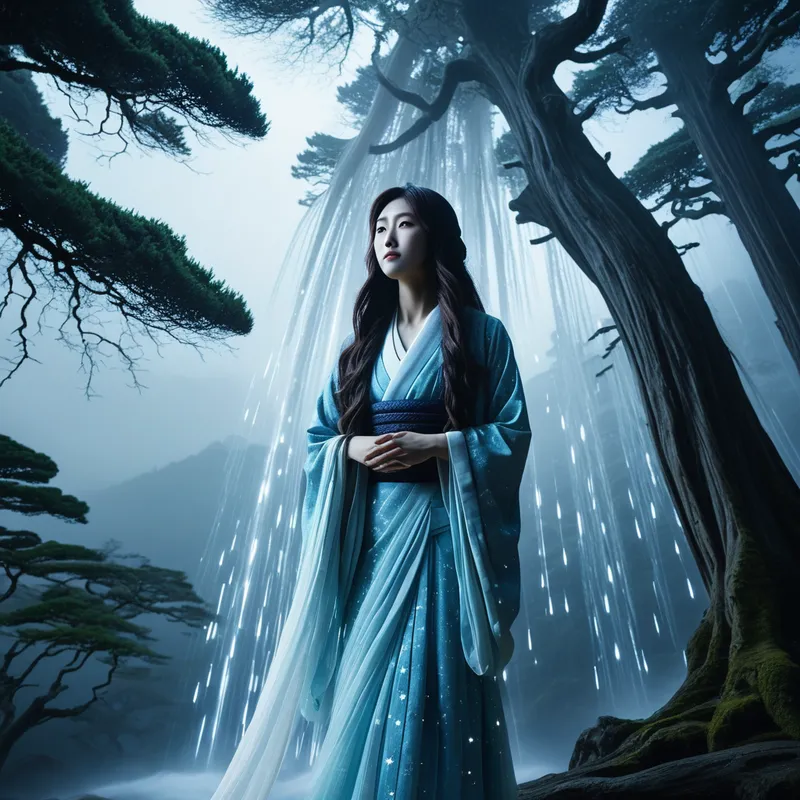
Kamiin hair Myth Meaning & Symbolism
A myth of a mortal who receives a divine hair, a gift of profound connection that becomes a source of both power and impossible yearning.
The Tale of Kamiin hair
In the time when the world was still soft with the breath of the gods, when the mountains were young and the rivers sang with clearer voices, there lived a mortal named Miyako. She was not a princess, nor a warrior, but a weaver of such skill that her threads were said to hold the colors of dusk and dawn. Her life was one of quiet rhythm, set to the shuttle's song, yet her heart held a silent chamber that echoed with a longing for something she could not name—a beauty so absolute it ached.
One evening, as the last light bled into indigo over the sacred yama, she took her basket to a secluded spring. The air was thick with the scent of damp earth and night-blooming flowers. As she bent to the water, she saw not her own reflection, but a presence within the pool’s dark mirror. It was a kami, a being of the deep woods. Not appearing in full form, but felt in the sudden stillness, seen in the way the moonlight on the water coalesced into a silhouette of serene, unbearable grace. No words passed between them, only a profound recognition that vibrated in the space between heartbeats.
Overwhelmed, Miyako cast her eyes down. When she dared to look up, the vision was fading. But upon the mossy stone where the kami had been perceived, a single strand of hair remained. It was not like any earthly thread. It held the silver of moonlit spider silk, the deep obsidian of a starless sky, and a faint, shimmering light that seemed to come from within. It was cool to the touch, yet it hummed with a silent, potent energy. This was the Kamiin hair.
She took it home, her hands trembling. When she placed it beside her loom, a miracle unfolded. Her ordinary threads, touched by its mere proximity, gained a luster and strength she had never achieved. The fabrics she wove became legendary; they felt like cloud and water, they held warmth in winter and coolness in summer. Her fame spread. Yet, with each masterpiece, her silent longing grew. The hair was a connection, a tangible piece of that sublime encounter, but it was only a piece. It was the signature of the divine, but not the presence itself. She would spend hours simply gazing at it, the beauty of her creation a bittersweet reminder of the beauty that had departed.
As years passed, the hair’s light began, imperceptibly, to dim. Not from decay, but as if its essence were slowly seeping back into the unseen world from which it came. On the night of a full moon, Miyako, now an old woman with eyes still young with yearning, took the hair back to the spring. She held it aloft, and as the moonlight struck it, the strand dissolved—not into nothing, but into a shower of minute, glowing motes that drifted upwards, merging with the beams of light, returning to the musubi, the generative force of the universe. Miyako felt no loss, only a final, peaceful release. She had been the keeper of a mystery, and in letting it go, she understood that the connection had never been broken, only transformed.
Cultural Origins & Context
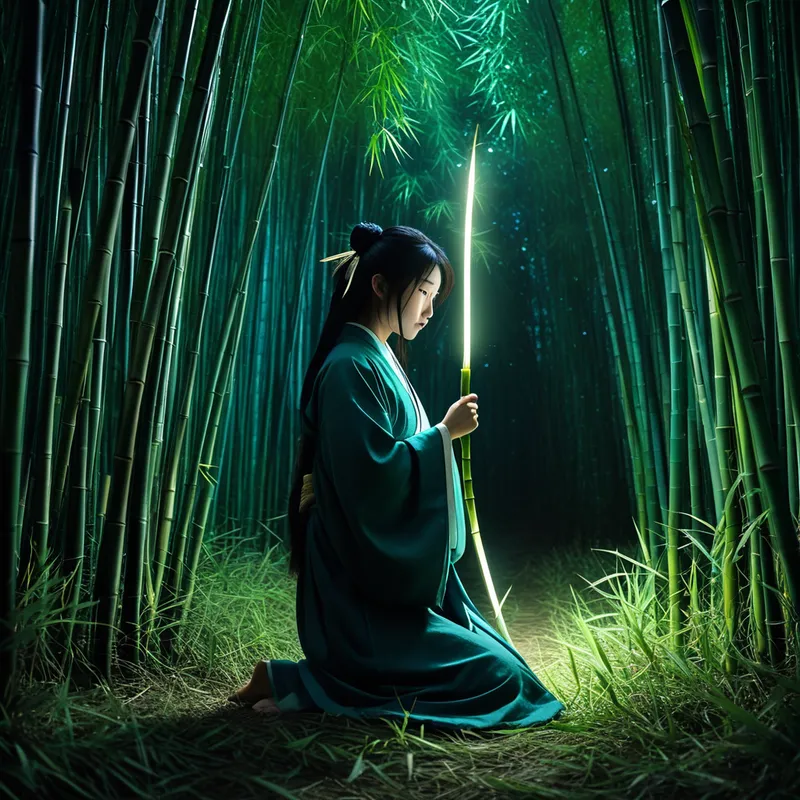
The myth of the Kamiin hair finds its roots not in the grand, state-sponsored chronicles like the Kojiki or Nihon Shoki, but in the rich soil of regional folktales and kōshin—oral traditions passed down by village elders and itinerant storytellers. It belongs to a class of narratives concerning kami no sōdan, where the boundary between the human and divine worlds grows thin, often at liminal places: springs, mountain passes, ancient trees.
Its societal function was multifaceted. On one level, it explained exceptional human talent or beauty as a gift from the kami-yo, a divine favor that came with a weight of responsibility and often, solitude. On another, it served as a profound meditation on the nature of gifts and relationships with the sacred. The kami does not stay; it offers a token, a catalyst. The myth validates the human experience of transcendent longing—mono no aware—while grounding it in a narrative where such longing is not a pathology, but a natural consequence of brushing against the divine. It was a story told to remind people that the most precious things are often fleeting connectors to a greater whole, not possessions to be held indefinitely.
Symbolic Architecture
The Kamiin hair is a supreme symbol of the numinous encounter—the human meeting with a reality that is wholly other, utterly captivating, and fundamentally transformative. It is not the deity itself, but its trace, its relic. Psychologically, it represents the indelible impression left by a peak experience, a moment of awe, love, or insight that changes one’s internal landscape forever.
The divine hair is the soul’s souvenir from a country it can visit but never inhabit.
Miyako, the weaver, embodies the creative ego that is catalyzed by this encounter. Her loom is the structure of ordinary life; the divine hair is the infusion of transpersonal energy that elevates her work to the realm of art and meaning. Yet, the core conflict is not external, but internal. The hair is a constant, beautiful reminder of a presence that is absent. It symbolizes the paradox of spiritual or creative inspiration: it empowers and fulfills, yet simultaneously creates a yearning for the source that can never be fully satisfied in the material world. The gradual dimming of the hair signifies the natural entropy of such peak inspirations; they are not meant to be permanent fuel, but transformative events whose energy must eventually be integrated or released.
The Dreamer's Resonance
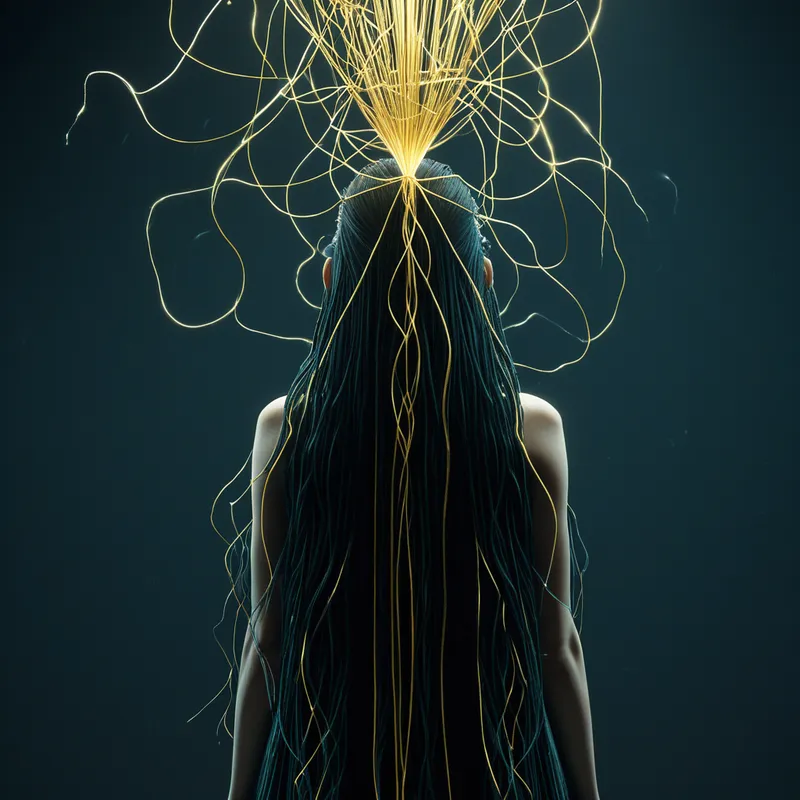
When this myth pattern surfaces in modern dreams, it often manifests during a period of profound creative or spiritual awakening, or in the poignant aftermath of a deeply meaningful connection that has passed. The dreamer might find a strange, beautiful object—a gem, a key, a piece of cloth—that glows with significance. They feel it is a gift from a powerful, often shadowy or unseen figure. The dream is charged with a mix of euphoria and melancholic longing.
Somatically, the dreamer may report a feeling of energy humming in their hands or chest upon waking, or conversely, a deep, hollow ache. Psychologically, this dream signals the ego’s processing of a transpersonal influx. The dream-ego is tasked with being the “keeper of the relic,” trying to understand what to do with this transformative energy in their waking life. The conflict in the dream mirrors the internal struggle: how to honor and utilize this gift without becoming attached to the form of the encounter itself, and how to bear the bittersweet loneliness that often accompanies being touched by something greater than oneself. It is the psyche working on the problem of how to live after the revelation.
Alchemical Translation
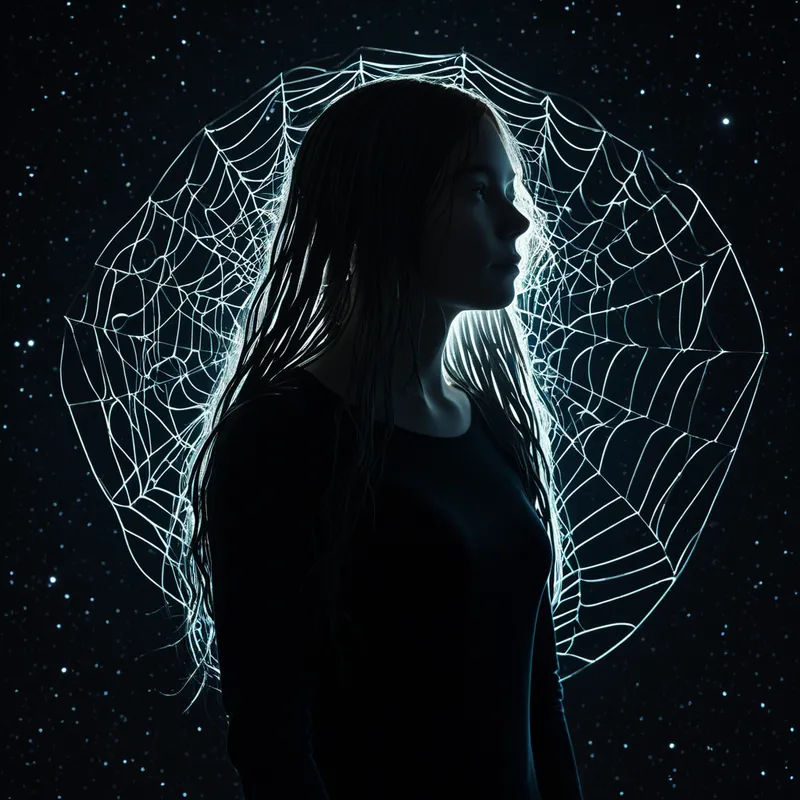
The myth models the complete arc of psychic transmutation, a blueprint for individuation where the central alchemical agent is the numinous experience itself. The initial encounter at the spring is the nigredo—the blackening, the overwhelming, humbling confrontation with the Self (the divine other). The gift of the hair is the first coagulation, the albedo or whitening, where a tangible symbol of the experience is extracted and brought into consciousness.
Miyako’s weaving represents the citrinitas, the yellowing or conscious work. Here, the ego actively engages with the symbolic material, using its energy to create, to give form and beauty to the world. This is the stage of “inspired living,” where the transcendent fuels the immanent. However, the myth wisely includes the shadow of this stage: the risk of fixation. The longing and the dimming hair are the psyche’s correction, moving the process toward the final stage.
Individuation is not about capturing the divine, but about being faithfully changed by its visitation, and then releasing its form so its essence can become part of your marrow.
The return to the spring and the hair’s dissolution is the rubedo, the reddening, the culmination. It is the conscious sacrifice of the sacred symbol itself. The ego, now strengthened and refined by its long engagement, must release its attachment to the specific form of the initial experience. The energy does not vanish; it is reabsorbed into the greater psyche, the universal musubi. The individual is no longer a weaver using a divine tool, but has become a vessel through which the divine creativity itself can flow, having integrated the lesson that the true connection was internal all along. The myth teaches that the goal is not perpetual visitation, but transformative remembrance, leading to a liberated and authentic existence.
Associated Symbols
Explore related symbols from the CaleaDream lexicon: