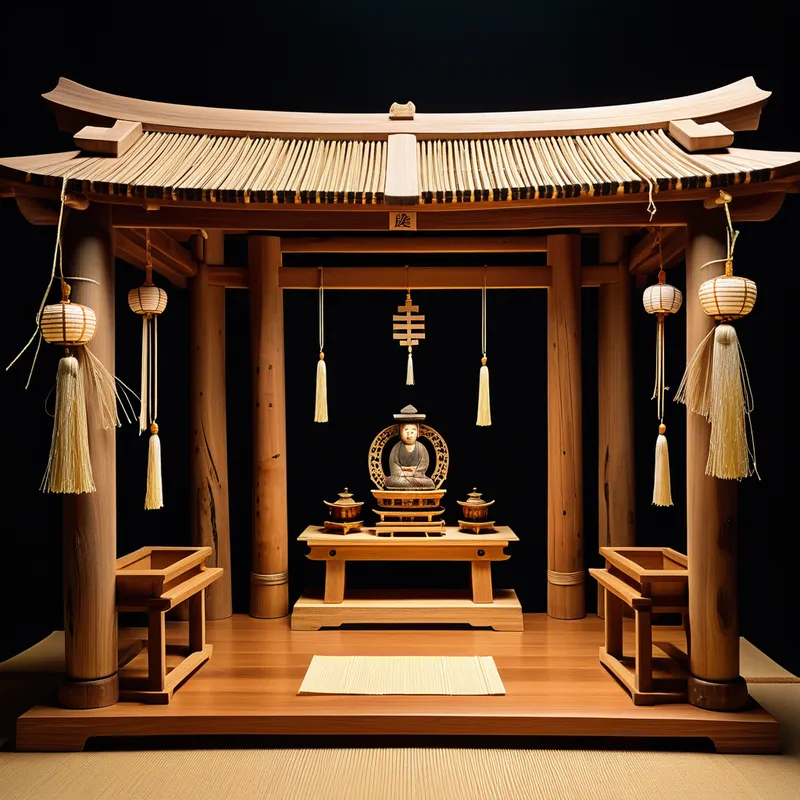
Kamidana Myth Meaning & Symbolism
The myth of the Kamidana tells of the sacred household altar, a threshold where the divine descends to dwell within the ordinary, weaving kami into daily life.
The Tale of Kamidana
Listen, and let the silence between the words speak. This is not a story of a single battle or a lone hero’s quest. It is the quieter, deeper tale of the space between heaven and hearth, a story whispered by the smoke of morning incense and the first light touching the shimenawa.
In the beginning, there was separation. The kami dwelt in the high places—in the womb of the sun, in the heart of the ancient mountain, in the whisper of the waterfall. Humanity dwelt below, in the world of soil and struggle, of harvest and hunger. A vast, silent longing stretched between them. The people felt the kami in the storm’s fury and the cherry blossom’s fleeting beauty, but it was a distant, awesome presence, as untouchable as the moon on water.
Then, a longing arose—not from humanity alone, but from the kami themselves. Amaterasu-Ōmikami, she who illuminates all things, saw the fragility of her children in the world. She saw their labors, their joys, their fleeting lives. And in her divine compassion, a thought was born: a bridge must be built. Not a bridge of stone, but of invitation. A sacred agreement.
The first kamidana was not built; it was recognized. It began when a humble farmer, his hands caked with the earth of his rice paddy, felt a profound stillness at the edge of his field at dawn. The light did not just fall; it settled. It pooled in a particular spot, by an old, gnarled tree. An understanding, wordless and deep, filled him. This was not just a place. It was a welcome.
He did not construct a temple. He simply cleared a space. He placed a smooth stone from the river, washed clean. He laid a few grains of the first rice of the season before it. He offered a dipper of clear water. And he bowed. In that act, the threshold was drawn. The high kami, through the infinite compassion of Amaterasu, sent forth a fragment of their essence—a bunrei—traveling down the path of the sun’s rays, down the reverence of the offered grain, to alight upon that humble stone.
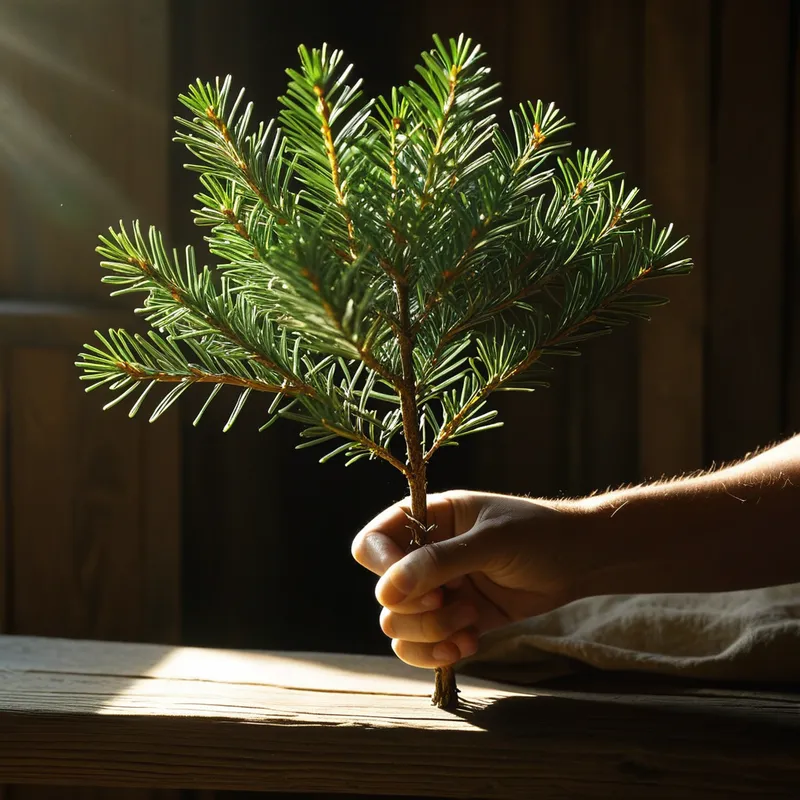
From that day, the separation was healed, not by erasing the distance, but by creating a conduit. The kamidana became the appointed place. A shelf, pure and unadorned, often facing the life-giving south or east. Upon it, the mitamaya was placed, a tiny palace for the guest of honor. The shimenawa, strung with lightning-bolt shide, marked the boundary of the sacred. Every morning, fresh water, rice, salt—the essence of life and purity—were offered. The scent of sakaki leaves filled the air.
The conflict was the chaos of a world without a sacred center. The resolution was the gentle, daily act of return. The kami did not come to rule, but to reside. To witness. To bless the comings and goings, the births and deaths, the daily bread. The myth tells us the divine does not demand a cathedral; it accepts a clean shelf, a sincere heart, and the first fruits of the day. The hearth had found its heaven, and heaven had found its home.
Cultural Origins & Context
The myth of the kamidana is not contained in a single sacred text like the Kojiki or Nihon Shoki. It is a living, evolving narrative woven from the very fabric of Shinto practice. Its origins are animistic and deeply local, predating the formalization of shrine worship. In ancient Jōmon and Yayoi periods, people venerated kami in natural features—a striking rock (iwasaka), a mighty tree (shinboku), a waterfall.
As society shifted from nomadic to agricultural, the need arose to invite these protective, fertile forces closer to the human community—first to the village boundary, then into the home itself. The kamidana myth codifies this transition. It was passed down not by bards, but by grandparents to parents, by shrine priests to parishioners, through the ritual act itself. Its societal function was foundational: to sacralize the domestic sphere, to embed gratitude and reverence into the daily routine, and to affirm that the family unit was under the direct, benevolent gaze of the kami. It served as a constant reminder of interdependence—the family cared for the kami with offerings, and the kami cared for the family with protection and blessing.
Symbolic Architecture
Psychologically, the kamidana is a master symbol of the axis mundi—the world axis—personalized for the individual soul and the family psyche. It represents the conscious establishment of a sacred interiority.
The altar is not where we go to escape the world, but where we invite the sacred to sanctify our existence within it.
The shelf symbolizes the prepared mind, a cleared, elevated space within consciousness dedicated to something higher than the ego’s daily concerns. The shimenawa is the boundary of the Self, demarcating where the profane chatter of the world stops and inner reverence begins. The offerings (water, rice, salt) are the libido—the psychic energy—we willingly redirect from personal consumption to nourish the transpersonal, the numinous. The enshrined kami is the archetypal image of the Self, the divine counterpart within, the organizing, guiding center of the psyche that is both intimately personal and universally connected.
The myth’s core action—the daily offering—is a ritual of attention. It is the ego’s daily bow to the Self, acknowledging a greater order and source of meaning within one’s own home.

The Dreamer's Resonance
When the motif of the kamidana appears in modern dreams, it often signals a profound somatic and psychological process: the search for an inner sanctuary. The dreamer may be navigating a life of fragmentation, over-stimulation, or spiritual homelessness.
The dream image might be a familiar bookshelf transforming into a glowing altar, a forgotten corner of a childhood home holding a strange, peaceful light, or even the act of desperately searching one’s apartment for a "clean enough" place to put something precious and sacred. These are not dreams of grand religious conversion, but of subtle, urgent re-orientation. The body-mind is seeking to establish or repair its own axis mundi. The somatic feeling is often one of relief, centered calm, or a poignant longing upon waking. The psyche is attempting to perform, in the nocturnal language of symbols, the very ritual the myth prescribes: creating a dedicated, respectful space for the numinous to dwell amidst the clutter of modern life. It is the Self prompting the ego to build an inner shrine.
Alchemical Translation
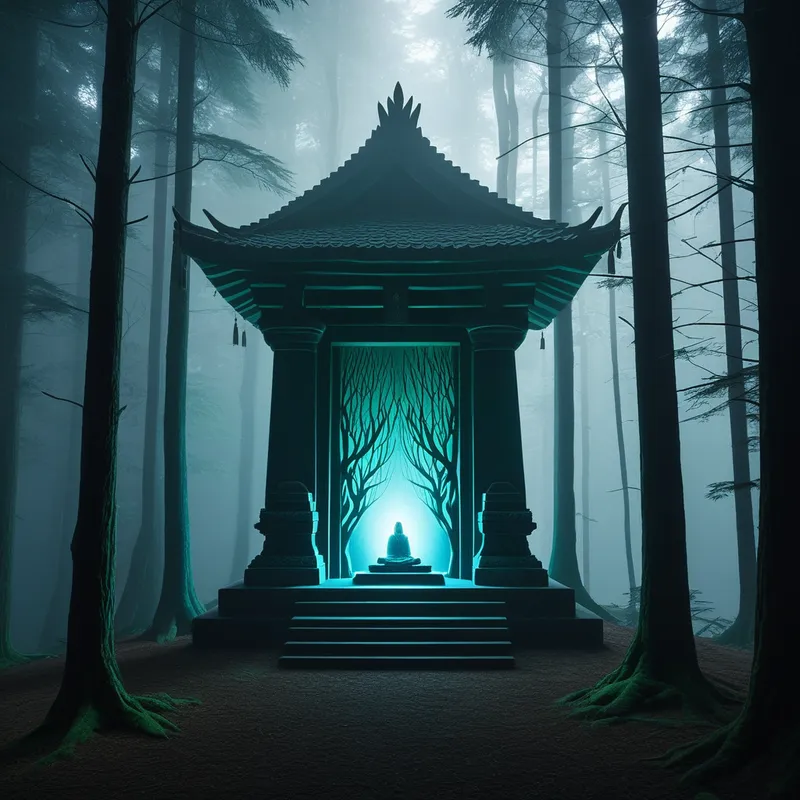
The alchemical process modeled by the kamidana myth is that of invitation and continuous relationship, which is the heart of Jungian individuation. It is not a heroic, one-time conquest of a dragon, but the humble, daily work of building a living connection to the Self.
The first stage (nigredo) is the felt sense of separation—the spiritual dryness, the meaninglessness, the feeling that life is merely transactional and profane. The construction of the shelf is the beginning of the albedo—the conscious decision to create order, to designate a part of one’s life (through meditation, journaling, art, or conscious ritual) as sacred and set apart. The placing of the mitamaya is the citrinitas, the invocation of the golden, guiding image—the symbol, ideal, or value that represents one’s highest potential or deepest truth.
Individuation is the daily offering of one’s attention to the inner kami; the Self grows where the ego regularly kneels.
The daily offerings are the sustained work of rubedo, the reddening. This is the alchemical translation: the transmutation of base, daily psychic energy (worries, routines, passions) into sacred substance through the act of conscious dedication. You offer your first, freshest attention (the morning water). You offer the fruit of your labor (the rice). You offer what preserves and purifies (the salt). In return, the inner kami—the integrated Self—offers coherence, resilience, and a sense of being at home in the universe, even within the confines of a single, mortal life. The kamidana teaches that the divine does not crash into our lives unannounced; it awaits a sincere, consistent invitation. The ultimate alchemy is realizing that the shelf, the offering, and the recipient are all facets of one’s own awakening wholeness.
Associated Symbols
Explore related symbols from the CaleaDream lexicon: