Kami of the Sea Myth Meaning & Symbolism
A myth of the primordial sea's kami, its turbulent nature, and the sacred act of pacification that mirrors the soul's journey to wholeness.
The Tale of Kami of the Sea
Listen, and let the salt air fill your lungs. Let the memory of the first tide wash over you. In the time before time, when [the world](/myths/the-world “Myth from Tarot culture.”/) was still soft and unformed, [the sea](/myths/the-sea “Myth from Greek culture.”/) was not a place for ships or songs. It was a realm of pure, untamed essence—a kami of immense and restless power. Its name was Watatsumi, or perhaps it was [Ryūjin](/myths/ryjin “Myth from Japanese culture.”/), [the Dragon](/myths/the-dragon “Myth from Chinese culture.”/) King. But names are nets cast upon the deep; they cannot hold the whole.
This kami was the sea itself—not the gentle lapping at the shore, but the abyssal pressure, the typhoon’s birth, the tectonic groan from the ocean floor. Its body was the cold, dark [water](/myths/water “Myth from Chinese culture.”/). Its breath was the storm. Its mood was the difference between a bountiful harvest of fish and a village swallowed whole by a wave of black salt. It was chaos, potential, and profound indifference.
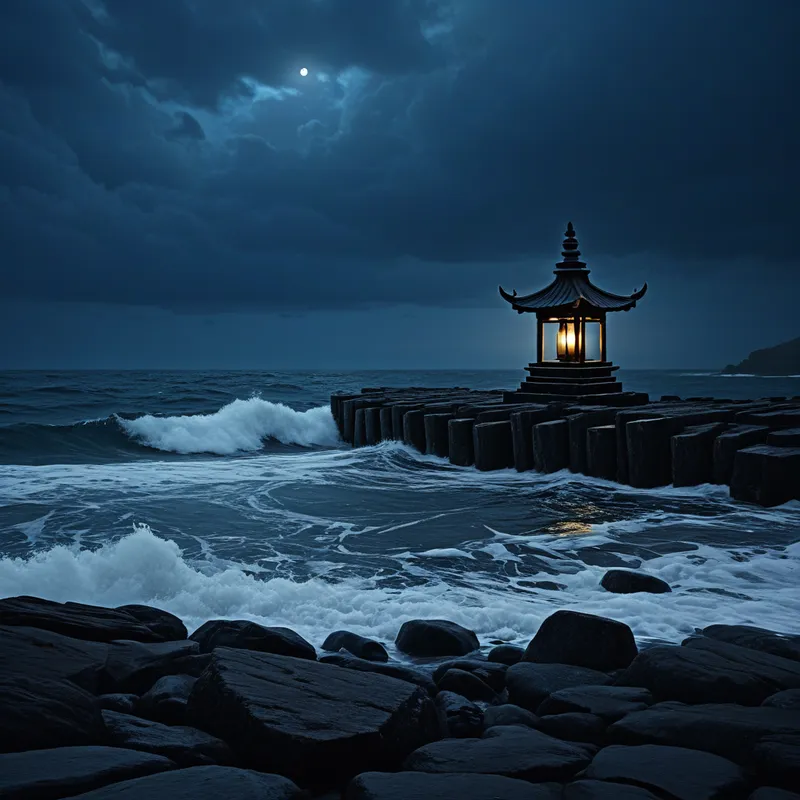
The people of the shore lived in the rhythm of its temper. They built their humble shrines upon the rocks, offering prayers, rice, and the first catch. But the offerings were like pebbles dropped into a bottomless well. The sea kami’s nature was turbulent, its attention vast and unfocused. It would gift a calm passage, then claim three brothers with a sudden, sucking whirlpool. It was the source of life and the face of oblivion, and it knew no pact.
Then came a different kind of prayer. Not of fear, but of relationship. A kannushi, a person of pure heart and unwavering intent, stood at the boundary where land yields to water. They did not beg for mercy. Instead, they began the sacred work of shizumenasu—to pacify, to settle, to invite.
For days and nights, they performed the rituals. They purified the space with salt and water. They wove a sacred boundary rope, a shimenawa, and hung shide that fluttered like the kami’s own white mane. They offered not just rice, but music from the kagurabue, and dance that mirrored the waves—not to control, but to reflect; not to command, but to understand.
And the sea listened.
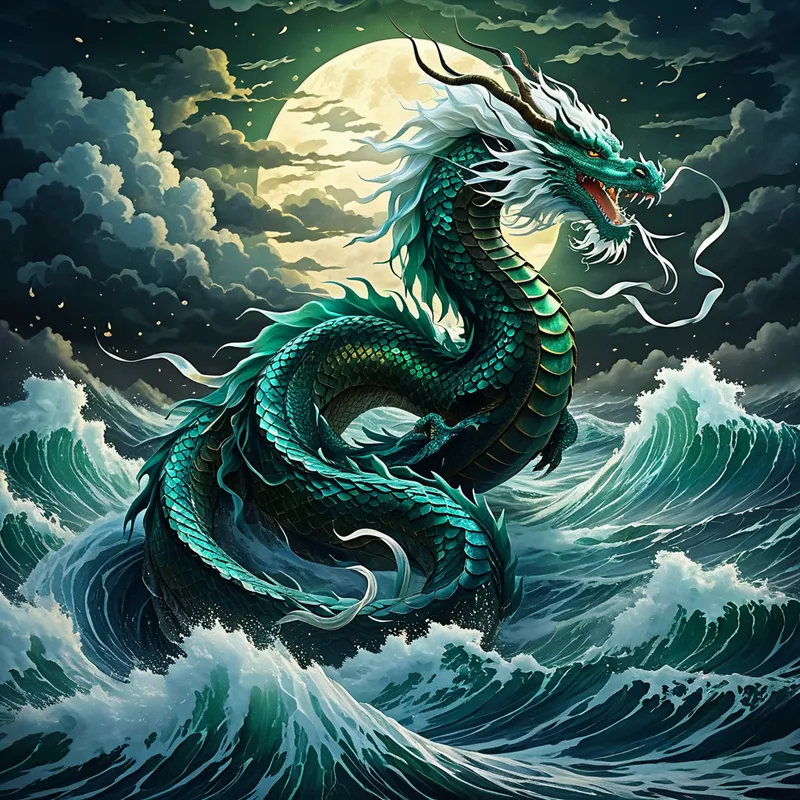
The response was not a voice, but a shift in the world’s substance. The raging surface calmed, not to glass, but to a purposeful swell. From the profound depths, a presence drew closer. The people saw not a monster, but a majesty: a great, serpentine form, scales like polished abalone catching the first light, eyes holding the patience of the deep. The kami had chosen to be seen. It had consented to a bond. It entered the purified space within the shimenawa, and in that moment, the wild, unconscious chaos took a form that could be met. The untamable was not tamed, but was welcomed into the community of things that have a name and a place. The sea remained vast and powerful, but now, a conversation had begun.
Cultural Origins & Context
This is not a single myth with one text, but a living pattern woven into the spiritual fabric of Shinto. The concept of the powerful, often capricious sea deity appears in Japan’s oldest chronicles, the Kojiki and Nihon Shoki, in figures like [Susanoo](/myths/susanoo “Myth from Japanese culture.”/) and the deity Owatatsumi. It is echoed in countless local mukashibanashi told in fishing villages from Hokkaido to Okinawa.
The myth was passed down not just in stories, but in ritual practice. It was enacted by kannushi and miko at coastal shrines, and remembered by fishermen who knew their lives depended on a respectful, reciprocal relationship with the sea’s spirit. Its societal function was fundamental: to model how humanity, a creature of the land and order, could relate to the vast, amoral, and generative power of nature. It taught that the goal is not domination, but respectful engagement—a [sacred marriage](/myths/sacred-marriage “Myth from Alchemy culture.”/) between the human realm and the wild, unconscious realm of nature.
Symbolic Architecture
Psychologically, the myth maps the [relationship](/symbols/relationship “Symbol: A representation of connections we have with others in our lives, often reflecting our emotional state.”/) between the conscious ego (the people on the shore) and the unconscious (the primordial sea). The unconscious, in its raw state, is the kami: a [source](/symbols/source “Symbol: The origin point of something, often representing beginnings, nourishment, or the fundamental cause behind phenomena.”/) of immense [energy](/symbols/energy “Symbol: Energy symbolizes vitality, motivation, and the drive that fuels actions and ambitions.”/), creativity, and potential, but also of terrifying, disruptive [chaos](/symbols/chaos “Symbol: In Arts & Music, chaos represents raw creative potential, uncontrolled expression, and the breakdown of order to forge new artistic forms.”/). It can provide inspiration (a bountiful catch) or erupt in a destructive [mood](/symbols/mood “Symbol: Mood in dreams often represents the emotional landscape of the dreamer, reflecting subconscious feelings that may not be acknowledged in waking life.”/) (a psychic storm, a neurosis, a wave of rage or depression).
The untamed sea is the soul before it knows itself—all power and no direction.
The [ritual](/symbols/ritual “Symbol: Rituals signify structured, meaningful actions carried out regularly, reflecting cultural beliefs and emotional needs.”/) of pacification, shizumenasu, is the act of [consciousness](/symbols/consciousness “Symbol: Consciousness represents the state of awareness and perception, encompassing thoughts, feelings, and experiences.”/) turning toward the unconscious with respect and [purpose](/symbols/purpose “Symbol: Purpose signifies direction, meaning, and intention in life, often reflecting personal ambitions and core values.”/). It is not an act of repression or control, but of creating a [temenos](/myths/temenos “Myth from Greek culture.”/)—a sacred, bounded [space](/symbols/space “Symbol: Dreaming of ‘Space’ often symbolizes the vastness of potential, personal freedom, or feelings of isolation and exploration in one’s life.”/) (the shimenawa) where [dialogue](/symbols/dialogue “Symbol: Conversation or exchange between characters, representing communication, relationships, and narrative flow in games and leisure activities.”/) can occur. The offerings of [music](/symbols/music “Symbol: Music in dreams often symbolizes the harmony between the conscious and unconscious mind, illustrating emotional expression and communication.”/) and dance symbolize [the ego](/myths/the-ego “Myth from Jungian culture.”/)‘s best gifts—its culture, its [attention](/symbols/attention “Symbol: Attention in dreams signifies focus, awareness, and the priorities in one’s life, often indicating where the dreamer’s energy is invested.”/), its art—presented not as bribes, but as tokens of sincere engagement.
The [moment](/symbols/moment “Symbol: The symbol of a ‘moment’ embodies the significance of transient experiences that encapsulate emotional depth or pivotal transformations in life.”/) the kami rises and consents to be seen within the [boundary](/symbols/boundary “Symbol: A conceptual or physical limit defining separation, protection, or identity between entities, spaces, or states of being.”/) is the [moment](/symbols/moment “Symbol: The symbol of a ‘moment’ embodies the significance of transient experiences that encapsulate emotional depth or pivotal transformations in life.”/) of symbolic realization. The formless energy of the unconscious acquires a symbolic form—an [image](/symbols/image “Symbol: An image represents perception, memories, and the visual narratives we create in our minds.”/), a dream figure, an artistic [impulse](/symbols/impulse “Symbol: A sudden, powerful urge or drive that arises without conscious deliberation, often linked to primal instincts or emotional surges.”/)—that the conscious mind can relate to and integrate. The chaos gains a face, and in doing so, becomes a [partner](/symbols/partner “Symbol: In dreams, the symbol of a ‘partner’ often represents intimacy, connection, and the dynamics of personal relationships, reflecting one’s desires and fears surrounding companionship.”/) in the [psyche](/myths/psyche “Myth from Greek culture.”/)‘s ecology rather than an external [threat](/symbols/threat “Symbol: A threat in dreams often reflects feelings of vulnerability, anxiety, or fear regarding one’s safety or well-being. It can indicate unresolved conflicts or the presence of external pressures.”/).
The Dreamer’s Resonance
When this myth stirs in the modern dreamer, it often manifests as dreams of vast, ambiguous bodies of water. To dream of a calm, clear sea may speak of a conscious connection with the deep self. But the myth’s pattern is more active in dreams of turbulent oceans, of being on a fragile boat in a storm, or of a great, unseen presence moving beneath dark waves.
These are somatic signals of the unconscious in a state of agitation, its contents pressing toward consciousness. The dreamer is the kannushi on the shore. The psychological process is one of holding the boundary. The ego feels small, threatened by the rising tide of emotion, forgotten memory, or instinctual energy. The dream is the first part of the ritual—the recognition of the storm. The work upon waking is the continuation: to create a “ritual space” through journaling, active imagination, or mindful attention to the emotional body, to “purify” one’s intent, and to respectfully invite the troubling content to show itself in a form that can be understood. The fear is that the wave will destroy; the hope of the myth is that the wave contains a message from the deep self, waiting to be heard.
Alchemical Translation
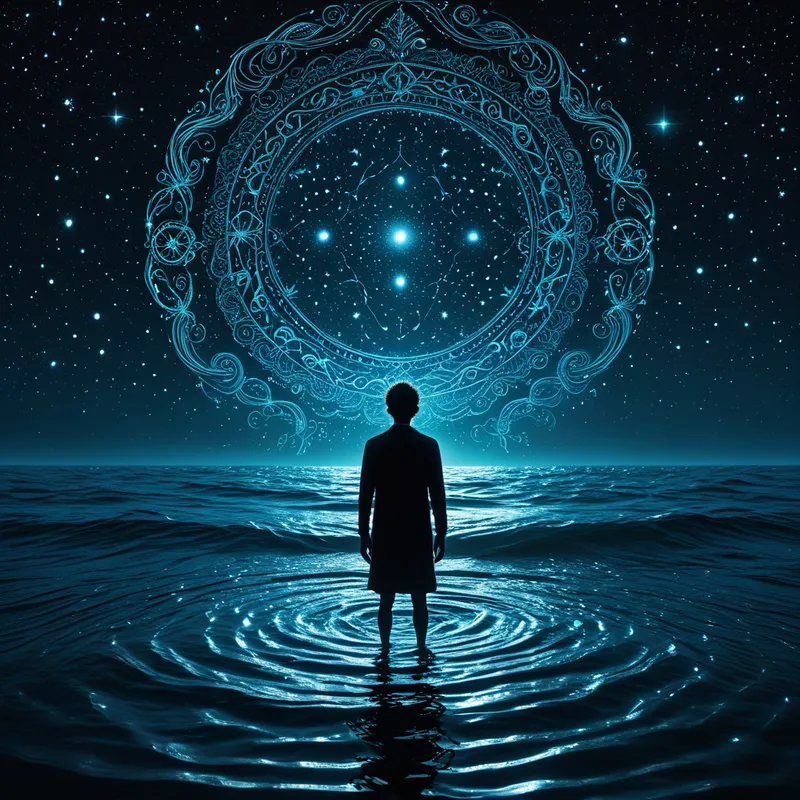
The alchemical process mirrored here is the coniunctio oppositorum—[the sacred marriage](/myths/the-sacred-marriage “Myth from Various culture.”/) of opposites. The land (consciousness, order, culture) and the sea (the unconscious, chaos, nature) are joined in a respectful union. For the modern individual on the path of individuation, this myth models the transmutation of raw psychic potential into a coherent, life-giving force.
Individuation is not about building a wall against the sea, but about learning the rituals that allow one to safely invite it ashore.
The first step is [nigredo](/myths/nigredo “Myth from Alchemical culture.”/): facing the “black,” turbulent, chaotic sea of one’s own shadow and unresolved depths. This is the stormy, indifferent kami. The second is albedo: the purification, the creation of the sacred space through honest self-reflection and the “white” heat of focused attention (the ritual). The final transmutation is [rubedo](/myths/rubedo “Myth from Alchemical culture.”/): the “reddening,” the moment of integration. This is when the great sea kami rises, luminous and majestic, into the bounded space. The energy that was once feared and projected outward is now recognized as an intrinsic, powerful part of [the self](/myths/the-self “Myth from Jungian culture.”/). The creative, instinctual, and emotional powers of the unconscious are no longer enemies to be suppressed, but allies in the creation of one’s unique life.
The myth concludes not with the kami being locked away, but with it residing near the village, in a shrine by the shore. So too in the integrated psyche: the deep unconscious is not eliminated. It remains vast, powerful, and ultimately mysterious. But a relationship has been established. A dialogue is ongoing. The individual can draw upon the sea’s depth for creativity and vitality, while the sea’s wildness is tempered by the respectful recognition of the conscious mind. This is the alchemical gold: a self that is both grounded and fluid, both individual and profoundly connected to the oceanic depths from which all life emerges.
Associated Symbols
Explore related symbols from the CaleaDream lexicon: