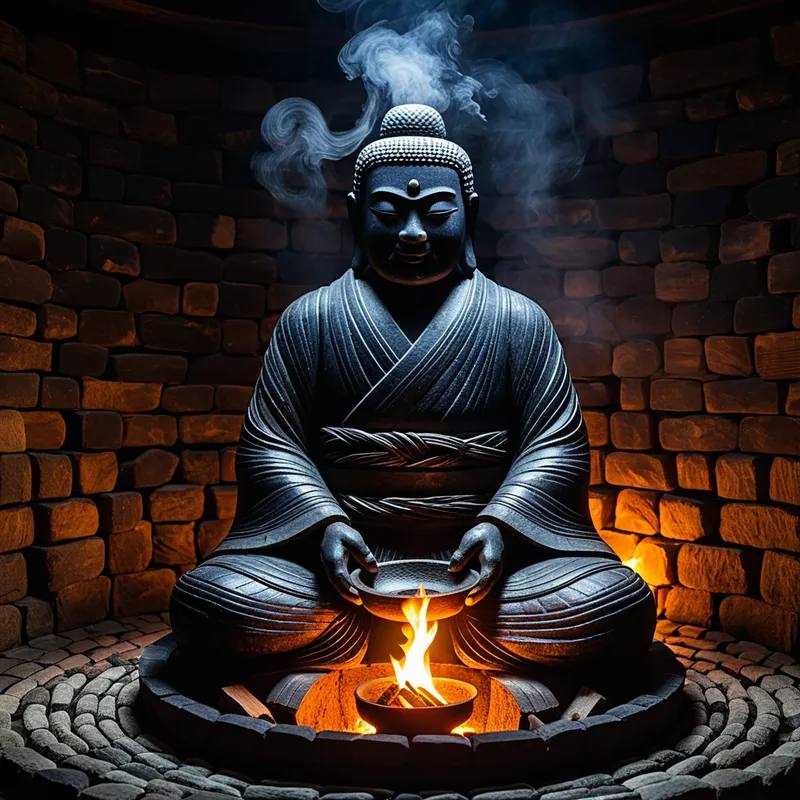
Kamado-gami Myth Meaning & Symbolism
The myth of the hearth deity, a spirit of fire, food, and family, embodying the sacred center of the home and the alchemy of daily sustenance.
The Tale of Kamado-gami
In the deep heart of the home, where shadows gather and the cold presses against the walls, there lives a quiet pulse. It is not the heartbeat of the sleeping family, nor the sigh of the wind in the eaves. It is the slow, patient breath of the kamado. In the time when every house was a world unto itself, and the forest loomed close, the fire was not a servant but a sovereign.
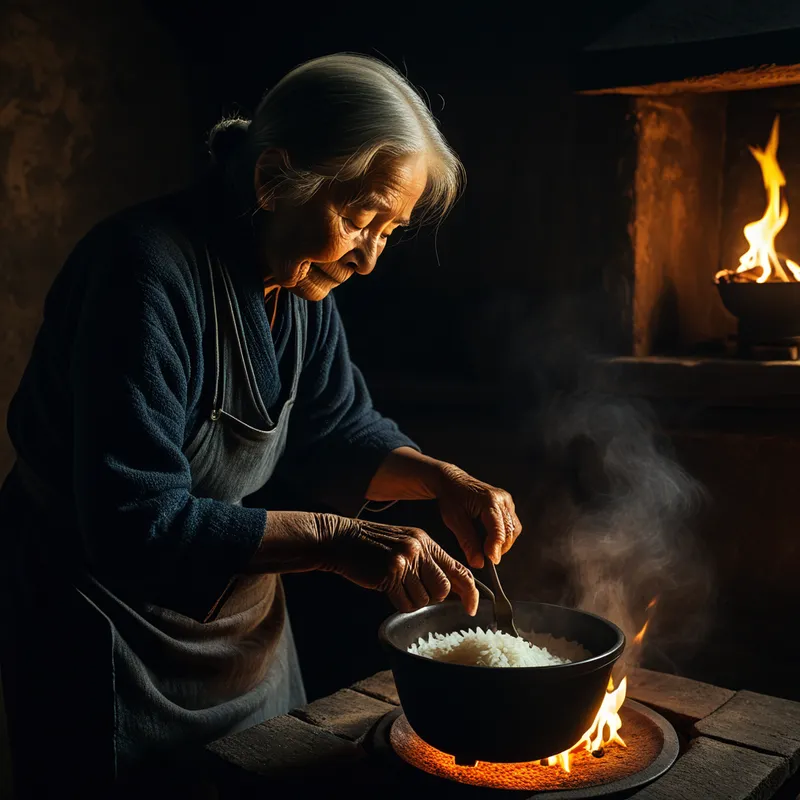
Before dawn, when the world was ink and silence, the grandmother would stir. Her footsteps were whispers on the packed earth floor as she approached the sunken irori or the earthen stove built into the wall. With hands that knew the weight of years, she would clear the ashes of yesterday—a fine, grey powder that held the memory of every meal, every warming, every story told in its light. This was not mere cleaning; it was an act of reverence. For to disturb the ashes carelessly was to disturb the one who slept within.
She would lay the new tinder, the dry kindling, speaking soft words not meant for human ears. Then, the strike of flint. A spark, tiny and desperate, would leap into the dark. And from that spark, a presence would awaken. It did not arrive with thunder or light, but with a slow, creeping warmth that began to paint the walls in gold. It was the Kamado-gami.
The deity had no single form. To the children, it was the dancing shapes in the flames—a fox, a bird, a laughing old man. To the cook, it was the perfect, steady heat that transformed hard grain into soft, life-giving rice. To the family gathered close on winter nights, it was the protective circle of light that held the vast darkness at bay. The Kamado-gami was the guardian of the threshold between the raw and the cooked, the cold and the warm, the wild outside and the cultivated within.
Its sole demand was respect. Waste no rice, for that grain held the sun's labor and the rain's gift. Never step over the hearth, for you trample the heart of the home. Never quarrel before the fire, for you poison the wellspring of warmth. And always, always, offer the first portion. The steam from the freshly cooked pot was its incense; the shared meal, its liturgy.
For generations untold, this was the compact. The family tended the fire, and the fire, in the form of Kamado-gami, tended to the family. It was a silent, smoky, sacred bond, the quiet miracle at the center of every day.
Cultural Origins & Context
The veneration of Kamado-gami is not the stuff of grand imperial mythology, like the tales of Amaterasu recorded in the <abbr title=""Records of Ancient Matters", an early Japanese chronicle">Kojiki. This is a folk belief, a <abbr title="""People's faith" or folk religion, distinct from formal Shinto">minshū shinkō, that lived in the smoke-blackened beams of farmhouses (minka) and the daily rhythms of agrarian life. Its priests were not shrine officials, but mothers and grandmothers, the keepers of the kitchen.
This myth was passed down not through scrolls, but through ritualized action. A child learned it by watching where not to step, by helping to wash the rice, by feeling the solemnity that fell over the adults when the first bowl was set aside. It was a practical spirituality, intimately tied to survival. In a culture where rice was more than food—it was spirit, currency, and life itself—the apparatus that cooked it became sacred. The kamado was the alchemical chamber where the inedible became edible, where nature was transformed into culture.
Societally, the myth functioned as a powerful binding agent. It sacralized the home, making it a microcosm of the ordered world. It taught conservation and gratitude in a life of often precarious resources. It also established the kitchen, typically a woman's domain, as a site of profound spiritual power, a counterpoint to the more public, male-dominated shrine rituals.
Symbolic Architecture
At its core, the myth of Kamado-gami is about the sanctification of the necessary. It elevates the most fundamental human act—transforming raw sustenance into nourishment—into a divine communion.
The hearth is the first altar, and the cook, the first priest. The miracle is not in the distant heavens, but in the steam rising from the daily pot.
The Kamado (Hearth/Stove) symbolizes the axis mundi of the domestic world. It is the fixed center, the warm core around which life orbits. Psychologically, it represents the transformative center of the psyche—the place where raw experience, emotion, and impulse are "cooked" into conscious understanding and sustenance for the soul.
Fire here is not the wild, destructive fire of forests, but the domesticated flame. It symbolizes controlled transformation, will applied with patience, and the vital spark of life contained within a cultural vessel. It is the energy of Eros—not as passion, but as the binding, warming, nurturing force that creates and maintains relationship and community.
Rice and Water are the raw materials of the alchemy. They represent the basic, undifferentiated stuff of life and emotion. The Kamado-gami's work is to apply the heat of consciousness to this raw material, creating something that can feed and integrate the whole being.
The Offerings and Taboos structure a sacred relationship. They symbolize the necessary reciprocity between the individual and the transformative power within. To take without gratitude, to waste the fruits of transformation, or to disrespect the process (by stepping over it) is to sever the connection to one's own inner nourishing source.
The Dreamer's Resonance
When the pattern of Kamado-gami stirs in the modern unconscious, it often surfaces in dreams of neglected or potent spaces in the home. One might dream of a cold, ash-filled fireplace in the center of a bustling modern apartment, or conversely, of a simple, blackened stove in a minimalist kitchen radiating immense, comforting heat.
Somatically, this can connect to issues of digestion and metabolism—not just of food, but of life experience. Are you able to "cook" your daily events into wisdom, or do they sit in you, raw and indigestible? Psychologically, this myth activates when the dreamer's life lacks a warm, nurturing center. It speaks to a hunger for sacred routine, for a practice that transforms daily drudgery into ritual. The dream may be calling for a return to one's own "hearth"—a meditation practice, a creative ritual, or simply the conscious, grateful preparation of a meal—to rekindle the inner transformative fire that turns existence into nourishment.
The conflict in such dreams is often between neglect and tending. Finding the forgotten match to light the cold stove is a powerful symbol of reclaiming one's capacity for self-care and inner transformation.

Alchemical Translation
The individuation process, the journey toward psychic wholeness, is mirrored perfectly in the compact with Kamado-gami. It is the slow, patient alchemy of turning the base lead of our unconscious contents into the nourishing gold of consciousness.
The first step is Building the Vessel. We must identify and honor our own inner kamado—the psychological structure (a journal, therapy, art, disciplined reflection) that can safely contain the heat of our examination. This is the "kitchen" of the soul where the work happens.
Next is Gathering the Raw Materials. This involves courageously acknowledging our "raw" states: unmetabolized grief, uncooked anger, primitive desires, and half-formed insights—the rice and water of the psyche.
The fire of consciousness must be kindled not with grandiose gestures, but with the humble, daily strike of attention.
Then comes the Application of Sacred Heat. This is the disciplined, patient work of introspection—the fire of focused attention. We sit with our raw material, allowing the heat of consciousness to transform it, without forcing or rushing. This is the role of Kamado-gami: the autonomous, archetypal force of transformation that works when we create the right, respectful conditions.
Finally, The Offering and the Feast. The final stage is gratitude and integration. The first fruits of this inner work—a new understanding, a released emotion, a creative idea—must be "offered." This means acknowledging it, giving it its due, not greedily consuming it or wasting it. Then, and only then, can it be integrated to nourish the entire personality. The shared "meal" is the Self partaking of its own wholeness.
To live this myth is to recognize that the most sacred acts are the most ordinary, and that the divine dwells not apart from us, but in the careful, grateful tending of our own inner hearth.
Associated Symbols
Explore related symbols from the CaleaDream lexicon: