Kamadhenu Myth Meaning & Symbolism
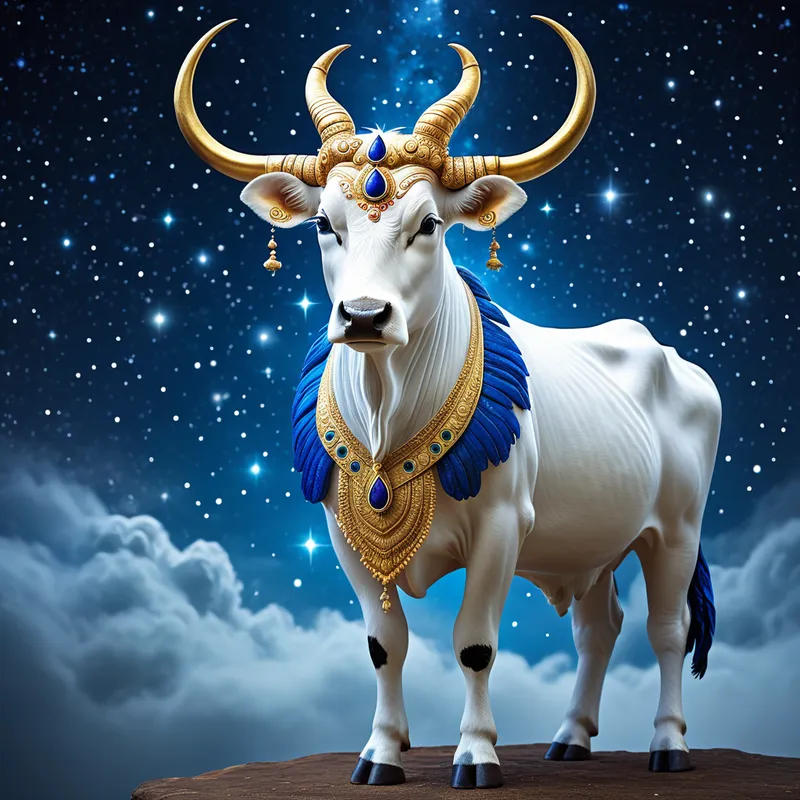
The celestial cow Kamadhenu emerges from the churning ocean, embodying boundless nourishment and the sacred covenant between the divine and the earthly.
The Tale of Kamadhenu
In the age when gods and demons walked a razor’s edge between chaos and order, they gathered at the milk-white shores of the cosmic ocean. Their purpose was titanic: to churn the primordial waters for the nectar of immortality. They coiled the great serpent Vasuki around the mountain Mandara, and with a collective heave that strained the axis of the worlds, they began. The ocean roared, frothed, and convulsed. From its depths, it first yielded poison, then the moon, then the goddess of wine. The waters seethed with the pain and promise of creation.
And then, she emerged.
A profound calm settled upon the waves. From the foaming heart of the turmoil arose a being of such gentle majesty that the very air seemed to soften. She was a cow, yet more than a cow. Her form was luminous white, like solidified moonlight. Her horns were curved like new moons, tipped with gold. Her tail was a fan of peacock feathers, iridescent and alive. Upon her flanks, the miniature forms of every god and sage seemed to dwell, a moving tapestry of the cosmos. She was Kamadhenu, and her other name was Surabhi. Where she stepped, the ground grew lush and fertile. Her breath was the scent of rain on dry earth. Her lowing was a promise. She was the embodiment of all nourishment, the mother who could yield not just milk, but every desirable thing.
The gods claimed her, and she became the cherished possession of the great sage Vasishtha, in whose ashram she resided. Her presence meant no sage, no guest, no being in need would ever go hungry. She was the living hearth of the hermitage.
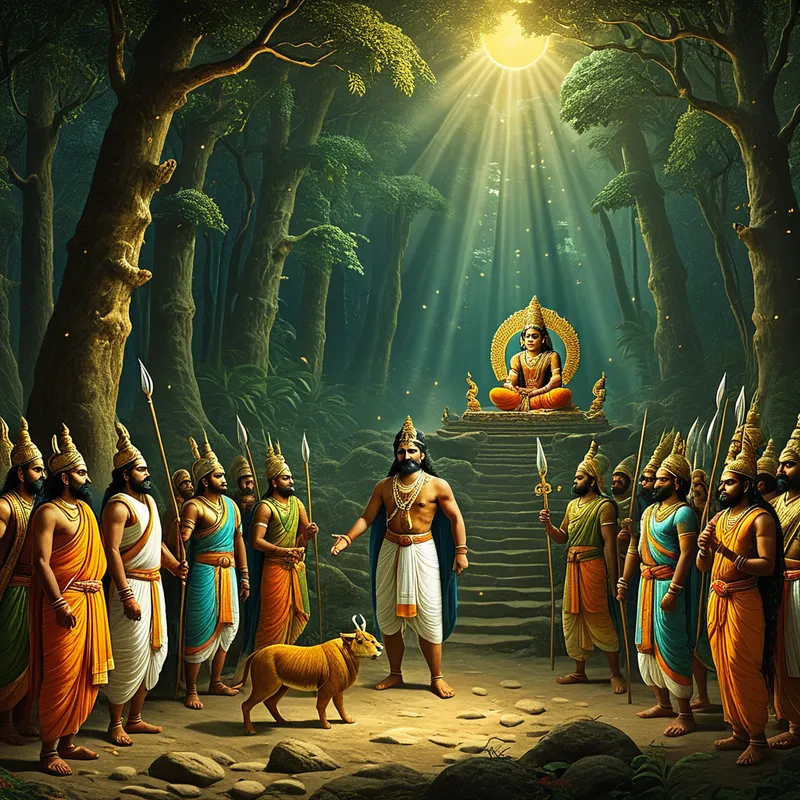
But desire casts long shadows. The mighty king Vishwamitra, powerful and proud, came upon Vasishtha’s simple hermitage. He was traveling with his vast, opulent army. With royal magnanimity, he offered to feed his host. The sage politely declined, saying his own resources were sufficient. To Vishwamitra’s astonishment, from a single shed, Kamadhenu provided a feast so lavish, so exquisitely prepared, that it put the king’s own royal provisions to shame. It was a feast for a hundred thousand.
A fire of covetousness ignited in the king’s heart. This was not just a cow; this was the source of sovereignty, of boundless power. He demanded to buy her. Vasishtha refused, his voice calm as deep water. “She is not property. She is the sustainer of dharma itself. She cannot be sold.”
Enraged, his pride wounded to its core, Vishwamitra ordered his soldiers to seize her by force. They rushed the peaceful grove. It was then that the gentle mother revealed her other nature. From her body, from her breath, from the mere sound of her distress, an army erupted. Fierce warriors, known as the Pramathas, materialized, their weapons flashing. They fell upon the king’s army and routed them utterly, driving the humiliated Vishwamitra from the ashram.
The sage stood, unharmed, beside the now-calm Kamadhenu. The air stilled, carrying only the scent of trampled grass and the fading echo of conflict. The cow lowed softly, a sound of profound, unassailable abundance that had defended itself not through want, but through the inexhaustible power of its own giving nature.
Cultural Origins & Context
The myth of Kamadhenu is woven into the earliest strata of Hindu thought, appearing in the Vedas, the Itihasas, and the Puranas. She is not the subject of a single, linear epic, but a pervasive presence, a foundational symbol. Her story was passed down not merely for entertainment, but as a core piece of cultural software. In a primarily agrarian society, the cow was the literal basis of life—providing milk, butter, fuel, and labor. Kamadhenu mythologized this practical reality, elevating it to a cosmic principle.
The tellers of this tale were the Brahmins and the itinerant storytellers (Kathakars) who performed at festivals and in temple courtyards. Her narrative served multiple societal functions: it encoded the ethic of hospitality (Atithi Devo Bhava), as Kamadhenu ensured no guest was turned away; it reinforced the ideal of the Brahmin’s non-violent spiritual power over the Kshatriya’s martial might, as seen in Vasishtha’s defeat of Vishwamitra; and it established a sacred ecology, where the natural world (the cow) was not a resource to be exploited, but a divine mother (Gau Mata) to be revered and protected.
Symbolic Architecture
Kamadhenu is the archetype of the Magna Mater in her most benevolent, all-providing form. She is not a goddess of dramatic passions, but of quiet, foundational sustenance. Her symbolism is an intricate architecture of abundance.
She represents the unconscious itself in its nourishing aspect—the deep, psychic substrate from which all possibilities, all creations, and all fulfillment emerge.
Her emergence from the churned ocean (Samudra Manthan) is key. She is not a creation ex nihilo; she is what is revealed when the psyche is agitated, when opposites (gods and demons, effort and resistance) engage in profound struggle. The “wish-fulfilling” capacity (Kalpavriksha in bovine form) is not about magical materialism. It symbolizes the psyche’s inherent potential to manifest what is needed for growth and balance when approached with reverence and correct relationship.
Her defeat of Vishwamitra’s army is a profound psychological truth. The force that tries to seize, control, and egoistically own the source of nourishment is always defeated by that source’s own generative, protective power. The nurturing principle, when violated, reveals an inherent, fierce capacity for self-preservation and the preservation of the sacred order (Dharma).
The Dreamer's Resonance
When Kamadhenu appears in the modern dreamscape, she seldom arrives as a literal cow. She manifests as a feeling of profound, unexpected nourishment in a place of scarcity. The dreamer may find a forgotten room in their house overflowing with wholesome food; a barren tree in their backyard suddenly heavy with ripe, luminous fruit; or a dry fountain in a public square beginning to flow with rich, warm milk.
Somatically, these dreams often accompany a process of recovery—from burnout, from emotional depletion, or from a period of intense striving that has left the psyche arid. The dream is a direct communication from the deep unconscious that the inner well is not dry; it is infinitely deep. The psychological process is one of receiving. The ego, often in the Vishwamitra-like mode of “seizing what it needs,” is being shown a different way: to create the peaceful “ashram” within, the condition of receptivity and gratitude, where abundance naturally flows.
Conversely, a dream of chasing or losing such a source of nourishment points to the “Vishwamitra complex”—the ego’s attempt to possess and control inner creativity or emotional sustenance, leading to frustration and inner conflict.

Alchemical Translation
The individuation process modeled by Kamadhenu is not one of heroic conquest, but of sacred husbandry. It is the alchemy of transforming the base metal of need into the gold of fulfilled being through relationship, not force.
The first operation is the Churning: engaging consciously with the tensions of life (the gods and demons within) to stir the depths of our own oceanic unconscious. We must commit to the labor, accepting that the first yields may be poison (shadow material) before the nourishing forms emerge.
The second is Recognition: seeing the Kamadhenu when she appears. This is the capacity to identify the inner and outer sources of true, sustainable nourishment—be it a creative impulse, a supportive relationship, a practice of stillness—and to honor them as sacred, not merely useful.
The final, crucial operation is Stewardship, Not Ownership: building the inner hermitage of Vasishtha. This is a psychic structure of humility, reverence, and generosity. The ego does not own the creative, nourishing power of the Self; it serves as its custodian. It creates the conditions—through discipline, gratitude, and non-violent intent (Ahimsa)—where that power can flow unimpeded, nourishing the whole of one’s being and, by extension, offering sustenance to the world around.
The ultimate alchemical translation is this: we do not find the wish-fulfilling cow. We become the ashram that merits her presence. In doing so, we realize the wish is not for objects, but for the state of being where all needs are met from within the boundless, self-renewing depths of the sacred itself.
Associated Symbols
Explore related symbols from the CaleaDream lexicon: