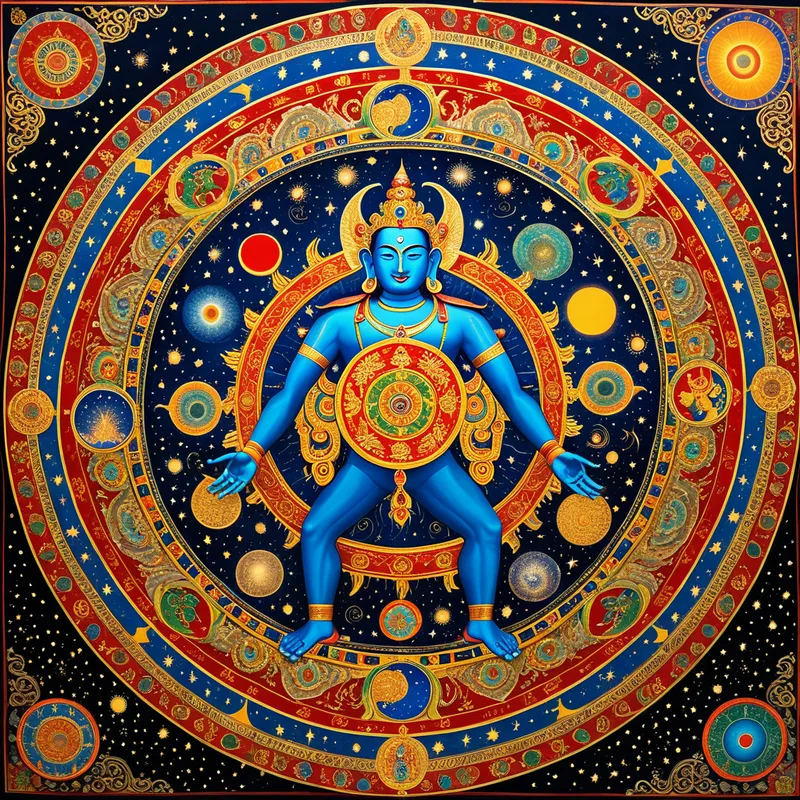
Kala Chakra Myth Meaning & Symbolism
A myth of the cosmic wheel of time, where the Buddha manifests as a wrathful deity to subdue the demon of linear time and reveal the path beyond birth and death.
The Tale of Kala Chakra
Listen, and hear the turning of the great wheel, the grinding of epochs against the silence of the void. In a time before time was measured, in the land of Shambhala, a shadow grew. It was the shadow of a king, Rudra Chakrin, the Wrathful One with the Wheel. His pride was a mountain that scraped the heavens; his power was the illusion of a fixed and fearsome order. He declared himself master of the cycles—of birth, of decay, of death—and from his fortress of concepts, he bound all beings to the relentless treadmill of suffering, the hamster-wheel of cause and effect without end.
The land groaned under the weight of this tyranny. Seasons lost their rhythm, becoming prisons. Youth was a sentence to age, and life a condemned march toward an inevitable, meaningless end. The very air thickened with the ticking of a billion internal clocks, each counting down to despair. The pleas of the trapped souls rose like incense, a bitter smoke that reached the farthest realms of compassion.
And from that boundless compassion, an answer was forged not in gentle whispers, but in a roar that shattered cosmic silence. The Buddha Shakyamuni, the one who had seen the true nature of reality, manifested in a form never before witnessed. He became Kālachakra, the Lord of Time. His body was the color of a twilight sky, deep and infinite. His many arms held the sun and moon, a sword of wisdom, and a lotus blooming in the void. His consort, Vishvamata, embraced him, their union the very engine of transcendent bliss that dissolves all duality.
With a stride that crossed kalpas, Kālachakra descended upon the kingdom of Shambhala. The earth did not tremble; instead, the fabric of illusion did. He stood before the towering fortress of Rudra Chakrin, not as an attacker, but as the embodiment of the truth the demon-king denied. A battle erupted, but it was not of swords and shields. It was a battle of visions. Rudra hurled armies of fears—fear of loss, fear of the future, fear of the end. Kālachakra absorbed them into his vast, empty sky-like nature. Rudra unleashed the ultimate weapon: the crushing, inescapable reality of linear time.
In that moment, Kālachakra raised the ultimate teaching. He did not stop time; he revealed its secret heart. He displayed the Kālachakra Mandala—a palace of exquisite geometry, where past, present, and future interpenetrated in a single, luminous now. The wheel turned, but its hub was still, its center an eternal point of peace. Confronted with this vision of reality, Rudra Chakrin’s power shattered like a mirror. His mountain of pride crumbled. He fell prostrate, not in defeat, but in recognition. The conqueror was conquered by truth, and in that submission, he was liberated. The wheel turned, not as a trap, but as a path. The tyranny was over. The teaching had begun.
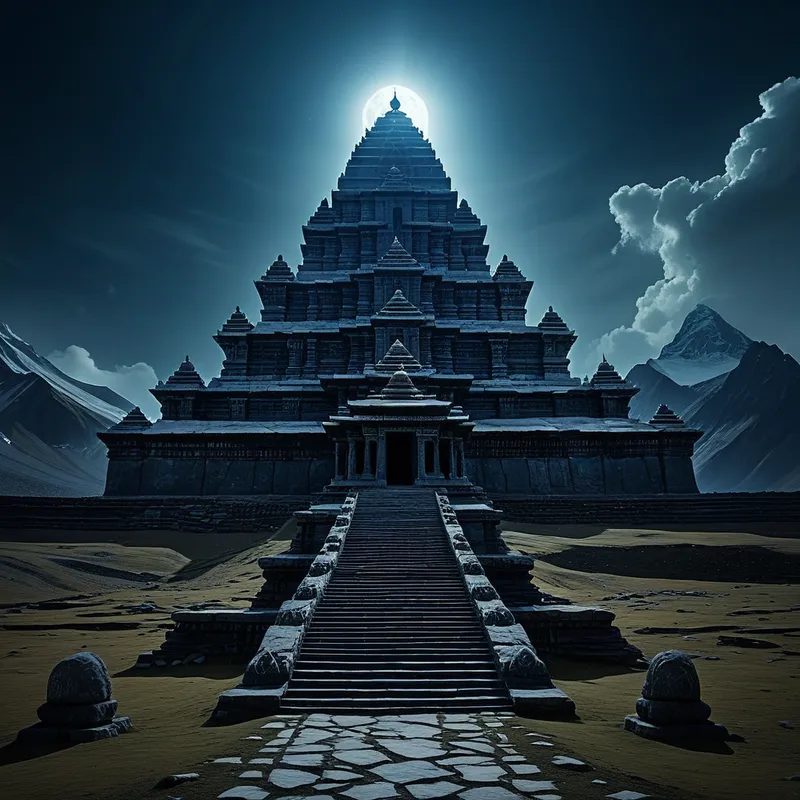
Cultural Origins & Context
The myth of Kālachakra is not a folktale of antiquity, but a living, breathing mandala of philosophy and practice. It entered the Buddhist corpus around the 10th-11th centuries CE, with its roots likely in earlier Indian tantric traditions. Its primary vehicle is the Kālachakra Tantra, one of the most complex and advanced systems in <abbr title="The "Diamond Vehicle," the esoteric branch of Buddhism">Vajrayana Buddhism.
The myth is intrinsically linked to the legendary kingdom of Shambhala, prophesied as a source of this wisdom in a future age of decline. It was passed down through tightly held lineages of masters to disciples, often in secret, requiring extensive preparation and initiation. Its societal function was dual: on an outer level, it provided a cosmological model of astronomy and astrology; on an inner, secret level, it mapped a radical psychophysiological process for using the very energies of body, breath, and mind—the "wheels within the body" or chakras—to achieve enlightenment within a single lifetime. The story of the demon-king’s subjugation is the foundational allegory for this entire transformative science.
Symbolic Architecture
At its core, the myth is a profound map of the psyche’s relationship with the ultimate source of anxiety: time itself. Rudra Chakrin is not an external devil, but the personification of the ego’s most fundamental and arrogant structure—the mind that believes in a solid, separate self moving through a linear, predatory time.
The demon of time is not a monster in the stars, but the tyrant in the synaptic pathways, insisting "I was, I am, I will be lost."
The fortress of Shambhala under his rule symbolizes a corrupted inner paradise, a psyche that has mistaken cyclical neurosis for natural order. Kālachakra’s wrathful form represents the terrifying, fierce compassion required to dismantle this deep-seated illusion. His blue body symbolizes the vast, empty sky of shunyata, the only reality spacious enough to contain time without being bound by it. The embrace with Vishvamata signifies the non-dual union of method (compassionate action) and wisdom (insight into emptiness), the alchemical engine that transmutes temporal energy into liberating bliss.
The Kālachakra Mandala is the master symbol. Its outer rings represent the cosmic cycles of planets and eras. Its inner palace, with 722 deities, maps the subtle body and mind. The entire structure is a hologram: the macrocosm of the universe, the mesocosm of the environment (Shambhala), and the microcosm of the human practitioner are one and the same. To enter the mandala through ritual and meditation is to reenact the myth internally, storming one’s own psychic fortress.
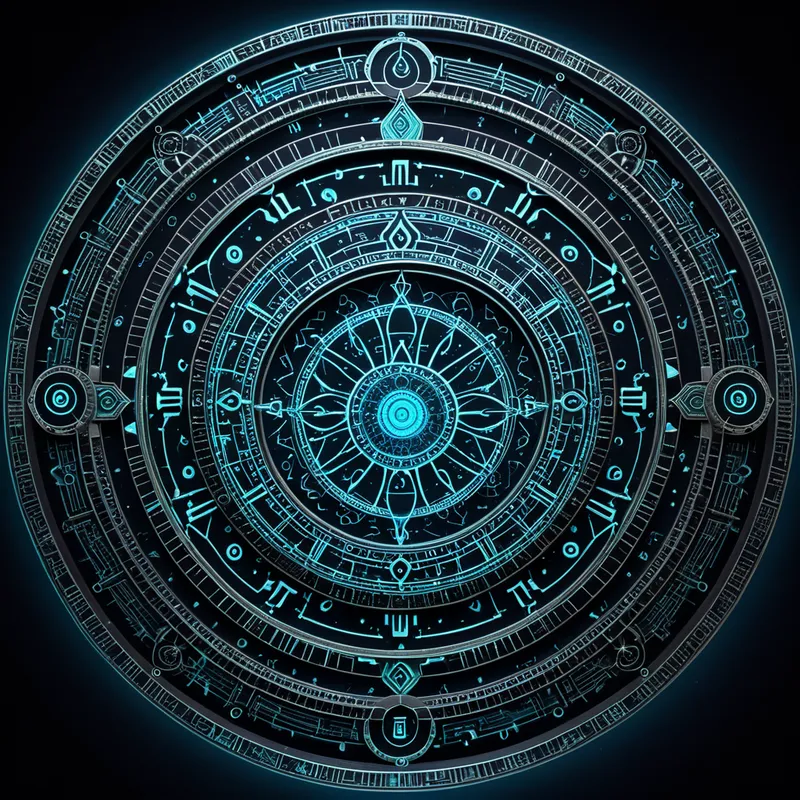
The Dreamer's Resonance
When this myth stirs in the modern unconscious, it often manifests in dreams of temporal anxiety and cosmic pressure. The dreamer may find themselves in vast, bureaucratic buildings (the fortress) where endless paperwork (karma) piles up, or on a speeding train (linear time) with no brakes, heading toward a cliff (death). The somatic feeling is one of constriction in the chest, a racing heart, a sense of being relentlessly "pushed" by an invisible force.
To dream of the crushing wheel is to feel the psyche’s revolt against the tyranny of the clock, the calendar, the biological deadline.
Alternatively, a healing resonance may appear: dreams of complex, beautiful machinery (the mandala) that operates in perfect, silent harmony; or of a serene, blue-lit space at the center of a storm. These are signals that the deep self is attempting to recenter, to find the still hub within the turning world of responsibilities, aging, and loss. The dream is initiating a process of temporal integration, where the fragmented parts of the self—the regretted past self, the anxious present self, the feared future self—are being summoned to the court of awareness to be reconciled.
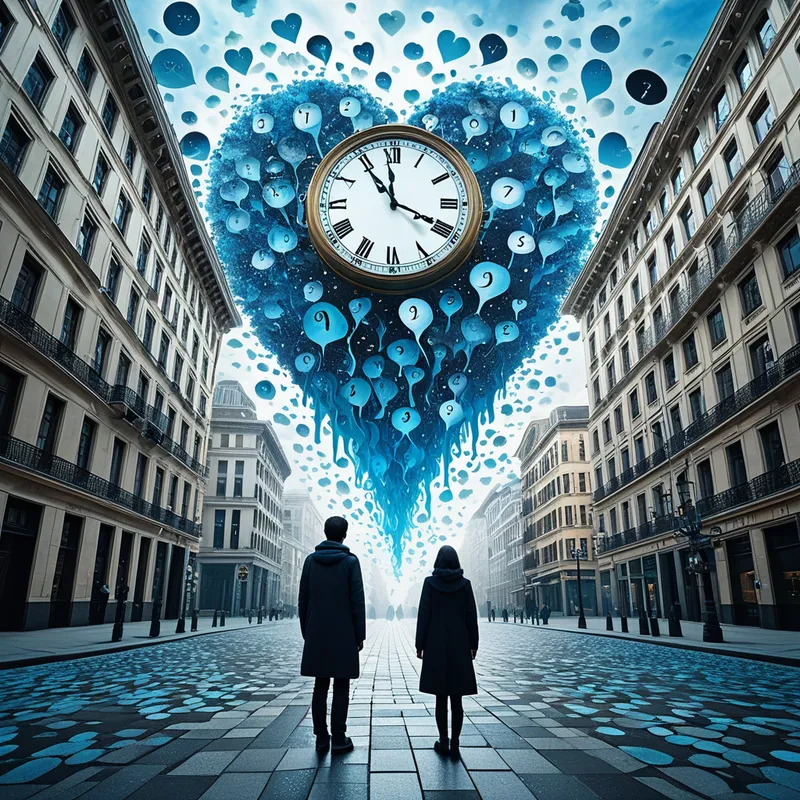
Alchemical Translation
The individuation process modeled by the Kālachakra myth is the ultimate alchemical work: the transmutation of chronos (quantitative, devouring time) into kairos (the qualitative, right moment of opportunity). It is not about defeating time, but about conquering our relationship to it.
The first stage is Recognition of the Tyrant. This is the painful, honest admission of how one’s life is governed by fear of running out of time, nostalgia for a lost past, or anxiety about a looming future. Rudra Chakrin must be seen as an internal governor.
The second is the Invocation of Fierce Wisdom. This is not passive acceptance, but an active, almost wrathful commitment to self-inquiry. One must confront temporal anxieties with the "sword" of analytical meditation, cutting through the story of "not enough time" to see the empty nature of the one who feels lacking.
The alchemy occurs in the crucible of the present moment, when the energy of regret and fear is held in the non-dual embrace of awareness and compassion, and thereby released from its narrative chain.
The final stage is Dwelling in the Mandala. This is the sustained practice of re-centering consciousness in the "still point of the turning world." Through mindfulness and advanced tantric practices (symbolized by the deity yoga of Kālachakra), one learns to experience the body’s rhythms, the breath’s flow, and the mind’s fluctuations not as enemies, but as the dynamic, playful expression of the wheel itself. The ego, like Rudra Chakrin, is not destroyed but liberated—prostrate at the center, it finally serves a purpose greater than its own survival. One becomes the sovereign of Shambhala within, where time is no longer a river to drown in, but a dance to embody. The wheel turns, and you are, at last, both its witness and its blissful, unmoving axis.
Associated Symbols
Explore related symbols from the CaleaDream lexicon: