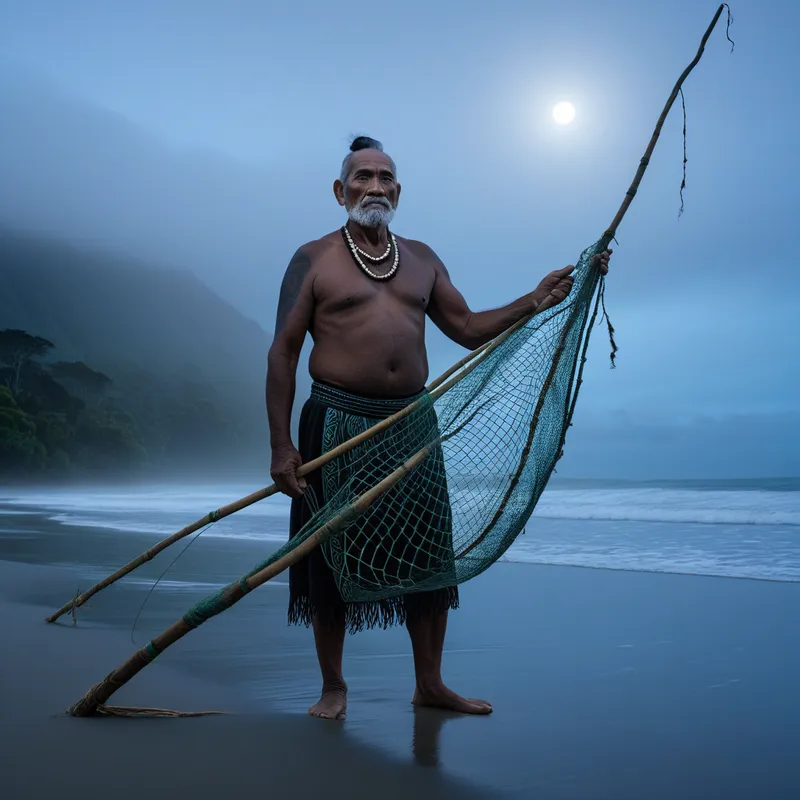
Kahukura and the Net Myth Meaning & Symbolism
A celestial ancestor witnesses the art of net-making from the Patupaiarehe, stealing the knowledge to gift it to humanity.
The Tale of Kahukura and the Net
Listen, and let the mist of Hawaiki gather around you. Let the salt spray of the Aotearoa coast sting your cheeks. Here, in the time when the world was still whispering its first names, there lived a man named Kahukura. He was no ordinary man; his lineage touched the sky, and in his veins flowed the curiosity of the stars.
One evening, as the sun drowned in the western sea and the cloak of Hine-nui-te-pō began to spread, Kahukura walked a lonely stretch of coast. The world was silent but for the sigh of the waves and the cry of a distant bird. Then, a new sound—a murmur of voices, light and fluid as water over stones. From the dense, shadowed bush emerged figures, pale as moonlight on water, with hair like flaxen cloud. They were the Patupaiarehe, the people of the mist, who shun the sun and walk only in the gloom of night or dawn.
They did not see Kahukura, for he stood as still as a watching stone. With an efficiency that spoke of ancient practice, they unrolled a great, finely meshed net—a thing of wonder Kahukura had never seen—and cast it into the booming surf. They chanted a soft, pulling chant, and when they hauled it back, it writhed and flashed with fish, a harvest from the dark belly of Tangaroa.
A fire ignited in Kahukura’s chest—not of envy, but of a profound, aching need. This art, this knowledge, could feed his people. It could turn a hungry season into one of plenty. He watched until the first grey fingers of dawn stretched across the sky. The Patupaiarehe, fearful of the sun, gathered their catch and their miraculous net and faded like dew into the forest, leaving only the memory of their work.
But Kahukura remained. He saw a single cord, a tie from their net, caught on a jagged rock. He took it. The next night, he returned, and the next, studying their knots, their throws, the rhythm of their labor. Finally, on a night when the moon was a sliver, he acted. As the pale fishermen pulled their laden net onto the sand, Kahukura, moving with the silence of an owl’s flight, took his stone blade and cut a long section from it. He fled, the precious net bundled in his arms, his heart pounding a drumbeat of triumph and terror.
He heard their cries of dismay—not angry, but filled with a sorrowful surprise—as they discovered the theft. They did not pursue him into the world of light. Kahukura ran until he reached his people. He laid the stolen net before them, this fabric of alien skill, and he showed them how to replicate it. The knowledge, once held by the spirits of the mist, now belonged to the children of the day.

Cultural Origins & Context
This myth belongs to the rich oral tradition of the Māori, specifically those iwi (tribes) of the North Island, such as Ngā Puhi. It is a pūrākau that functions as an origin story for technology—in this case, the woven fishing net (kupenga). Unlike myths that attribute inventions directly to atua (gods), this tale places the acquisition of knowledge in a liminal, risky, and deeply human (or ancestral) act of observation and appropriation.
Told by elders (kaumatua) and storytellers (kaitiaki kōrero), it served multiple societal functions. Practically, it encoded the importance and sacredness of fishing technology. Psychologically and spiritually, it explained the presence of advanced material culture as a gift obtained not from the gods of the pantheon, but from the otherworldly, elusive Patupaiarehe. This framed innovation as something existing just beyond the periphery of the known world, accessible only to those with the courage (and perhaps the moral ambiguity) to cross that boundary. The myth also reinforced the concept of tapu and the need for respect when engaging with knowledge from powerful, non-human realms.
Symbolic Architecture
At its heart, this is a myth of the threshold. Kahukura stands at the border between day and night, the human world and the spirit world, ignorance and knowledge. The net itself is the ultimate symbol of connection and interdependency—a woven matrix that captures sustenance from the chaotic sea.
The hero is not the one who invents the world, but the one who dares to steal the pattern from the dream of the Other, bearing the weight of its gift and its guilt.
The Patupaiarehe represent the unconscious, instinctual realm of primal knowledge. They work with natural efficiency, without toil or struggle, because the knowledge is innate to them. Humanity, symbolized by Kahukura, exists in a state of conscious separation from this instinctual wisdom. Our advancement requires a conscious, often disruptive, act of "theft"—of bringing what is latent in the unconscious into the light of conscious understanding and utility. Kahukura’s act is one of necessary transgression, a breaking of a natural order to establish a cultural one.

The Dreamer's Resonance
When this myth stirs in the modern psyche, it often manifests in dreams of observation, theft, or receiving forbidden gifts. You may dream of watching a skilled group from a hidden vantage point, filled with longing. You may dream of taking an object of great beauty or power from a place that feels sacred and "not yours," followed by a flight fueled by equal parts exhilaration and dread.
Somatically, this can feel like a tightness in the chest—the fire Kahukura felt—a burning desire for a skill, insight, or state of being that others possess effortlessly. The psychological process is one of differentiation. The dreamer is identifying a capacity or knowledge that exists in their own unconscious (the Patupaiarehe within) but is not yet integrated into their conscious identity. The "theft" is the arduous, often guilt-laden, process of ego-consciousness claiming that resource for itself, pulling a talent from the realm of potential into the realm of actualization.
Alchemical Translation
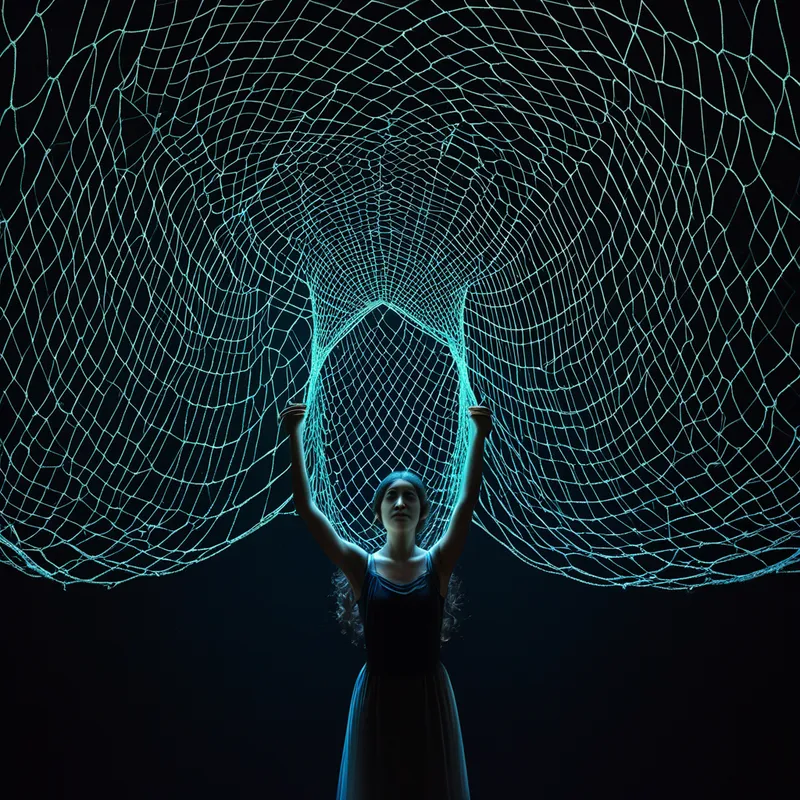
In the alchemical journey of individuation, Kahukura’s story models the stage of separatio and solutio—separation and dissolution. The conscious ego (Kahukura) must first separate itself from the undifferentiated mass of unconscious content (the night, the mist, the collective activity of the Patupaiarehe). It must then "dissolve" the old form of that content—the net as a mysterious, whole object—to understand its constituent parts and re-weave it into a form usable for the conscious personality.
The treasure is always guarded by dragons of guilt and otherness. To claim your own soul's inheritance, you must be willing to be called a thief in the court of the familiar.
The triumph is not without cost or shadow. The gift of consciousness and culture is paid for by the loss of innocent unity with the instinctual world. We gain the net, but we lose the ability to walk effortlessly in the mist. The modern individual undergoing this process moves from a state of unconscious competence (where things just work) to conscious incompetence (seeing the skill you lack), through conscious effort (the theft and study), toward a new, hard-won conscious competence. The myth assures us that this difficult, borderline-transgressive act of self-creation is the very engine of cultural and psychological evolution. We are all Kahukura, cutting a piece of the divine net to feed our own becoming.
Associated Symbols
Explore related symbols from the CaleaDream lexicon:
- Net — The central artifact of the myth, representing interconnected knowledge, the means to harvest sustenance from the unconscious (the sea), and the woven fabric of culture itself.
- Theft — The necessary, transgressive act of taking knowledge from its instinctual guardians, symbolizing the ego's assertive claim on unconscious content for conscious development.
- Night — The realm of the Patupaiarehe and the unconscious, where primal knowledge resides untouched by the discriminating light of day and conscious thought.
- Ocean — The domain of the god Tangaroa, symbolizing the vast, fertile, and chaotic depths of the unconscious from which the "fish" of insight and nourishment are drawn.
- Forest — The liminal borderland between the human world and the spirit world, a place of mystery where encounters with the Other and transformative knowledge occur.
- Dawn — The critical threshold moment when the stolen knowledge must be carried from the realm of night into the world of day, representing the integration of unconscious material.
- Gift — The ultimate result of the theft, reframing a transgressive act as a foundational boon for the community, symbolizing how personal psychological gains can serve the collective.
- Fear — The somatic and emotional companion to the act of theft, representing the natural guilt and anxiety that accompanies the separation from the unconscious and the claiming of individual power.
- Journey — Kahukura's physical and metaphysical passage from observer to actor, from the periphery to the center, modeling the essential heroic journey of acquiring and integrating new consciousness.
- Shadow — The Patupaiarehe themselves, representing the unconscious, elusive, and often feared aspects of the psyche that hold vital resources for the conscious self.