Kagami Myth Meaning & Symbolism
The myth of the divine mirror, a sacred object that reveals truth, banishes deceit, and embodies the soul's capacity for self-reflection and connection to the divine.
The Tale of Kagami
In the High Plain of Heaven, where the air was the breath of creation and the rivers flowed with amrita, the nectar of life, a shadow fell. It was not a shadow of night, for the sun goddess Amaterasu Ōmikami shone with a brilliance that banished all darkness. This shadow was one of chaos, born from the turbulent heart of her brother, Susanoo-no-Mikoto.
Driven by a tempestuous rage, Susanoo rampaged across the celestial fields. He broke the sacred rice paddies, defiled the hallowed weaving halls, and in a final, grievous act, flung a heavenly piebald horse through the roof of Amaterasu’s sacred loom. The shock, the violence, the sheer desecration of her ordered world struck the sun goddess like a physical blow.
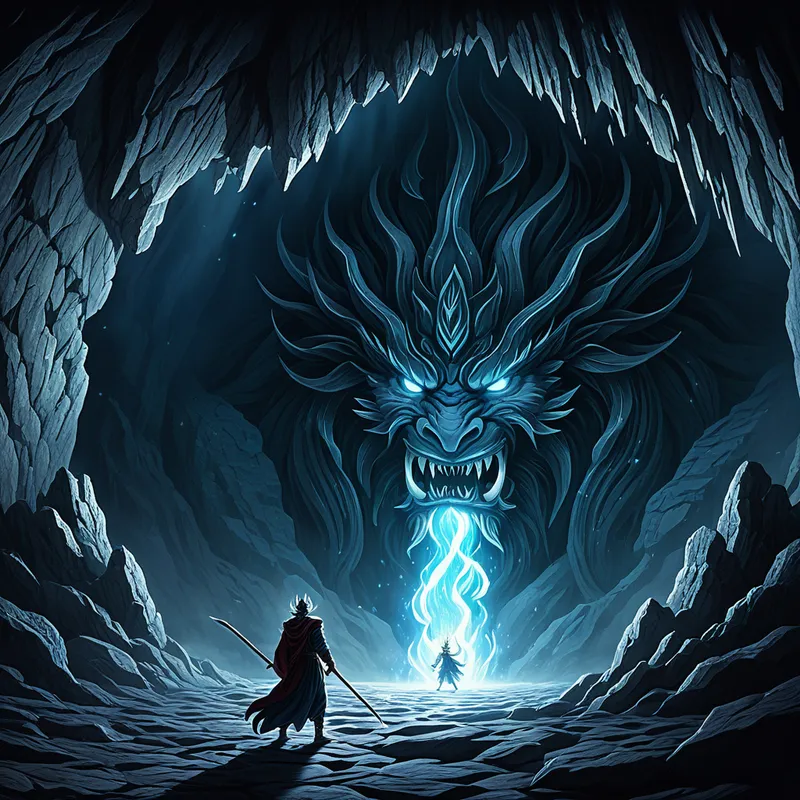
Heart shattered, spirit retreated. Amaterasu fled to the Ama-no-Iwato, a cavern carved into the living rock of the cosmos. She sealed the entrance with a mighty stone, and plunged all of creation—heaven, earth, and the myriad spirits—into an abyssal darkness. Without her light, life withered. Chaos reigned. The eight million kami wailed in despair upon the dry riverbed of heaven.
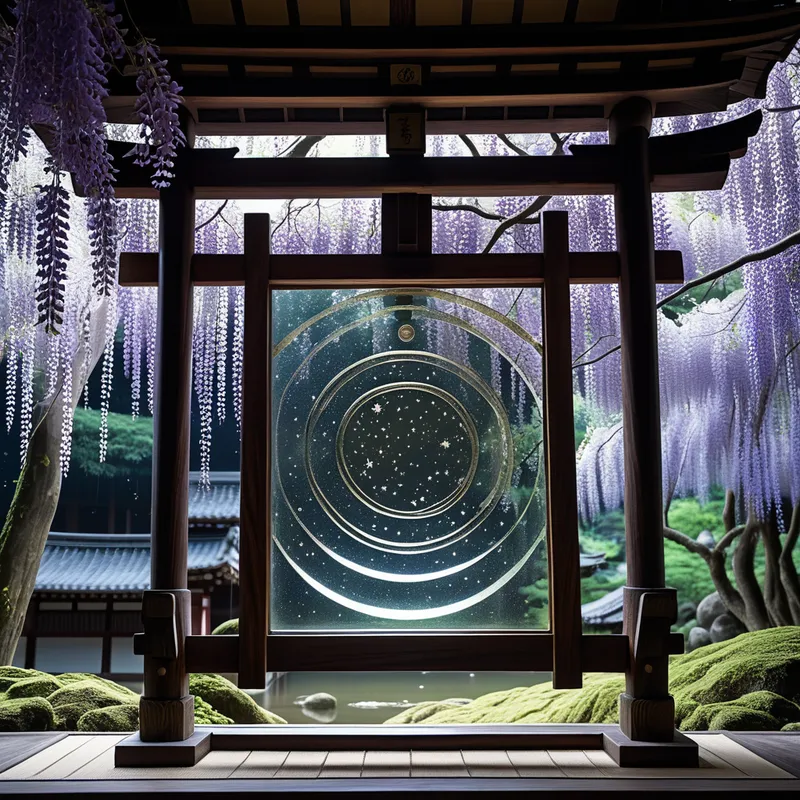
Then, the goddess of thought and artistry, Ame-no-Uzume-no-Mikoto, stepped forward. A plan was woven in the dark. The kami gathered before the sealed cave. They erected a sacred yagura and upon it, they hung the Yata-no-Kagami, a mirror of perfect craftsmanship, its surface polished to hold the very essence of light.
Uzume began to dance. She stamped upon an upturned tub, her movements becoming wild, ecstatic, a primal rhythm against the silence of the void. She shed her garments, and her divine laughter rang out, raw and infectious. The assembled kami roared with mirth, their collective joy a tangible force that shook the stars.
Curiosity, a tiny spark in the profound dark, stirred within the cave. “How can there be laughter when I am gone?” Amaterasu’s voice, faint as a whisper, echoed from behind the stone. Uzume called out, “We rejoice because a goddess greater than you has appeared!” Puzzled, Amaterasu slid the stone door open just a crack.
In that sliver of an opening, the gathered kami held aloft the Yata-no-Kagami. “Behold,” they declared. Amaterasu, peering out, saw a radiant figure of blinding majesty and perfect grace. It was her own reflection, a brilliance she had never truly witnessed. Captivated, she leaned further out, drawn to this peerless light. In that moment of profound self-recognition, the god of strength, Ame-no-Tajikarao, seized the rock door and flung it aside forever.
Light flooded back into the world. Life surged. Order was restored. And the mirror, having held and reflected the essence of the sun itself, became forever sacred, an embodiment of truth and the means by which the divine sees itself.
Cultural Origins & Context
This myth, central to the Kojiki and Nihon Shoki, is not merely a story of celestial drama. It is a foundational narrative of Shinto, Japan’s indigenous spiritual tradition. It was preserved by court chroniclers to legitimize the imperial line, which claims direct descent from Amaterasu. The Yata-no-Kagami, alongside the sword Kusanagi and the jewel Yasakani no Magatama, forms the Sanshu no Jingi, the Imperial Regalia symbolizing the emperor’s divine right and virtue.
The myth was performed and re-enacted in rituals, serving a crucial societal function: it explained the cosmic order, the necessity of ritual purity and joy (the carnivalesque dance of Uzume), and the restoration of harmony (wa) after a rupture. The mirror, enshrined at Ise Jingu, is the physical and spiritual heart of this covenant between the people, the emperor, and the kami.
Symbolic Architecture
The Kagami is far more than a plot device; it is the myth’s psychic core. It represents the principle of truth (makoto)—not as a abstract concept, but as a revealing, illuminating force. It does not create light; it gathers and reflects what is already there, forcing a confrontation with reality.
The mirror does not judge; it reveals. In its surface, the soul meets its own image, stripped of narrative and excuse.
Amaterasu’s retreat symbolizes depression, trauma, or a profound withdrawal of psychic energy—the “solar consciousness” going into eclipse. The world inside the cave is the unconscious, a place of potential but also of stagnation. The laughter and dance of the kami represent the necessary, often chaotic, life force that must be mobilized to lure the conscious self back into engagement. The pivotal moment is not an attack, but an invitation to see. The mirror provides the first objective perspective Amaterasu has ever had on her own essence. She is captivated by her own soul, and in that captivation, she is drawn out of her isolation.
The Dreamer's Resonance
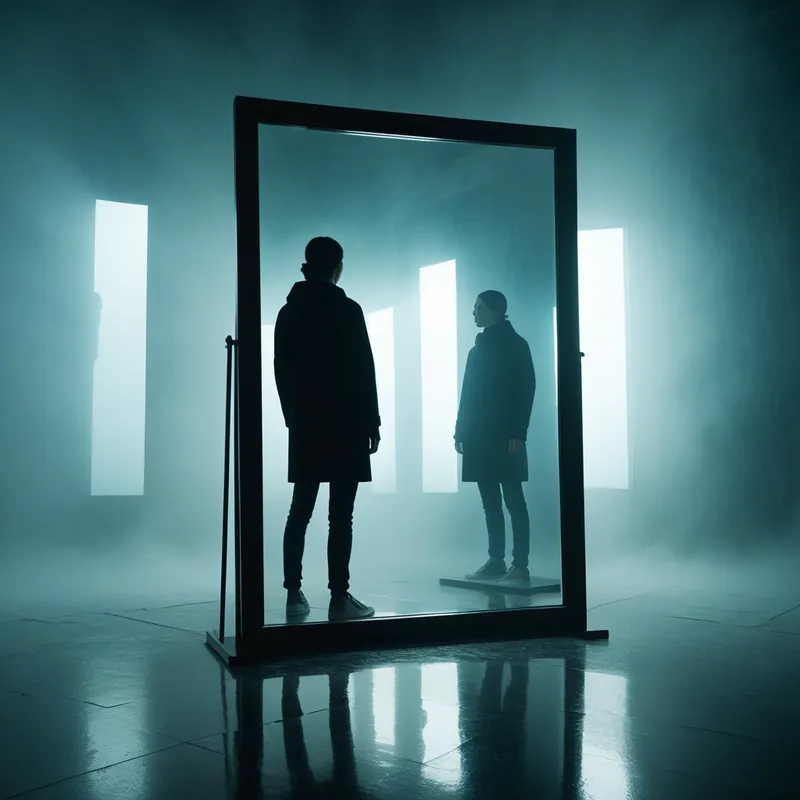
When this myth pattern stirs in the modern dreamer, it often manifests as dreams of mirrors. But these are not ordinary mirrors. They may be impossibly large, fogged, fractured, or show a reflection that is older, younger, wiser, or shadowy. The dreamer might be trying to clean a dirty mirror, avoid looking into one, or be fascinated by a light within it.
Somatically, this can feel like a tightening in the chest or a hollow feeling—the cave of the self. Psychologically, it signals a critical phase of self-confrontation. The psyche is assembling its own “gathering of kami”—memories, emotions, forgotten talents (the dancer, the strongman, the artisan)—to stage an intervention. The dream mirror is the tool of this intervention. To look into it is to engage in a radical honesty with oneself, to see not the curated persona, but the authentic, perhaps hidden, source of one’s own light and power. The resistance to look is the rock door; the compulsion to look is the divine laughter from outside.
Alchemical Translation
The myth of Kagami models the alchemical process of individuation—the journey toward psychic wholeness. The initial state is a fragile, inflated identity (the sun that thinks it is the only light). The necessary nigredo, or blackening, is Amaterasu’s retreat: a collapse into the darkness of the unconscious, a crushing but fertile despair.
The gathering of the kami and the forging of the mirror is the albedo, the whitening. It is the conscious ego (the community of psychic forces) preparing the tool of reflection—self-awareness, therapy, art, journaling—to engage with the hidden Self. Uzume’s dance is crucial; it is the embodied, irrational, joyful life force that makes the process enticing, not just a grim duty.
The triumph is not in storming the cave, but in making the cave’s occupant curious about her own brilliance.
The moment of reflection is the coniunctio, the sacred marriage. The conscious self (Amaterasu) encounters the objective Self (her reflection) and is reunited. The light restored is not the old, naive light, but a light that has seen itself and integrated its own shadow (the chaos of Susanoo). The sacred mirror, now an internalized object, becomes the permanent seat of the Self within the psyche. For the modern individual, the alchemical translation is clear: we are not healed by ignoring our darkness or by violently suppressing our chaos. We are made whole when we have the courage to construct a vessel of honest reflection, and then allow our deepest, brightest self to be captivated by the truth of what it sees there. The mirror remains, a silent sage within, always ready to show us who we are when we dare to look.
Associated Symbols
Explore related symbols from the CaleaDream lexicon: