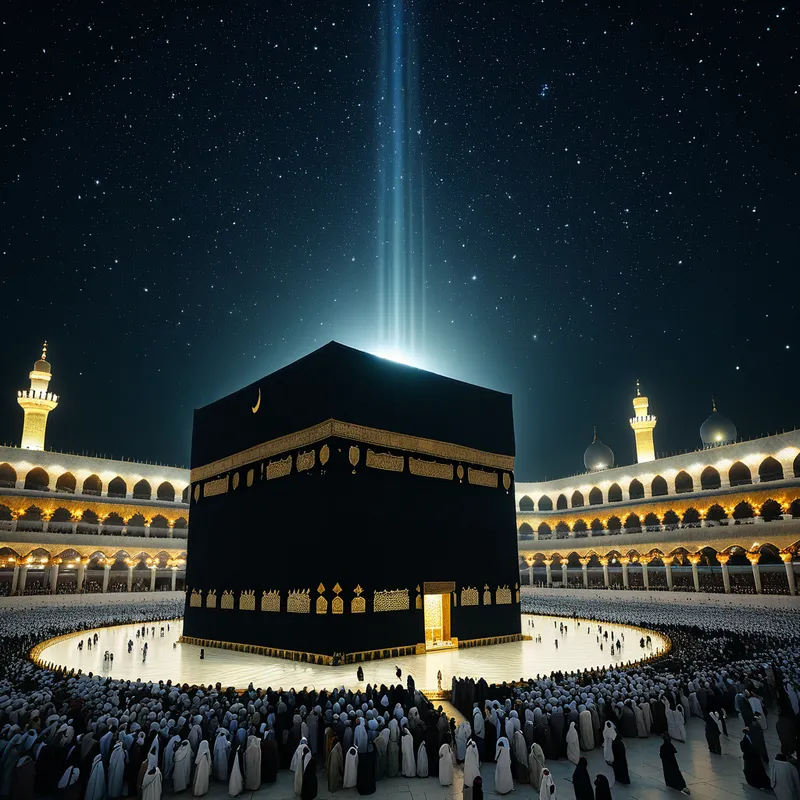
Kaaba Myth Meaning & Symbolism
A sacred story of a father and son building the first house for the One God, a primal covenant etched in stone at the world's spiritual heart.
The Tale of Kaaba
In the time before time was counted, when the desert was a sea of whispering sand and the sky a dome of unbroken blue, there walked a man chosen by the One. His name was Ibrahim, a man whose heart was a furnace of faith. He was commanded to leave all he knew, to journey with his wife Hajar and their infant son Ismail, into the barren valley of Bakkah—a place of thirst and silence.
Left with only her child and her trust, Hajar ran seven times between the hills of Al-Safa and Al-Marwah, her breath ragged, her hope a fragile thread. Then, at the foot of her crying son, the earth wept. A spring, Zamzam, burst forth, its water sweet and life-giving. The valley was no longer barren; it was blessed.
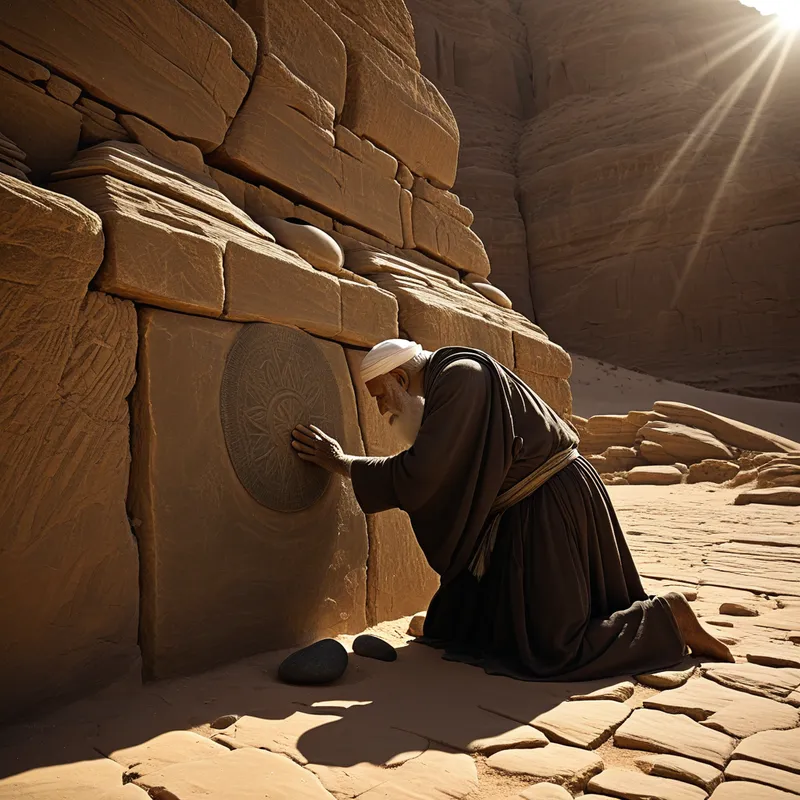
Years later, when Ismail had grown into a strong man, the call came again to Ibrahim. "Build a house for Me," spoke the Voice. "A house for all humanity, where the heart can turn and find its center." Father and son, their backs against the endless sky, began to gather stones from the surrounding hills. There was no grand design, only a divine instruction: raise a sanctuary, a simple cube, from the very earth of the valley. They worked, their hands blistering under the sun, their prayers the mortar between each rough-hewn rock. As the walls rose, a need emerged—a cornerstone. The angel Jibril brought a stone, a relic from paradise, once white as milk but now blackened by the sins of humanity. This, the Al-Hajar al-Aswad, they set into the eastern corner, a touchstone of the primordial covenant.
When the work was done, a simple, austere structure stood against the wilderness. Ibrahim climbed upon a rock, the Maqam Ibrahim, and called out to all corners of the earth: "O people! Answer your Lord!" And the call echoed through time, a summons that would never cease. The first Tawaf began, as father and son walked seven times around the house they built, tracing the orbit of devotion around the still point of the world.
Cultural Origins & Context
This narrative forms the sacred pre-history of Makkah within Islamic tradition. It is not a folktale but a foundational revelation, meticulously preserved in the Qur'an and the collected sayings and deeds of the Prophet Muhammad (ﷺ). Its primary societal function was to establish the monotheistic sanctity of a site already ancient, cleansing it of idolatry and re-anchoring it to the primordial faith of Ibrahim, the Hanif.
The story was passed down not by bards, but by prophets and scholars, serving as the spiritual charter for the Hajj pilgrimage. Every ritual act of the Hajj—the running between Safa and Marwah (Sa'y), the drinking of Zamzam water, the circumambulation of the Kaaba—is a somatic re-enactment of this myth. It binds the individual believer directly to the actions of the founders, creating a living, breathing lineage that transcends history. The myth thus functions as both an origin story and an eternal present, a template for devotion repeated by millions each year.
Symbolic Architecture
At its core, the Kaaba myth is an archetypal drama of foundation. The cube, or Kaaba, is not merely a building; it is the symbolic axis mundi, the navel of the world.
The Black Stone is not worshipped; it is kissed. It is the point of contact between human longing and divine mystery, a testament that the sacred can be encountered in the tangible, yet never contained by it.
Psychologically, Ibrahim represents the conscious ego tasked with an impossible, transcendent directive: to give form to the formless, to build a house for the uncontainable. His obedience is not passive, but a creative, collaborative act with the divine and with his son, Ismail. The desert valley symbolizes the barren, undeveloped psyche—the tabula rasa upon which a new, centered consciousness must be constructed. The spring of Zamzam is the sudden, miraculous upwelling of the unconscious, the life-giving waters of meaning and sustenance that appear only after a crisis of faith and a desperate search (Hajar's run).
The ritual of Tawaf, the circling, models the psyche's necessary orbit around a central, numinous truth. One does not enter the Kaaba; one moves around it. The Self, in Jungian terms, is not possessed; it is approached, honored, and circumambulated.
The Dreamer's Resonance
When this myth pattern stirs in the modern dreamer, it often signals a profound process of inner re-orientation or a crisis of foundation. To dream of a stark, geometric structure in a vast emptiness may reflect the soul's yearning for a center, a stable point in a life experienced as chaotic or meaningless. Dreaming of searching for water in a desert, like Hajar, speaks to a somatic experience of spiritual or emotional drought, and the body's deep intuition that sustenance must be found.
A dream of building something fundamental with a parental or ancestral figure can indicate the psyche's work in constructing a lasting value system or a stable identity, often in collaboration with internalized guides. The act of circling an object in a dream—a tower, a tree, a light—is a direct somatic resonance with Tawaf, suggesting the dreamer is psychologically "circling" a core, perhaps still unconscious, aspect of the Self, not yet ready to integrate it fully but acknowledging its central importance.
Alchemical Translation
The alchemical process mirrored here is that of coagulatio—the making solid, the formation of the sacred stone. The psychic raw material (the scattered stones of the desert, the disparate elements of a life) is gathered and assembled according to a supra-personal blueprint. The struggle is the heat of the desert sun, the weight of the stones, the sheer effort of making the intangible tangible.
The triumph is not in finishing the house, but in answering the call to build it. The individuation journey is the pilgrimage itself, the repeated turning towards the center, not the acquisition of the center.
For the modern individual, the myth translates into the arduous, lifelong work of building a coherent personality around a central, numinous principle—be it love, truth, justice, or faith. This principle often feels "given" (the divine command), not self-invented. The "Ishmael" within is that part of our nature—our instinct, our resilience, our future lineage—that must collaborate with the guiding "Ibrahim" consciousness. The "idols" that once cluttered the sacred precinct (pre-existing beliefs, societal conditioning, personal complexes) must be cleared away to make space for this simple, austere, and foundational structure. The ultimate goal is to become, oneself, a living sanctuary—a centered being from whom a call to meaning can emanate, turning the barren valley of the world into a place of pilgrimage.
Associated Symbols
Explore related symbols from the CaleaDream lexicon: