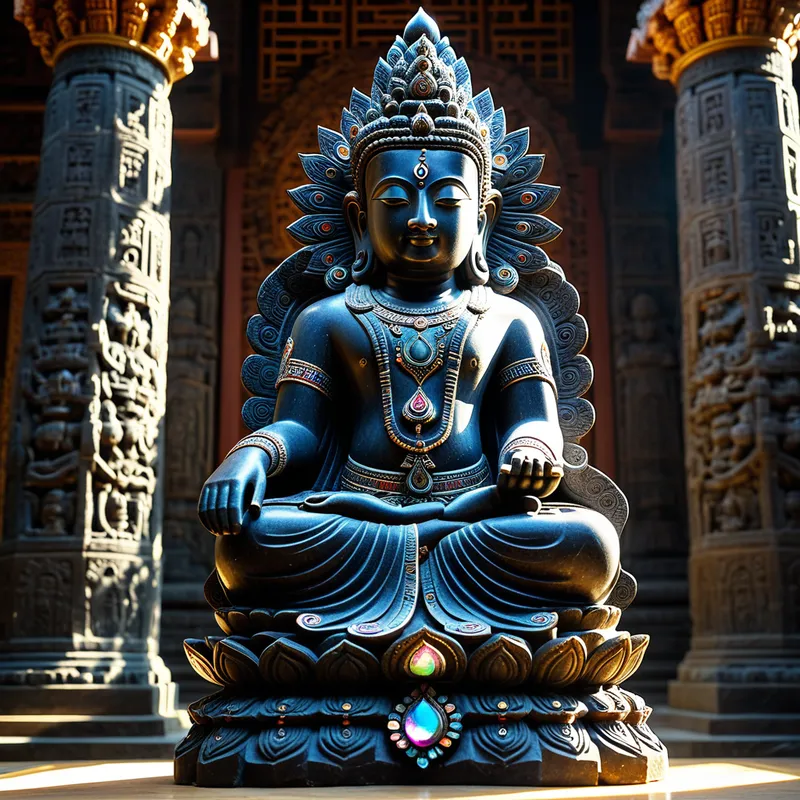
Ka Statues Myth Meaning & Symbolism
The myth of the Ka Statue reveals the ancient Egyptian understanding of the soul's double, a divine essence housed in a sacred vessel for eternity.
The Tale of Ka Statues
Listen, and hear the whisper of stone that is not stone, the breath within the statue that never draws air.
In the time when the gods walked close to the black earth of Kemet, the sun Ra sailed his barque across the sky, and the Nile’s heartbeat was strong, there lived a truth known to every king and commoner alike: a man is not one, but two. There is the body that walks, eats, and tires—the khat. And there is the vital force, the divine spark, the essential self—the Ka.
But the Ka is a hungry ghost. It is born with you, a gift from the gods, yet it dwells in the realm of perfect forms. When death comes, a great tearing occurs. The khat fails, and the Ka is cast adrift, a royal exile from its own palace. It wanders the twilight between worlds, thirsting, starving for the essence of life it once knew.
This is the terror. This is the silence that followed every life.
So the wise ones, the priests of Ptah, and the artists touched by his grace, devised the sacred remedy. They did not build tombs merely as storehouses for wealth, but as eternal homes. And at the heart of this home, in the sealed, silent chamber known as the serdab, they placed the vessel.
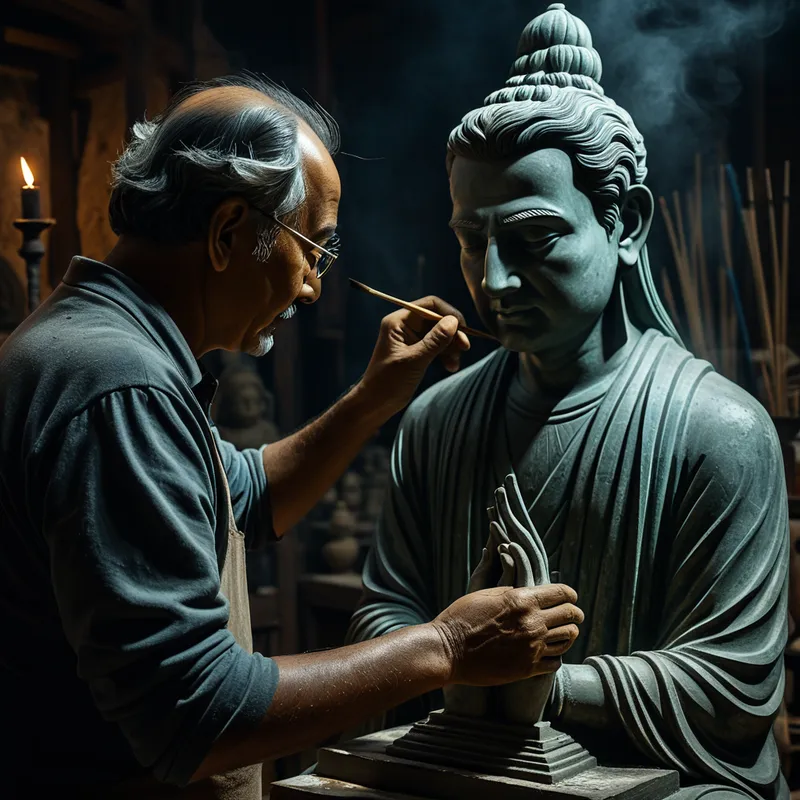
The sculptor was not a mere craftsman but a priest of form. He sought not to flatter, but to capture the essential likeness—the brow as it expressed thought, the set of the mouth that revealed character, the posture of a life lived. The stone was chosen with care: enduring diorite, warm limestone, or imported cedar. The work was a ritual. Each chip of the chisel was an invocation.
The final act was the Opening of the Mouth. The chief lector priest, his voice echoing in the incense-heavy air, would touch the statue’s lips with sacred adzes and rods. He would call upon Anubis and Horus. He did not say, “Be alive.” He said, “You have your mouth. You have your eyes. You have your Ka.”
And in that moment, the statue ceased to be an object. It became a house. A door. The wandering Ka, hearing its name and seeing its perfect, unchanging face rendered in eternal stone, had a place to enter. It could descend, take residence, and receive the offerings—the bread, the beer, the incense—that sustained it forever. The statue did not represent the person; it was a body for the person’s immortal essence. The cycle of life, severed by death, was restored by art and ritual. The silence was broken by the eternal presence in the serdab, a presence that watched, received, and simply was, forever.
Cultural Origins & Context
The concept of the Ka is one of the most ancient and foundational in Egyptian theology, predating the pyramids. It was not an abstract philosophy but a practical, lived reality that shaped society from the Early Dynastic Period onward. The myth of the Ka statue was not a single narrative told around a fire, but a complex of beliefs enacted through state religion, funerary practice, and royal ideology.
It was passed down through the rigid, formalized training of priests and artisans within temple and palace workshops. The knowledge was liturgical and technical. The function was profoundly societal: to ensure the eternal well-being of the deceased, yes, but also to maintain cosmic order (Maat). A properly cared-for Ka of a pharaoh meant a king who could still intercede with the gods for the benefit of Egypt. On a personal level, for those who could afford it, it was the ultimate act of self-preservation and familial duty. The statue was the anchor point for the soul’s continuity, making the tomb a true “house of eternity.”
Symbolic Architecture
At its core, the Ka statue myth is a profound meditation on the architecture of identity. It posits that the self is not unitary but dualistic, comprising a temporal, perishable component and an eternal, essential counterpart.
The Ka is the blueprint of the self, the divine imperative of "you-ness" that exists before birth and demands a home after death.
The statue, then, is the ultimate symbol of the vessel. It is not the content (the Ka), but the container that makes the content viable in a given realm. Psychologically, this speaks to our need for a stable, enduring structure to house our core identity—a consistent ego-structure that can interface with the world. The serdab, the hidden chamber, mirrors the unconscious itself: a protected, inner sanctum where the most authentic self resides, unseen but fundamentally sustaining.
The ritual of the Opening of the Mouth symbolizes the activation of potential. The raw material (stone, wood) holds a latent possibility, which is realized only through a conscious, sacred act. This translates to the psychological process of bringing an unconscious aspect of the self into conscious realization, giving it a "voice" and a means to interact with the psyche.
The Dreamer's Resonance
When this mythic pattern stirs in the modern unconscious, it often manifests in dreams of doubles, mirrors, or idealized statues. To dream of encountering a perfect, stone version of oneself is not necessarily a nightmare, but a profound confrontation.
Somatically, it may be accompanied by a feeling of eerie recognition, stillness, or a chilling awe. Psychologically, the dreamer is facing their own Ka—their essential, perhaps neglected, self. The statue represents the part of the identity that feels eternal, true, and yet somehow frozen or inaccessible. The dream may highlight a disconnect: the waking ego (the wandering, hungry Ka) feels lost, while the true potential (the statue) sits dormant in a sealed chamber of the psyche. The dream is an invitation from the unconscious to perform your own "Opening of the Mouth" ritual—to acknowledge, animate, and integrate this static, essential self into the flow of daily life.
Alchemical Translation
The alchemical journey modeled by the Ka statue myth is the opus of individuation—the process of becoming the unique, integrated individual one is meant to be. The initial state is one of primal division: the conscious ego (the mortal body) is separated from its divine counterpart, the Self (the Ka). This is the nigredo, the blackening, the experience of psychic death, meaninglessness, or fragmentation.
The creation of the statue is the albedo, the whitening. It is the conscious work of crafting a vessel—a stable, enduring psychological structure—based on the true, essential form of the Self, not the fleeting masks of the persona.
The sculptor’s careful work is the disciplined practice of self-knowledge: meditation, therapy, art, or any practice that seeks to discern the authentic shape of one’s being beneath the accretions of conditioning. The ritual of animation is the rubedo, the reddening. It is the moment of integration, where the vital essence descends into the crafted form. Psychologically, this is the embodied realization, the moment when insight becomes lived reality. The ego consciously aligns with and becomes a vessel for the greater Self.
The final state is not a static eternity, but a sustained relationship. The offerings—the bread and beer—symbolize the ongoing commitment required. For the modern individual, these are the daily practices, reflections, and acts of integrity that "feed" the connection between the conscious life and the deep, enduring Self. The myth teaches that immortality is not about avoiding death, but about building, through conscious effort and sacred intention, a vessel so true that the essence of who you are can find a home forever within your own life.
Associated Symbols
Explore related symbols from the CaleaDream lexicon: