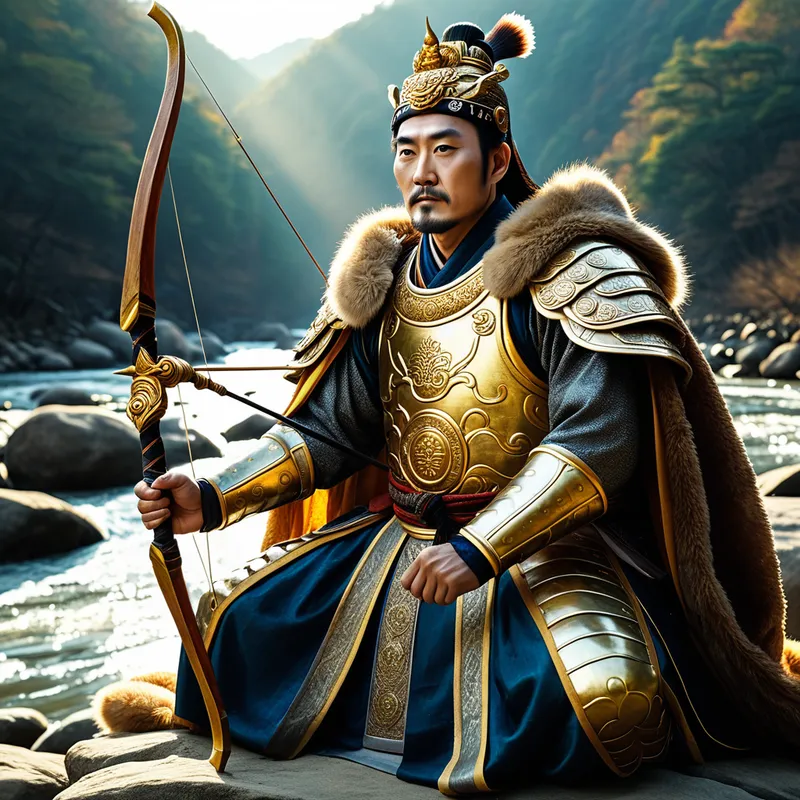
Jumong Founder of Goguryeo Myth Meaning & Symbolism
A myth of divine conception, exile, and destiny, where a son of heaven and river overcomes betrayal to found a kingdom from a single arrow.
The Tale of Jumong Founder of Goguryeo
Hear now the tale sung when the world was younger, when the spirits walked closer to the earth and the fate of kingdoms was written in the flight of an arrow.
In the land of Buyeo, under a sky heavy with portent, King Geumwa received a miraculous gift. A maiden of unearthly beauty, Yuhwa, was found by the river, bathed in a light that was not of the sun. She spoke of a celestial encounter, of being touched by the breath of Haemosu who descended in a golden chariot. For this, she was cast out from the heavens, her radiance now confined to the mortal realm. The king, captivated, brought her into his palace, but she remained untouched by mortal hands, a vessel of a divine secret.
In time, a beam of sunlight pierced her chamber. Where it fell upon her, a child quickened in her womb. When the boy was born, his cry was the sound of thunder on the plains. They named him Jumong. From his first breath, he was extraordinary. He grew not by months but by deeds, his skill with the bow unmatched; at seven, he crafted his own arrows, each one flying true as a kingfisher to its prey. But his brilliance cast long shadows in the halls of Buyeo. The sons of King Geumwa, Daeso and Yongpo, watched with hearts curdling into envy. They saw not a brother, but a usurper of sunlight, a threat to their inherited twilight.
Whispers became plots. Traps were laid in the hunting grounds—sabotaged saddles, poisoned flasks. Yet Jumong, guided by an instinct sharper than his arrows, evaded them all. His mother, Yuhwa, whose eyes held the sorrow of two worlds, finally spoke the warning that had been gathering like storm clouds. “My son,” she said, her voice the murmur of the river from which she came, “this soil is sown with jealousy. Your roots are elsewhere. You must flee. Cross the waters, and found your own destiny.”
With a heart heavy yet resolute, Jumong chose three loyal companions—Oyi, Mari, and Hyeopbo. They fled at dawn, the hooves of their horses beating a desperate rhythm toward the Ubal River. Behind them, the thunder of pursuit; before them, the impassable, wide waters, surging as if to bar the way of fate itself.
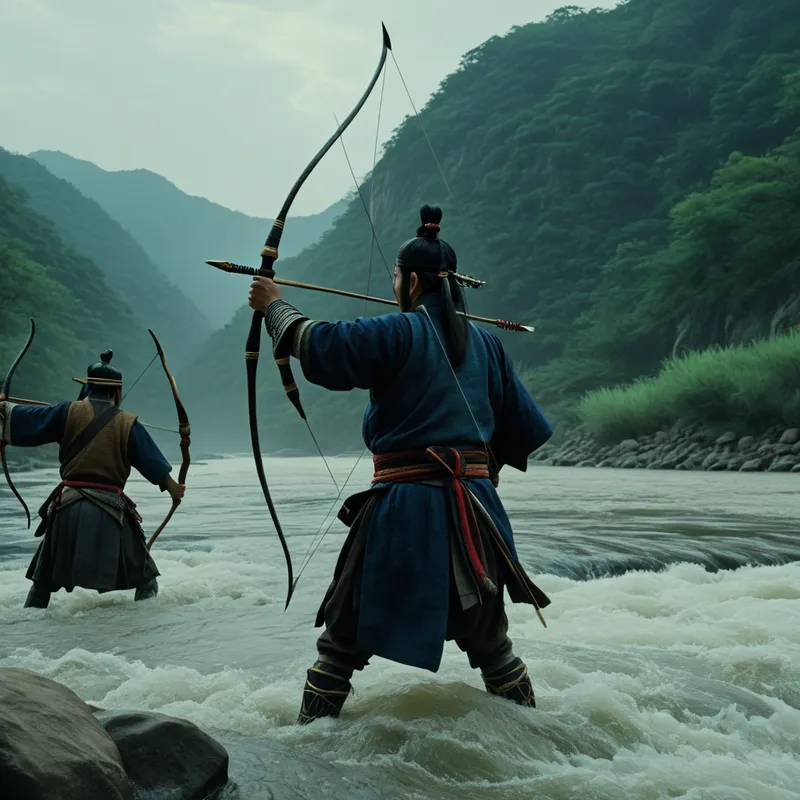
At the river’s edge, with no boat and the cries of his brothers’ soldiers closing in, Jumong raised his face to the heavens. He called upon the legacy of his blood—the sky father and the river mother. “I am the son of Haemosu! If my destiny is true, let the turtles and the fish of this river rise and make me a bridge!”
The waters churned. From the depths, creatures of scale and shell surged upward, locking together, forming a trembling, living causeway across the torrent. The party crossed in awe, and as the last hoof left the miraculous bridge, it dissolved back into the current, leaving their pursuers stranded on the far shore.
In the new land, Jumong took an arrow from his quiver. He drew his great bow, the wood groaning with potential. “Where this arrow falls,” he declared, “there shall be our capital, the heart of our kingdom.” The arrow sang through the air, a streak of light and intention. It flew far, farther than any mortal shot, and plunged into the side of a mountain. There, on that hallowed ground, they built the fortress of Jolbon. And so, from exile and a single, fateful shot, the great kingdom of Goguryeo was born.
Cultural Origins & Context
The myth of Jumong is the foundational narrative of Goguryeo, a powerful kingdom that flourished in northern Korea and Manchuria from 37 BCE to 668 CE. It is preserved in the Samguk Sagi (History of the Three Kingdoms) and the Samguk Yusa (Memorabilia of the Three Kingdoms), texts compiled centuries later but drawing on far older oral traditions. These stories were not mere entertainment; they were the sacred charter of a people, recited by court historians and shamans to legitimize the ruling dynasty by connecting it directly to the divine (Cheon).
The myth served a crucial sociopolitical function: it transformed a historical process of migration, conflict, and state formation into a cosmic inevitability. By framing Jumong as a son of heaven and a river spirit, the narrative established an unassailable cheonming (mandate of heaven) for Goguryeo’s rulers. His exile from Buyeo mirrors a classic pattern of the younger, divinely-favored son overcoming the entrenched, envious elder siblings—a metaphor for Goguryeo’s own emergence and assertion of power against established neighbors. The tale was a tool for unity, a story that told the Goguryeo people they were not merely inhabitants of a land, but children of a destiny forged by a hero who commanded the very elements.
Symbolic Architecture
At its core, the myth of Jumong is a profound map of individuation—the psychological process of becoming who one is destined to be, against all opposition. Jumong is the archetypal Divine Child, born of a union between the transcendent (Haemosu) and the immanent (Yuhwa). He embodies the potential wholeness that exists when spirit and nature, sky and water, are conjoined.
The hero’s journey begins not with a call to adventure, but with a sentence of exile. The place that cannot contain your light is not your home.
The envy of his stepbrothers, Daeso and Yongpo, represents the oppressive force of the stagnant status quo, the collective shadow that seeks to suppress the unique and destined Self. His flight is not cowardice, but a necessary separation from the collective psyche of his birthplace to establish his own consciousness. The Ubal River is the ultimate threshold, the boundary between the old, constricted life and the new, uncharted potential. The miraculous bridge of creatures signifies that when one aligns with one’s true destiny, the unconscious itself (the creatures of the deep) rises to support the passage.
The final, defining act is not conquest, but foundation through focused intention—the shooting of the arrow. This symbolizes the conscious act of choice and commitment that translates potential into reality. The arrow is the directed will, and the place it strikes is the point where the inner Self chooses to manifest in the outer world.
The Dreamer's Resonance
When the pattern of Jumong stirs in the modern psyche, it often manifests in dreams of profound transition under duress. One might dream of being pursued by faceless authorities or family members through a familiar landscape that suddenly ends at a vast, uncrossable body of water. The somatic feeling is one of trapped panic mixed with a strange, burgeoning certainty.
This dream-state signifies a critical psychological impasse. The “Buyeo” of the dreamer’s life—be it a career, a relationship, an identity, or an internalized belief system—has become hostile to their growth. The jealous “brothers” are often internalized voices of criticism, comparison, or familial expectation that sabotage one’s unique gifts. The dream is a signal that the psyche has reached its Ubal River; the old way is untenable, and a leap—a total reorientation—is required.
The healing, or the resolution of this dream pattern, comes not from fighting the pursuers, but from turning toward the impossible boundary and, like Jumong, invoking one’s own deeper resources. It is the moment in therapy or introspection when one stops trying to fix the old situation and instead asks, “What is my arrow? Where is my true ground?” The dream invites a declaration of sovereignty over one’s own life.

Alchemical Translation
The alchemy of the Jumong myth models the complete cycle of psychic transmutation. It begins with the Conjunctio, the divine marriage of opposites (sky/river) that produces the golden child, the nascent Self. This is followed by the Nigredo, the blackening: the persecution, the envy, the dark night of exile where the precious Self is threatened and forced into flight.
The crossing of the river is the Albedo, the whitening or purification. It is the letting go, the surrender to a power greater than the ego (the helping creatures of the unconscious), which allows passage from the known to the unknown. One is washed clean of old loyalties that have become prisons.
The kingdom is not found; it is founded. Individuation is not a discovery, but a deliberate act of creation upon the ground your own truth has claimed.
Finally, the shooting of the arrow and the founding of Goguryeo represent the Rubedo, the reddening or culmination. This is the stage of conscious, embodied creation. The diffuse energy of potential (the bowstring drawn back) is focused into a single, purposeful act (the released arrow). The kingdom that arises is the integrated personality—a Self-governed, resilient, and creative psyche, established not by chance, but by the unwavering aim of one’s deepest will upon the landscape of reality. The myth teaches that our highest destiny is not to inherit a pre-ordained throne, but to become the archer-king who, from the raw materials of exile and struggle, founds a kingdom worthy of the soul.
Associated Symbols
Explore related symbols from the CaleaDream lexicon:
- Arrow — The directed will and focused intention of the Self, the singular act that translates destiny from potential into manifest reality, marking the center of one's psychological kingdom.
- River — The powerful boundary of the unconscious and the flow of life; a sacred threshold that must be crossed to move from a constricted old identity into a new, destined existence.
- Exile — The necessary, painful separation from the familiar collective (family, tribe, old self) required for the individuated Self to emerge and claim its own sovereignty.
- Bridge — The miraculous connection forged by the unconscious between the old life and the new possibility, appearing only when one fully commits to the journey of destiny.
- Sun — The divine father principle, transcendent consciousness, and the illuminating destiny that seeks embodiment in the mortal world through the heroic individual.
- Horse — The instinctual energy and mobility of the psyche, carrying the hero away from persecution and toward his fate with speed and vital power.
- Mountain — The enduring, foundational ground of the Self where the arrow of purpose lands; the stable, elevated center from which one surveys and governs one's inner kingdom.
- Blood — The lineage of destiny and divine inheritance; the mysterious, potent connection to ancestral and spiritual powers that flows through the hero, setting him apart.
- Destiny — The inescapable, archetypal pattern seeking fulfillment through the individual, a pull from the future that is felt as a calling or a fate that must be forged.
- Crown — The achieved sovereignty of the integrated Self, the psychological authority earned not by birthright in the old world, but by foundational action in the new.