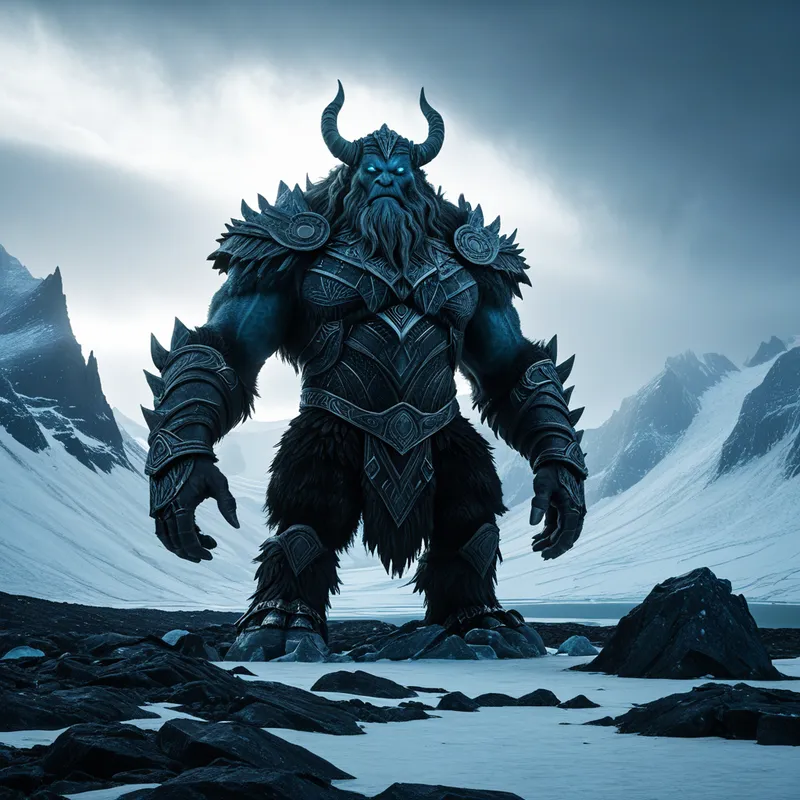
Jotunheim Myth Meaning & Symbolism
The mythic realm of primal giants, representing the untamed chaos and raw potential that the ordered world of the gods must confront and integrate.
The Tale of Jotunheim
Listen, and let the fire’s crackle become the groan of ancient ice. Beyond the ordered realms of gods and men lies a land where the world’s bones break the sky. This is Jotunheim, a realm of crushing mountains, rivers of grinding stone, and forests so deep they swallow light and time. Here, the air is a blade, and the earth remembers the first scream of creation.
In the high halls of Asgard, where mead flows and the Bifröst shimmers, the gods speak in whispers of that eastern waste. For from Jotunheim’s womb came the first beings, the Ymir, and from its shadows creep those who would see the gods’ works undone: the jötnar. They are not mere brutes, but forces—Mimir holds a head of whispers, Gridr lends her strength, and Loki, the trickster, walks among the Æsir as both blood-brother and herald of ruin.
The tale is not of one battle, but of an eternal tension. It is Odin, one-eyed and raven-cloaked, venturing into those frozen fastnesses. He does not go to conquer, but to seek. He journeys to the foot of the Yggdrasil where it sinks its roots into Jotunheim’s wells, to trade an eye for a drink from Mímisbrunnr. The giant’s price is steep, but the god pays, for wisdom is often found in the lands of your enemies.
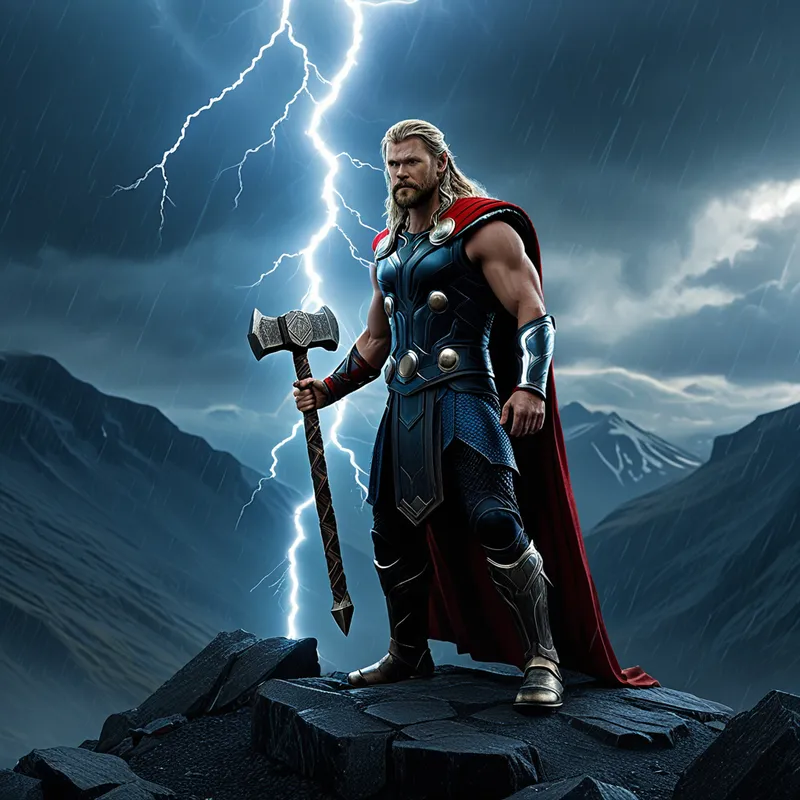
It is Thor, whose chariot tears the sky, who rides to Jotunheim with thunder in his heart. He goes to answer challenge, to break skulls with Mjölnir, to fish for the Midgard Serpent from a jotun’s boat. His is the raw, roaring confrontation. In these lands, his mighty strength is tested by cunning—a drinking horn connected to the sea itself, a cat that is the world-serpent in disguise, an old woman who is Old Age incarnate. He returns, not always victorious, but reminded that brute force meets its match in primordial trickery.
And it is in the final, gathering twilight, the Ragnarök, that the tension snaps. From the gates of Jotunheim, the hosts will march: Surtr with his flaming sword, the frost-giants on ships of dead men’s nails, Fenrir and the Jörmungandr, Loki at their helm. They are the chaos that was never banished, only held at bay, now returning to meet the gods on the plain of Vígriðr. In that last clash, the ordered world will burn and drown, not in meaningless destruction, but in a necessary, terrible cleansing. From the silence after, the sagas whisper, new green will rise.
Cultural Origins & Context
These stories did not live in books, but in the smoke of longhouses and the spray of the North Sea. They were the province of skalds—poet-historians who wielded complex meters like weapons, preserving the lore of kings and gods. The myths of Jotunheim were not children’s fables; they were a sophisticated cosmological and psychological map for a people intimately acquainted with a hostile, sublime environment.
The Norse worldview was not one of good versus evil in a simplistic sense. The jötnar were not devils. They were the other, the embodiment of the untamed wilderness, the destructive yet creative chaos that existed before order. The gods themselves were descended from giants, and frequently intermarried with or sought wisdom from them. Jotunheim represented the fundamental, amoral power of nature—the avalanche, the volcano, the crushing winter, but also the fertile soil and the raw matter of creation. The myths served to explain the precariousness of cosmic and social order, which required constant vigilance, sacrifice, and even negotiation with the very forces that threatened it.
These narratives were compiled primarily in 13th-century Iceland, in texts like the Poetic Edda and the Prose Edda of Snorri Sturluson. While filtered through a Christian lens, they retain the stark, non-sentimental character of the earlier pagan worldview. The function was to bind the community to a vision of a universe where heroism was defined by facing inevitable doom with courage, and where wisdom was purchased at a terrible personal cost.
Symbolic Architecture
Jotunheim is the psychological and symbolic shadow of Asgard. It is everything the conscious, ordered self seeks to suppress or control: raw instinct, chaotic emotion, unbridled creativity, and the terrifying knowledge of mortality and limitation.
The giant is not what we fight, but what we refuse to name within ourselves. To journey to Jotunheim is to dare the descent into one's own foundational chaos.
The gods’ various journeys there map different attitudes toward the unconscious. Odin’s quest is one of assimilation; he willingly sacrifices a part of his sovereign self (his eye) to gain the deep, watery wisdom of the well. This is the ego making a pact with the unconscious for greater insight. Thor’s adventures, by contrast, are often exercises in projection and confrontation. He externalizes the shadow as a monster to be smashed, only to find its nature is elusive, symbolic, and ultimately unconquerable by sheer force. His struggles illustrate the futility of trying to simply overpower the depths of the psyche.
The giants themselves symbolize specific aspects of this inner wilderness. The frost-giants represent stagnation, cold intellect devoid of feeling, and psychic inertia. The fire-giant Surtr embodies the purging, transformative, and potentially destructive fire of repressed passion or rage. The landscape—the frozen wastes, the impossible mountains—is the felt sense of the unconscious: vast, indifferent, and structured by a logic alien to the waking mind.
The Dreamer's Resonance
When the imagery of Jotunheim erupts into modern dreams, it signals a profound encounter with the personal or collective shadow. The dreamer may find themselves in a vast, barren, or terrifyingly majestic landscape—a psychological frontier. They may be pursued by, or must confront, a towering, often silent figure of immense power. This is not a call to battle, but a summons to recognition.
Somatically, this dream process can feel like a chilling dread, a weight of immense pressure, or a thrilling, fearful awe. Psychologically, it marks a point where repressed contents—a long-ignored talent, a festering resentment, a wild creative impulse, or a fundamental truth about one’s nature—are demanding acknowledgment. The giant in the dream does not wish to destroy the dreamer; it wishes to be seen. To flee is to consign that energy to continue acting autonomously, often in sabotaging ways. To stand and face it is the first step in the alchemical process of integration.
Alchemical Translation
The myth of Jotunheim models the indispensable, terrifying stage of psychic transmutation known as nigredo. It is the journey into the prima materia—the chaotic, base matter of the soul from which the gold of individuation is forged.
Individuation does not begin in the light of consciousness, but in the willing descent into the personal Jotunheim—the inner realm of all we have deemed monstrous, chaotic, and other.
The alchemical process mirrored in the myth involves three key operations. First, Solutio (dissolution): the ego’s structures are challenged and broken down by the chaotic waters of the unconscious, much as Thor’s might is dissolved by the magical challenges of the giants. Second, Separatio (separation): discerning what in this chaos is merely destructive dross and what is vital, creative potential, as Odin separates the essential wisdom of Mimir’s well from the surrounding danger. Finally, Coniunctio (union): the conscious mind integrates a piece of this shadow energy, not to become a giant, but to become more wholly human. The god gains a giantess as a wife; the seeker gains a fierce integrity.
For the modern individual, this means that growth is not found by perpetually fortifying the walls of Asgard—our persona and defenses—but by making periodic, courageous forays into our inner wilderness. We must trade our one-eyed certainty for deeper vision, face our thunderous rages not to vanquish them but to understand their source, and ultimately acknowledge that the giants of our psyche are our kin. They hold the raw, untamed power that, when integrated, fuels true creativity, resilience, and wisdom. The final Ragnarök in our personal myth is not an end, but the catastrophic yet necessary death of an outworn self-structure, making way for a new, more authentic consciousness to be born from the icy, fertile silence.
Associated Symbols
Explore related symbols from the CaleaDream lexicon: