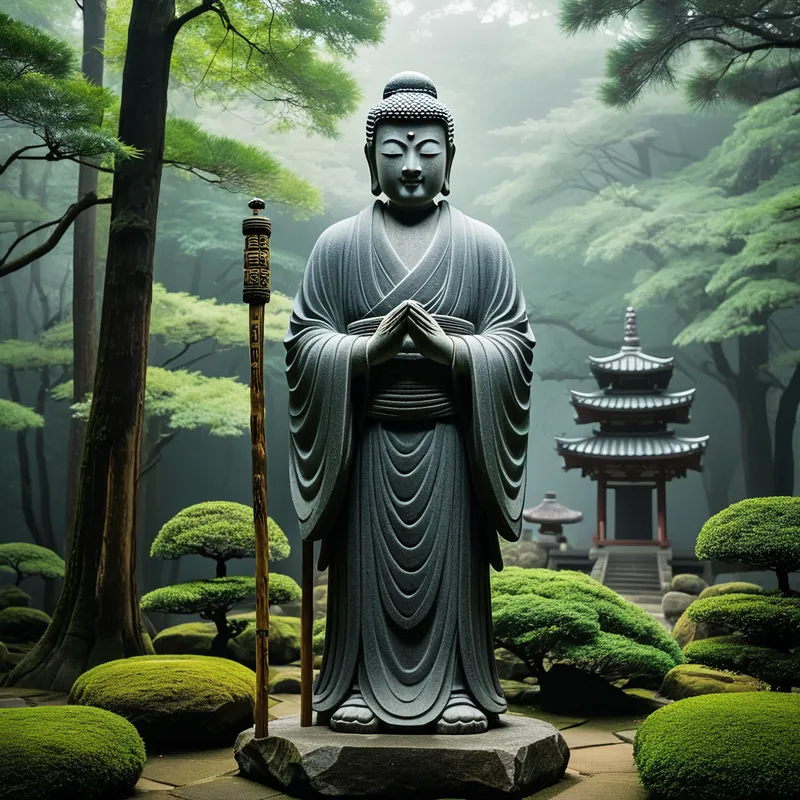
Jizo Myth Meaning & Symbolism
The compassionate Bodhisattva Jizo vows to rescue all beings from suffering, especially children, embodying the eternal promise of mercy in the face of profound loss.
The Tale of Jizo
Listen, and hear a tale not of thunderous gods, but of a quiet vow that echoes through the realms of shadow.
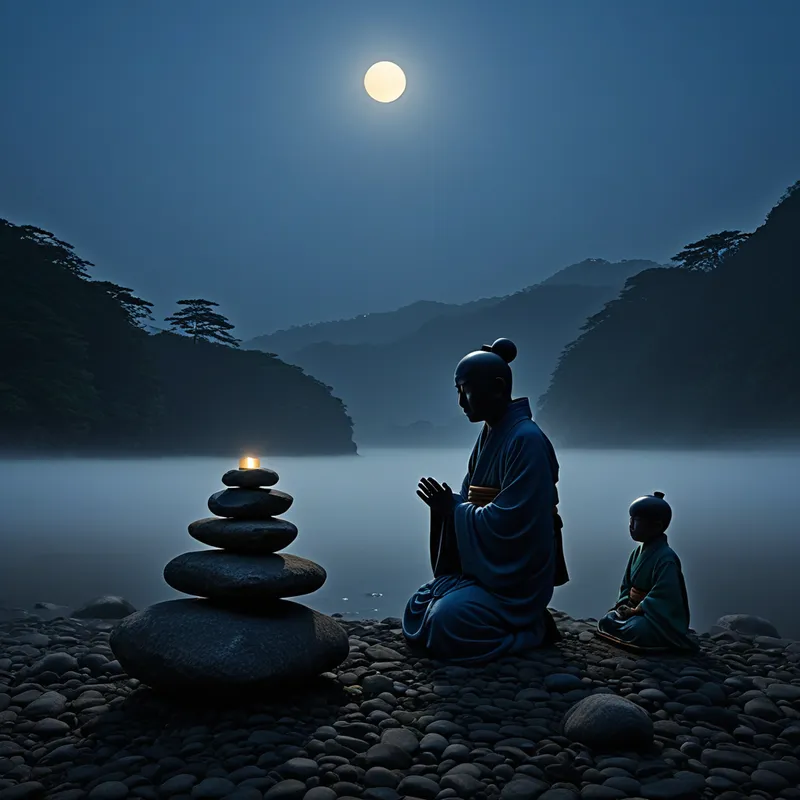
In the time beyond time, when the world was woven of spirit and sorrow, there existed a realm of twilight known as Samsara. Within its great wheel turned six destinies, from the bliss of heavens to the agonies of hells. And between them all flowed a cold, grey river—the Sai no Kawara. To this barren shore came the souls of children lost too soon, those who died before their parents. Their small hands, aching with a love they could no longer give, sought to build towers of pebbles for their living parents' merit. But demons of wind and regret would come, howling from the darkness, to scatter their fragile piles. The only sound was the soft, ceaseless weeping of countless souls and the clack-clack of stone upon stone.
Yet, into this landscape of muted despair came a figure. Not with fury, but with fathomless calm. He was Jizo Bosatsu. His robes were those of a humble monk, worn from walking countless paths. In one hand, he held the khakkhara, its six rings chiming a soft, clear note that parted the gloom. In his other hand, sometimes, was the Cintamani, a jewel glowing with the light of all compassion.
He did not fight the demons. He simply stood, a steadfast presence. He would kneel on the cold riverbank, gathering the weeping children into the vast, sheltering sleeves of his robe. To them, he whispered not complex doctrines, but a simple, enduring promise. He would be their parent in this lonely place. He would hide them from the tormenting winds. And he would guide them, when the time was right, to a peaceful rebirth. His vow was not to destroy the riverbank, but to transform it with his presence—from a place of abandoned sorrow to a sanctuary of watched-over grief. The clacking of stones continued, but now it was a rhythm underlaid by the steady, reassuring chime of his staff and the profound silence of his vigil.
Cultural Origins & Context
The figure of Jizo, known as Ksitigarbha in the Buddhist sutras that traveled from India through China, found uniquely fertile ground in the spiritual landscape of Japan. Arriving around the 8th century, the Bodhisattva’s core vow—to delay his own final enlightenment until every being in the hell realms is saved—resonated deeply with indigenous Japanese sensitivities toward ancestors, spirits of the dead (yurei), and the vulnerable.
The myth was not confined to temple scrolls; it was carried into the hearts of common people through folk tales, etoki (picture storytelling), and local festivals. Stone statues of Jizo, often adorned with red bibs and caps offered by grieving parents, began to dot crossroads, temple grounds, and especially cemeteries. These statues were not merely art; they were active participants in community life, functioning as protectors of travelers, children, and firefighters, but most profoundly, as guardians of mizuko (water children). In a culture with deep reverence for ancestors and acute awareness of life’s fragility, Jizo provided a compassionate, non-judgmental container for the most inarticulable of griefs. The societal function was clear: to offer a ritualized, shared pathway for processing loss and affirming that no soul, however small or seemingly lost, is ever beyond the reach of mercy.
Symbolic Architecture
Psychologically, Jizo represents the ultimate capacity of the conscious psyche to hold space for the most wounded, forgotten, and marginalized parts of the self—the inner children who have been "lost" through trauma, neglect, or the simple brutalities of growing up.
The true sanctuary is not the absence of suffering, but the presence of a consciousness that can bear witness to it without turning away.
The Sai no Kawara is the liminal psyche itself—the barren, inner landscape where unresolved grief and unfinished emotional business reside. The children stacking stones symbolize the ego's fragile, repetitive attempts to make meaning out of loss ("if I just build this, I will be loved/remembered/absolved"). The scattering demons are the forces of psychic negation: self-criticism, existential doubt, and the traumatic winds of memory that dismantle our fragile efforts at healing.
Jizo’s tools are profoundly symbolic. The khakkhara, with its six rings, signifies his active engagement with all states of being (the six realms of Samsara), from our heavenly ambitions to our hellish depressions. The Cintamani jewel is the luminous, focused intention of compassion itself—the wish to heal that has transformative power. His robe is the embodied, containing function of the Self, which can finally envelop and comfort the orphaned fragments of our experience.

The Dreamer's Resonance
When the pattern of the Jizo myth stirs in modern dreams, it often signals a profound process of inner reconciliation. The dreamer may not see a monk, but the archetypal energy manifests in potent symbols.
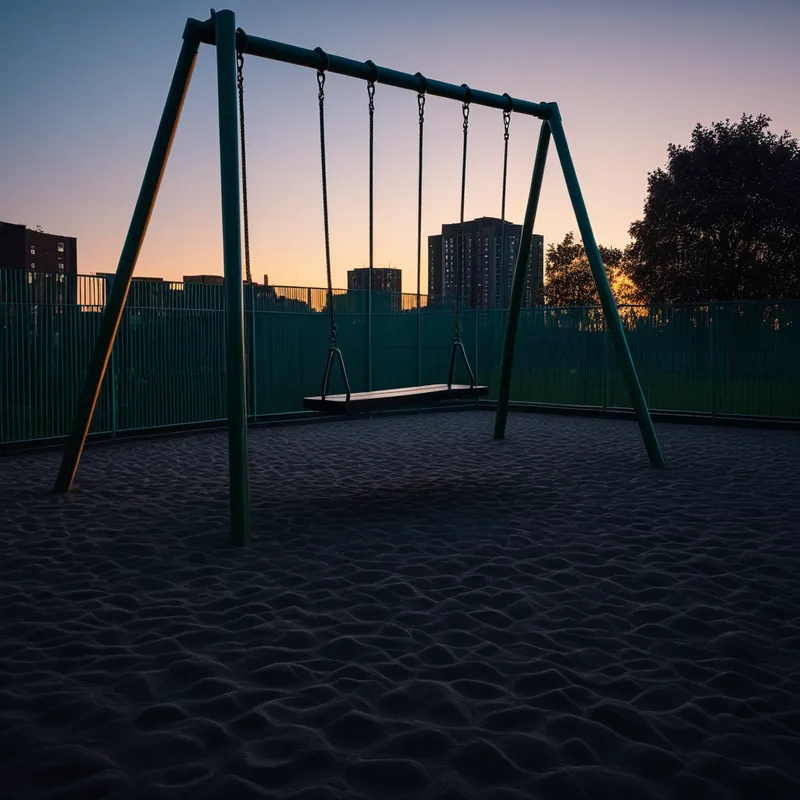
One might dream of finding a smooth, warm stone in a pocket during a time of anxiety, or of building a small cairn in a dream backyard. The dream landscape may be a deserted train station, an empty school hallway at dusk, or a shore littered with smooth glass—all modern analogues of the Sai no Kawara. The somatic feeling is often one of poignant sadness mixed with a strange, quiet comfort. There may be a figure in the dream who says nothing but whose presence instantly calms a rising panic, or a light source (a streetlamp, a nightlight) that holds back an encroaching darkness.
Psychologically, this indicates the ego's readiness to encounter and begin to care for "lost" psychic material. It is the Self, in the form of the Jizo Bosatsu archetype, initiating a process of internal witness. The dreamer is being called to move from being the weeping child on the riverbank to also becoming, in part, the compassionate presence that watches over it. This is not an act of "fixing," but of profound, attentive holding.
Alchemical Translation
The alchemical process modeled by Jizo is not one of fiery combustion, but of patient, earthy transmutation. It is the slow work of holding rather than solving.
The first stage is Recognizing the Sai no Kawara Within—acknowledging the interior landscapes where our unresolved grief, childhood wounds, and abandoned potentials reside. This is the nigredo, the blackening, the confrontation with the shadow of loss.
The second is The Vow of Presence. This is the crucial alchemical albedo, the whitening. Here, we consciously cultivate the Jizo function: the part of us that can sit beside the pain without rushing to bury it, rationalize it, or scatter it. We make a vow not to abandon ourselves in our own moments of desolation. This is often practiced through mindful attention, journaling addressed to one's younger self, or simply allowing a feeling of sadness to exist without narrative.
The transmutation occurs in the space between the pebble and the hand that places it—the moment of intention that says, "This, too, belongs."
The final stage is Sanctuary and Guidance. As the inner Jizo function stabilizes, the barren riverbank begins to transform. The repetitive, frantic stone-stacking (neurotic coping) can gradually become a more intentional, peaceful activity. The lost inner children are not "cured," but they are seen, held, and ultimately integrated. They are guided toward rebirth not as painful memories, but as sources of empathy, resilience, and deep compassion for the fragility of all life. The Cintamani jewel is realized as the core insight that our deepest wounds, when held with unconditional regard, become the very source of our capacity to heal ourselves and others. The individuation journey here is toward becoming a humble, steadfast guardian of one's own soul, and by extension, a more compassionate presence in a world full of unseen riverbanks.
Associated Symbols
Explore related symbols from the CaleaDream lexicon: