Jizō Myth Meaning & Symbolism
A compassionate Bodhisattva vows to save all beings, especially children, becoming a guardian of crossroads and a symbol of boundless, silent empathy.
The Tale of Jizō
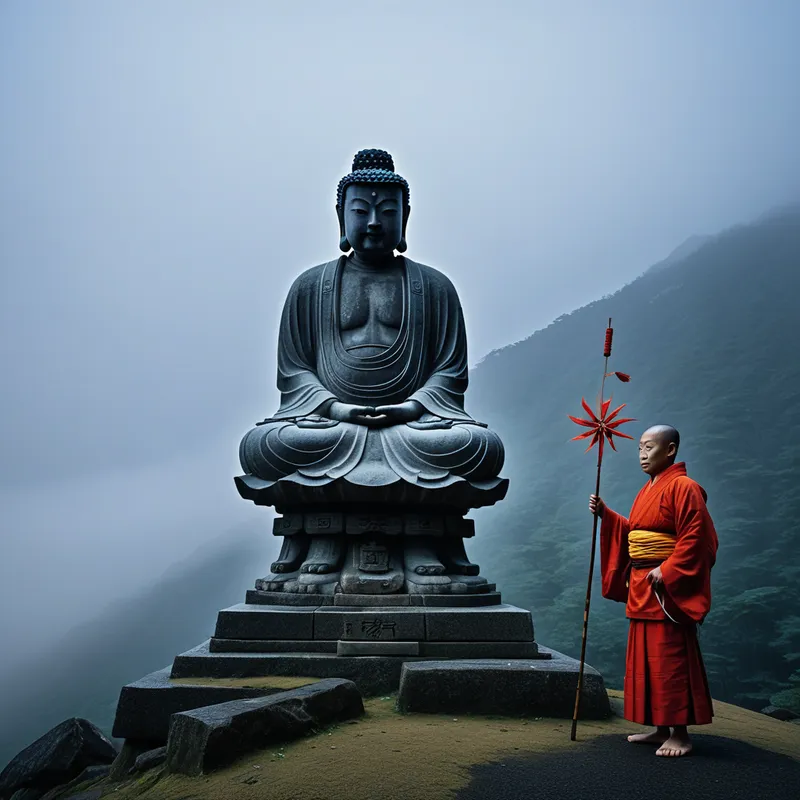
Listen, and let the mists of the Samsara part for a moment. In the spaces between worlds, where the roads fork and the rivers run dark, there walks a silent figure. His name is a whisper on the wind: Jizō Bosatsu.
He is not cloaked in celestial fire, nor does he ride a mythical beast. He is humble, carved from the patient stone of the earth itself. His head is shaven, a simple monk’s robe hangs from his shoulders, and in one hand, he carries the khakkhara, a staff whose rings chime with the sound of compassion. In his other hand, he holds the Cintamani, a jewel that glows with the light of all hopes.
His tale is not one of slaying demons, but of gathering sorrows. Long ago, before time was counted as we count it, he stood before the Buddhas and made a vow that shook the foundations of the cosmos. "I shall not attain final Buddhahood," he declared, "until every hell is emptied." His mission was the impossible: to descend into the deepest, darkest realms of suffering, to find every lost soul, and to guide them toward the light.
His most sacred charge is the souls of children—those little ones who died too soon, especially Mizuko. It is said these children, in their anguish and confusion, must pile stones into small towers on the banks of the Sanzu River, a task made futile by demons and the river’s flow. They weep in the cold, liminal dark.
And so, Jizō goes. He hides the children in the vast sleeves of his robe, shielding them from the eyes of tormentors. He helps them pile their stones. He comforts them with a silence more profound than any lullaby. He is the guardian of crossroads, of mountain passes, of cemeteries—all the places where one world bleeds into another. You will find him there, at the village edge, by the forgotten path, his stone face growing soft with moss, often draped with a tiny red bib or apron placed by grieving parents. This red is not the red of blood, but of a heart’s fervent prayer, a symbol of protection and boundless love. Small pinwheels spin before him, their whirring a gentle spell against the silence of loss.
He does not speak. His work is done in the quiet. He simply stands, and waits, and holds the space for all that is vulnerable, forgotten, and in-between. His story has no end, for his vow is eternal. His triumph is not in a final battle, but in every moment he chooses to stand vigil in the dark.
Cultural Origins & Context
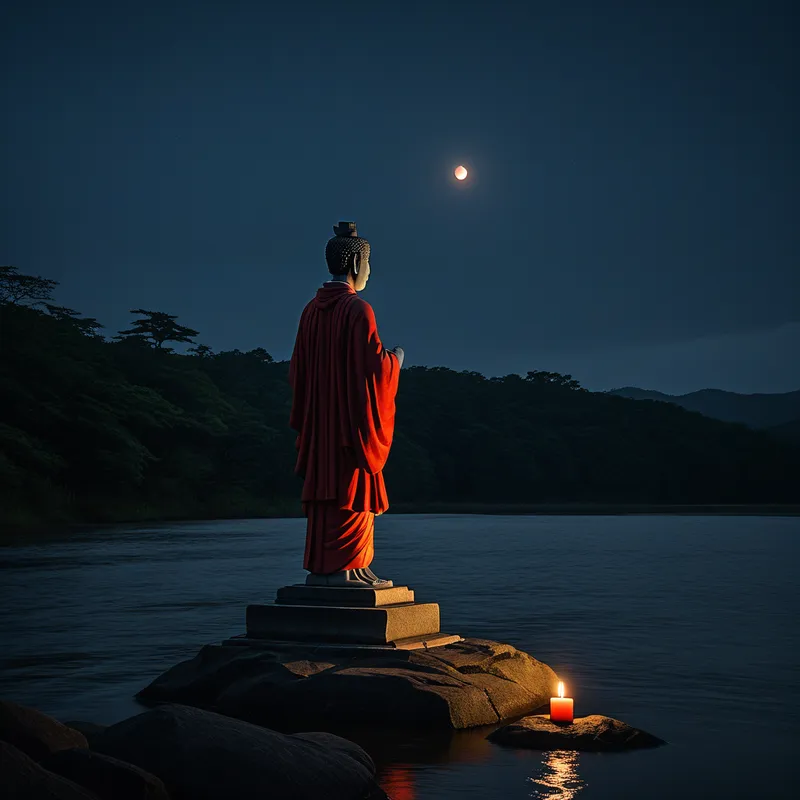
The figure of Jizō entered Japan from China and Korea, a transmission of the Mahayana Buddhist ideal of the Bodhisattva. Originally known as Ksitigarbha, his name signifies "Earth Womb" or "Earth Store," pointing to his nature as a grounding, nurturing, and foundational force. He was seamlessly woven into the indigenous spiritual fabric of Japan, becoming a protector of travelers (a role once held by local roadside deities) and a compassionate figure who resonated deeply with folk beliefs surrounding death and the afterlife.
His worship was not confined to temple altars but flourished in the communal heart. Stone statues, or Jizō-son, were erected along roadsides, in fields, and at village boundaries. This practice was both an act of communal piety and a practical spiritual technology—a way to mark and sanctify liminal spaces, ensuring safe passage for both the living and the dead. The myth was passed down not only through sutras but through the hands of stone carvers, the prayers of mothers, and the offerings of wayfarers. His societal function was profound: he provided a container for the most inexpressible grief, particularly the culturally complex grief associated with Mizuko, offering a pathway for ritual, solace, and the reaffirmation of compassionate connection beyond death.
Symbolic Architecture
Jizō is the archetypal embodiment of the vow—the conscious, unwavering commitment that structures chaos and gives meaning to suffering. He represents the part of the psyche that can hold space for the most wounded, orphaned, and vulnerable aspects of the self without demanding they "get better" immediately.
He is the psychological capacity to stand at the riverbank of our own despair and not look away, to become the steady ground upon which our inner lost children can finally rest.
His stone form symbolizes the ego’s necessary dissolution into something more enduring and impersonal—the Self. He is not a personality, but a presence. The red bib signifies the heart’s active compassion draped over this impersonal presence; it is the human touch, the personal love, that animates the archetypal pattern. The staff represents his journey into the depths of the unconscious (the hell realms), and the jewel is the transformative insight retrieved from those depths. Crucially, he is the guardian of liminality—the crossroads, the threshold, the in-between state. Psychologically, this is the critical, often painful, space between an old identity dying and a new one not yet born. Jizō protects the soul in this vulnerable, formative state.
The Dreamer's Resonance
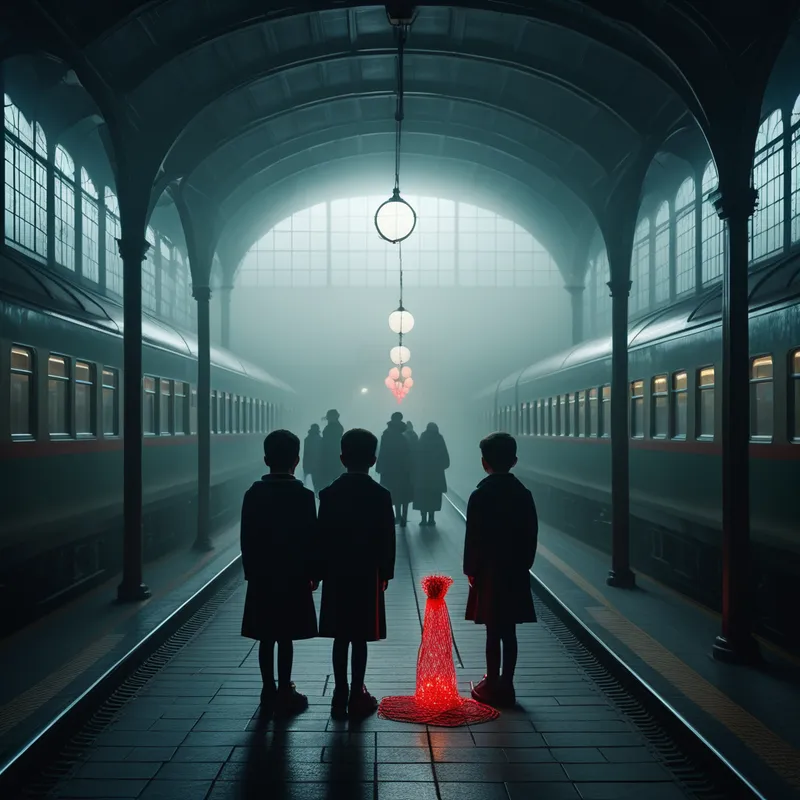
To dream of Jizō, or of his symbols—a quiet stone figure, a crossroads, a red cloth in a barren place, a gathering of silent children—is to encounter the psyche’s innate healing function activating around profound loss or transition. The dreamer is likely navigating a "Sanzu River" in their own life: a divorce, a career change, the aftermath of trauma, or the processing of grief that feels stuck and repetitive (like piling stones that keep falling).
Somatically, this dream may come with a felt sense of grounding, a deep calm, or a release of tension held in the chest or gut—the physical correlate of a burden being witnessed and shared. Psychologically, it signals that the dreamer is not alone in their suffering. The dream presents the archetypal caregiver, not as an external savior, but as an emerging internal capacity. The dream is an invitation to stop fighting the liminal state and to instead cultivate a silent, steadfast presence within it. The children in the dream often represent vulnerable, underdeveloped, or traumatized parts of the self that are finally being acknowledged and gathered in.
Alchemical Translation
The alchemy modeled by Jizō is not of turning lead into gold through force, but of transforming anguish into compassion through unwavering, patient presence. The modern individual’s journey of individuation is fraught with personal "hell realms"—shame, childhood wounds, repressed memories, and existential dread. The ego’s first impulse is to flee these realms or to fight the demons within them.
Jizō’s path offers a third way: sacred descent. It is the courage to consciously enter one’s own darkness, not as a warrior, but as a compassionate witness. The vow—"I will not abandon this part of myself"—is the foundational act of this alchemy.
The transmutation occurs in the holding. The silent, stone-like presence in the face of inner turmoil gradually transforms the raw lead of suffering into the gold of empathetic understanding.
The "children" saved are our own disowned potentials and frozen hurts. By vowing to care for them, we reclaim our wholeness. The red bib we tie is the act of bringing warm, personal feeling to cold, structural pain. Ultimately, the myth teaches that enlightenment is not an escape from the world of suffering, but a profound immersion into it with a heart that refuses to close. We become, in our own small way, a guardian of the crossroads for ourselves and others, a steady presence in the ever-turning wheel of Samsara. Our final jewel is the realized truth that compassion is the very ground of being—the Earth Womb from which all things arise and to which all things, finally, can return in peace.
Associated Symbols
Explore related symbols from the CaleaDream lexicon: