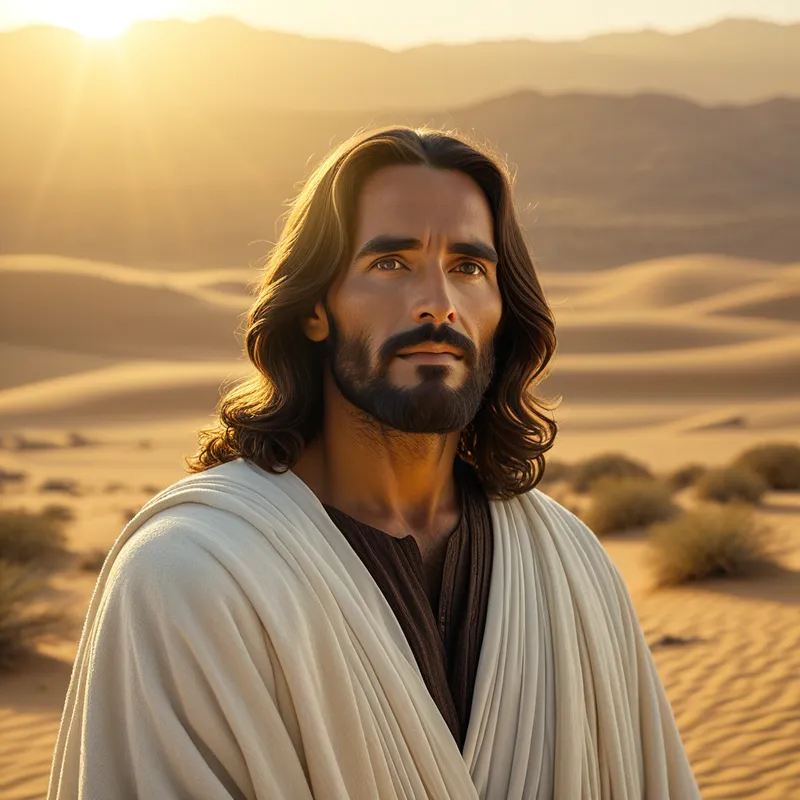
Jesus of Nazareth Myth Meaning & Symbolism
A story of divine descent, sacrificial death, and miraculous resurrection, embodying the ultimate archetype of transformation and eternal life.
The Tale of Jesus of Nazareth
Listen. In a land of dust and prophets, under the heavy sun of Judea, a whisper began. It started not in palaces of marble, but in [the womb](/myths/the-womb “Myth from Various culture.”/) of a young woman visited by a presence beyond the stars. Her child was born among the breath of beasts, his first cradle a feed-trough, heralded by a celestial fire to shepherds keeping watch in the night.
He grew in silence, in the small town of Nazareth, the stone and wood shaping his hands. But when he stepped into the waters of the Jordan, [the sky](/myths/the-sky “Myth from Persian culture.”/) tore open. A voice like thunder and honey declared, “This is my Son.” From that moment, the ordinary world peeled back. He walked the shores of Galilee, and his words were not like the words of the scribes. They were seeds that split the heart’s hard ground. “The kingdom of heaven is within,” he said, and the sick rose from their mats, the blind saw light, and the waves themselves grew calm at his command.
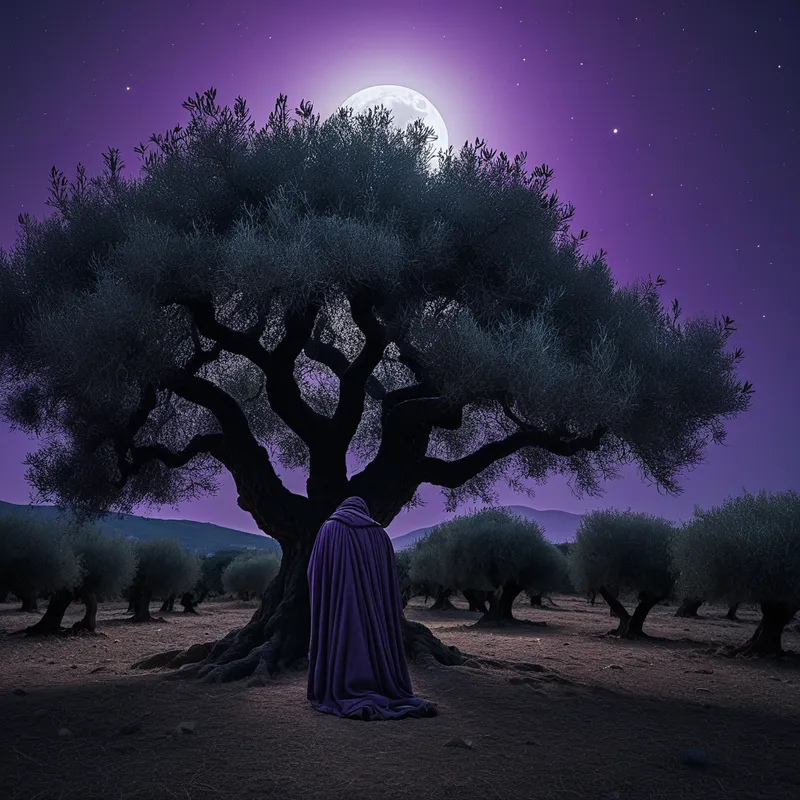
He gathered followers—fishermen, tax collectors, the weary and the hopeful. He spoke in parables of lost coins, prodigal sons, and mustard seeds. He turned [water into wine](/myths/water-into-wine “Myth from Biblical culture.”/), fed thousands with a few loaves, and walked on the churning sea. Yet, a shadow gathered. The powers of temple and throne saw not a healer, but a threat to the delicate balance of fear. In an [upper room](/myths/upper-room “Myth from Biblical culture.”/), he broke bread and poured wine, calling them his body and blood, a new covenant in [the shadow](/myths/the-shadow “Myth from Jungian culture.”/) of the old. Then, in a garden of ancient olives, the weight of [the world](/myths/the-world “Myth from Tarot culture.”/) pressed down. He sweat tears of blood, begging for the cup to pass, yet surrendering to a will greater than his own fear.
Betrayed with a kiss, he was paraded before cynical rulers. A crown not of gold, but of vicious thorns was pressed upon his brow. He was scourged, his back a map of agony. Forced to carry the instrument of his death—a rough-hewn cross—through streets of jeers and tears, he stumbled toward the Place of the Skull, [Golgotha](/myths/golgotha “Myth from Christian culture.”/). Nails were driven. He was hoisted between earth and sky, a bridge of suffering. “Father, forgive them,” he whispered into the gathering dark. As life left him, the sun hid its face, [the earth](/myths/the-earth “Myth from Hindu culture.”/) trembled, and [the veil](/myths/the-veil “Myth from Various culture.”/) in [the temple](/myths/the-temple “Myth from Jewish culture.”/)—the barrier between the human and the holy—was torn in two from top to bottom.
They laid him in a tomb sealed with a stone. For three days, hope lay entombed in silence. But at dawn, women came to anoint a corpse and found the stone rolled away, the grave clothes empty. A figure stood in the garden, mistaken for a gardener, until he spoke her name. He appeared among his terrified friends, showing wounds that were now portals of light. He was not a ghost, but flesh transformed—the firstborn from the dead. After forty days, he ascended, a promise lingering on the air: “I am with you always.” The story did not end. It exploded, carried on the breath of witnesses, a tale of death conquered, a love that would not stay in the grave.
Cultural Origins & Context
This story emerged from the fertile, fraught soil of Second Temple Judaism, a people under the heel of the Roman Empire, yearning for a Messiah. It was not initially written as a single, authoritative text. It was an oral tradition, a “gospel” (good news) proclaimed by traveling apostles and teachers in marketplaces and homes. The earliest written accounts, the Gospels, were composed decades after the events, each for a different community with distinct concerns—Matthew for Jewish converts, Mark</ab title=“The second book of the New Testament, traditionally attributed to John Mark”>Mark for a persecuted Roman audience, Luke for Gentiles, and John offering a mystical, theological vision.
Its societal function was revolutionary. It created a new identity, a “Christian” identity, not based on ethnic lineage but on shared belief in this transformative narrative. It offered a cosmic framework that made sense of suffering (uniting with the suffering God), promised ultimate [justice](/myths/justice “Myth from Tarot culture.”/) and renewal, and formed the bedrock of community ethics, charity, and hope in the face of martyrdom. The story was performed in liturgy, depicted in catacomb art, and eventually codified into creeds, becoming the central mythos of Western civilization for two millennia.
Symbolic Architecture
At its core, the myth of [Jesus](/myths/jesus “Myth from Christian culture.”/) is a master [symbol](/symbols/symbol “Symbol: A symbol can represent an idea, concept, or belief, serving as a powerful tool for communication and understanding.”/) of the coniunctio oppositorum—the union of opposites. He is the God-Man, [eternity](/symbols/eternity “Symbol: The infinite, timeless state beyond human life and measurement, often representing the ultimate or divine.”/) intersecting time, [spirit](/symbols/spirit “Symbol: Spirit symbolizes the essence of life, vitality, and the spiritual journey of the individual.”/) fully incarnated in matter. This resolves the ancient, painful split between the transcendent and the immanent.
The crucifixion is the ultimate alchemical vessel where divine love and human suffering are fused into a new substance: grace.
His [life](/symbols/life “Symbol: The symbol of ‘Life’ represents a journey of growth, interconnectedness, and existential meaning, encompassing both the joys and challenges that define human experience.”/) maps the individuation [journey](/symbols/journey “Symbol: A journey in dreams typically signifies adventure, growth, or a significant life transition.”/). The [baptism](/symbols/baptism “Symbol: A ritual of spiritual cleansing, initiation, and rebirth, symbolizing profound transformation and commitment to a new path.”/) in the Jordan symbolizes the conscious awakening to [the Self](/myths/the-self “Myth from Jungian culture.”/), the “divine son-ship” within. The forty days in the [wilderness](/symbols/wilderness “Symbol: Wilderness often symbolizes the untamed aspects of the self and the unconscious mind, representing a space for personal exploration and discovery.”/) represent the necessary confrontation with the [shadow](/symbols/shadow “Symbol: The ‘shadow’ embodies the unconscious, repressed aspects of the self and often represents fears or hidden emotions.”/), the devil as the totality of untamed psychic potentials and temptations. The miracles are demonstrations of the [psyche](/myths/psyche “Myth from Greek culture.”/)’s power to re-order chaotic, “dis-eased” realities (the stormy sea, the sick [body](/symbols/body “Symbol: The body in dreams often symbolizes the dreamer’s self-identity, personal health, and the relationship they have with their physical existence.”/), [death](/symbols/death “Symbol: Symbolizes transformation, endings, and new beginnings; often associated with fear of the unknown.”/) itself) when aligned with the deeper Self.
The Eucharist is profound symbolic cannibalism: to internalize the [archetype](/symbols/archetype “Symbol: A universal, primordial pattern or prototype in the collective unconscious that shapes human experience, behavior, and creative expression.”/), to literally “take in” the body and spirit of the transformative principle. [The resurrection](/myths/the-resurrection “Myth from Christian culture.”/) is not merely a physical [event](/symbols/event “Symbol: An event within dreams often signifies significant life changes, transitions, or emotional milestones.”/) but the symbol of the psyche’s indestructible core, the Self that cannot be annihilated by any [trauma](/symbols/trauma “Symbol: A deeply distressing or disturbing experience that overwhelms the psyche, often manifesting in dreams as unresolved emotional wounds or psychological injury.”/), failure, or “death” of [the ego](/myths/the-ego “Myth from Jungian culture.”/).
The Dreamer’s Resonance
When this mythic pattern stirs in the modern dreamer, it often signals a profound crisis of identity and a call to a painful but necessary transformation. Dreaming of being betrayed, put on trial, or carrying a heavy burden speaks to the ego feeling sacrificially scapegoated by life’s circumstances or its own inner council.
To dream of crucifixion is to somatically experience the ego’s terrifying, yet sacred, immobilization—the point where all striving ceases, and a deeper will must be surrendered to.
Dreaming of an empty tomb or a radiant, resurrected figure indicates a nascent realization. The old identity, the old way of being (which felt like a solid, albeit limiting, “body”), has dissolved. What emerges is not the old ego restored, but something new, lighter, and empowered—the beginning of identification with the resilient Self. A dream of turning [water](/myths/water “Myth from Chinese culture.”/) into wine suggests the dreamer’s potential to transmute the ordinary, mundane aspects of life (water) into something meaningful, intoxicating, and soul-nourishing (wine). These dreams mark the psyche’s intrinsic, archetypal push toward wholeness, using this deeply embedded cultural code to narrate its own journey.
Alchemical Translation
For the individual, the Jesus myth is a blueprint for psychic transmutation. The process begins with the Incarnation: the descent of a transcendent value (a calling, a talent, a deep love) into the messy, limited reality of one’s personal life. This is always a humiliation for the spirit, which must be “born in a stable.”
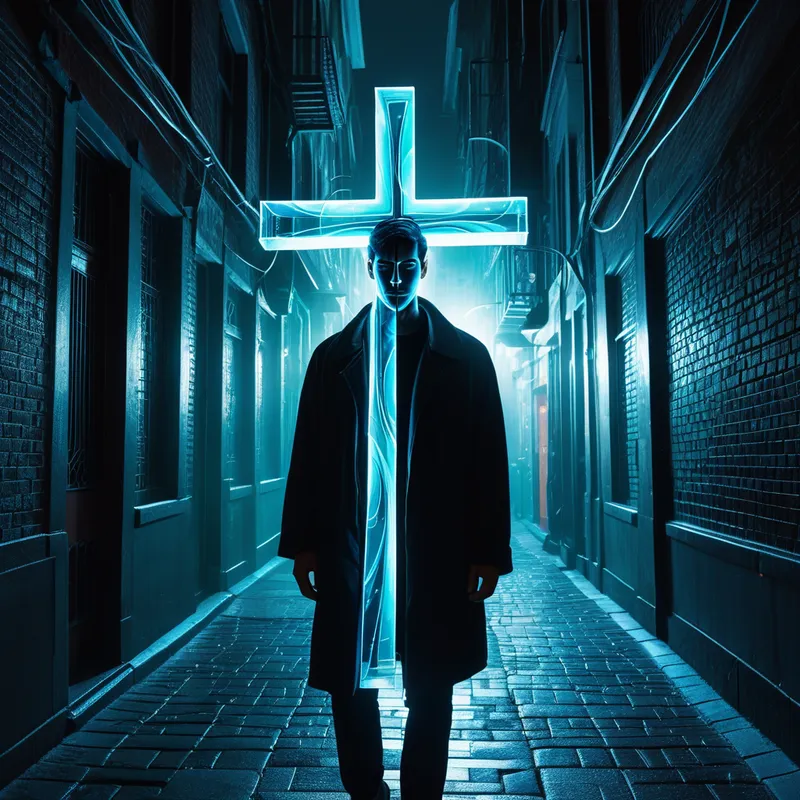
The core alchemical work is the Crucifixion. This is the stage where the conscious attitude (the ego) must be willingly stretched on the tension of opposites. One’s ideals versus one’s failures, one’s love versus one’s hatred, one’s will versus life’s resistance. The ego is “nailed” in place, unable to escape the conflict. This is the [nigredo](/myths/nigredo “Myth from Alchemical culture.”/), [the dark night of the soul](/myths/the-dark-night-of-the-soul “Myth from Christian Mysticism culture.”/), where everything seems lost.
The resurrection occurs not by avoiding the cross, but by enduring it fully. The new body is forged in the very fire that appears to consume the old.
The three days in the tomb represent the essential period of gestation. After a great defeat, loss, or surrender, there must be a fallow time, a psychic [Sabbath](/myths/sabbath “Myth from Judeo-Christian culture.”/) where the unconscious works silently to reorganize the psyche around the central, indestructible Self. To rush this is to seek a mere resuscitation of the old ego.
Finally, the Ascension is the final stage of alchemical translation. It is not an escape from the world, but the integration of the transformed consciousness back into the totality of life. The individual no longer identifies solely with the suffering, limited ego, nor with an inflated, disembodied spirit. They become a vessel through which the transcendent principle (“the Father”) operates immanently (“I in you, and you in me”). The myth teaches that the goal is not to become a god apart from humanity, but to become fully human, which is [the vessel](/myths/the-vessel “Myth from Alchemical culture.”/) for the divine. The journey is from unconscious wholeness (Paradise), through conscious fragmentation ([the Fall](/myths/the-fall “Myth from Biblical culture.”/), the Crucifixion), to conscious, earned wholeness (Resurrection)—the Self, known and embodied.
Associated Symbols
Explore related symbols from the CaleaDream lexicon: