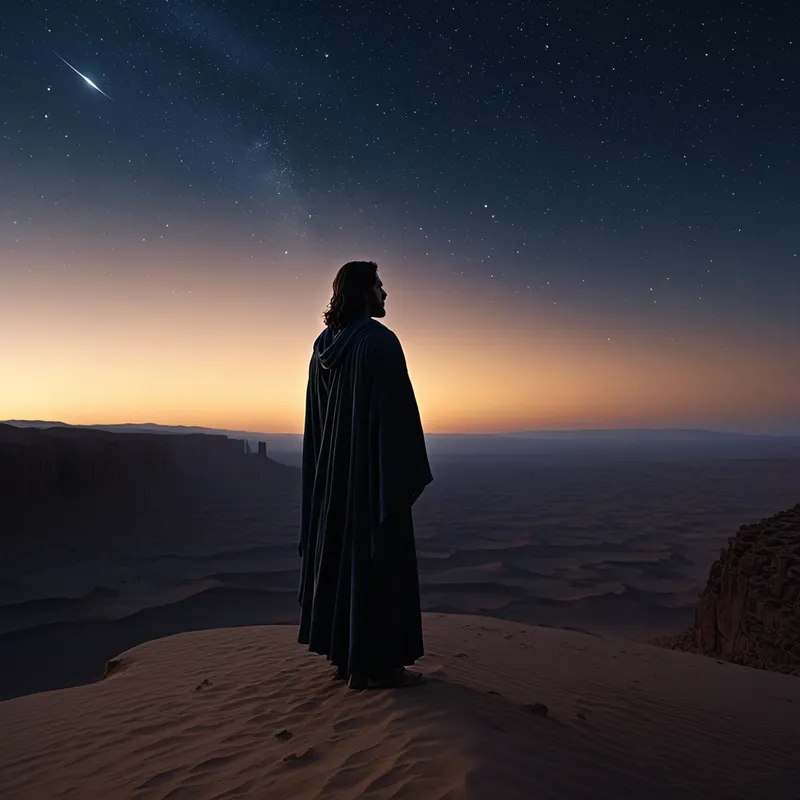
Jesus in the Wilderness Myth Meaning & Symbolism
A story of sacred solitude, where the divine meets the demonic in the desert, forging a self through temptation and profound inner dialogue.
The Tale of Jesus in the Wilderness
The heavens had just been torn open. The voice of the Father still echoed in the ripples of the Jordan, and the Spirit, like a descending dove, now rested upon him. But this anointing did not lead to a throne. It led, with an undeniable gravity, into the emptiness.
The Christ was driven—not led, but driven—by that very Spirit into [the wilderness](/myths/the-wilderness “Myth from Biblical culture.”/). It was a place of teeth: the teeth of jagged rocks, the teeth of [the wind](/myths/the-wind “Myth from Various culture.”/), the gnawing teeth of hunger. The sun was a hammer on the cracked earth; the nights, a cloak of freezing silence. For forty days and forty nights, he was with the wild beasts, and the angels attended him, their presence felt only as a faint sustaining grace against the overwhelming thereness of desolation.
Then, when the hunger had hollowed him to a pure vessel, the Adversary came. The voice did not boom from the clouds. It spoke from the dryness of his own throat, from the ache in his bones.
“If you are the Son of the Father,” it whispered, a thought slithering into his mind, “command these stones to become bread.”
The Christ looked at the stones, warm from the sun. The temptation was not for mere food, but to use the sacred power to erase the sacred condition—to bypass the humanity he had come to inhabit. His reply was a whisper of scripture, a breath of spirit: “One does not live by bread alone.”
Undeterred, the tempter showed him all the kingdoms of [the world](/myths/the-world “Myth from Tarot culture.”/) in a moment of panoramic vision, their glory shimmering like a mirage. “All this authority I will give you, for it has been given to me. If you worship me, it will all be yours.”
It was the offer of the shortcut, [the crown](/myths/the-crown “Myth from Various culture.”/) without the cross, the world gained by losing the soul. The answer was a sword of refusal: “Worship the Lord your God, and serve only him.”
Finally, the adversary took him to the pinnacle of the Temple in the holy city, high above the milling crowds. “If you are the Son of God, throw yourself down. For it is written, ‘He will command his angels concerning you to protect you.’”
This was the most insidious test: the temptation to spectacle, to force the hand of the divine, to trade trust for a circus act of guaranteed salvation. The Christ’s final word cut the last thread of the illusion: “Do not put the Lord your God to the test.”
The tempter, having exhausted every avenue, departed from him—until an opportune time. And then, only then, did the angels come and minister to him, not as rescuers from the trial, but as attendants to the one who had endured it. The wilderness had done its work.

Cultural Origins & Context
This narrative is found in the synoptic gospels of Matthew, Mark, and Luke, with the most detailed account in Matthew 4:1-11. It is positioned immediately after [Jesus](/myths/jesus “Myth from Christian culture.”/)‘s baptism and before the start of his public ministry, functioning as a crucial hinge in the gospel story. Early Christian communities, living under Roman occupation and often in their own states of spiritual and physical precariousness, would have heard this as a foundational story of identity and resistance.
The forty days directly echo the forty years of Israel’s testing in [the desert](/myths/the-desert “Myth from Biblical culture.”/) and [Moses](/myths/moses “Myth from Biblical culture.”/)‘s forty days on Sinai. For the early church, this established Jesus as the true Israel and the new [Moses](/myths/moses “Myth from Biblical culture.”/), succeeding where the nation had faltered. Told and retold during Lent—a period of fasting and penitence—the myth served a societal function of spiritual preparation, modeling how to face internal and external temptations through scriptural grounding and unwavering commitment to God’s will. It was a myth of orientation, teaching believers that the path of faith inevitably passes through a desert of doubt and confrontation.
Symbolic Architecture
The [wilderness](/symbols/wilderness “Symbol: Wilderness often symbolizes the untamed aspects of the self and the unconscious mind, representing a space for personal exploration and discovery.”/) is the ultimate [symbol](/symbols/symbol “Symbol: A symbol can represent an idea, concept, or belief, serving as a powerful tool for communication and understanding.”/) of the [prima materia](/myths/prima-materia “Myth from Alchemical culture.”/), the raw, undifferentiated state of the [soul](/symbols/soul “Symbol: The soul represents the essence of a person, encompassing their spirit, identity, and connection to the universe.”/). It is not evil, but it is empty, a blank slate where all illusions are stripped away. Here, the divine ego (the baptized Son) encounters the personal and collective [shadow](/symbols/shadow “Symbol: The ‘shadow’ embodies the unconscious, repressed aspects of the self and often represents fears or hidden emotions.”/), personified as the Adversary.
The three temptations are not random evils but a precise, psychological assault on [identity](/symbols/identity “Symbol: Identity represents the sense of self, encompassing personal beliefs, cultural background, and social roles.”/) and [purpose](/symbols/purpose “Symbol: Purpose signifies direction, meaning, and intention in life, often reflecting personal ambitions and core values.”/). They represent the core distortions of spiritual power:
The temptation of bread is the reduction of life to the material, the instinctual, and the immediate. It asks: Will you use your essence to merely sustain the physical self?
The temptation of kingdoms is the seduction of the political, the ego’s desire for control, influence, and worldly validation. It asks: Will you worship the system of power to gain power within it?
The temptation of the temple pinnacle is the spiritualization of the ego, the desire for magical protection, special status, and a faith that demands proof. It asks: Will you manipulate the sacred to guarantee your own invulnerability?
Each refusal by Jesus is an act of profound [integration](/symbols/integration “Symbol: The process of unifying disparate parts of the self or experience into a cohesive whole, often representing psychological wholeness or resolution of internal conflict.”/). He does not destroy [the shadow](/myths/the-shadow “Myth from Jungian culture.”/); he dialogues with it, defines himself against it, and in doing so, incorporates its [energy](/symbols/energy “Symbol: Energy symbolizes vitality, motivation, and the drive that fuels actions and ambitions.”/) into a conscious [structure](/symbols/structure “Symbol: Structure in dreams often symbolizes stability, organization, and the framework of one’s life, reflecting how one perceives their environment and personal life.”/). The wild beasts and ministering angels symbolize the reconciliation of the instinctual and the spiritual realms within the now-solidified Self.
The Dreamer’s Resonance
When this mythic pattern stirs in the modern dreamer, it often manifests as a period of intense, isolating introspection—a “desert time.” One might dream of being alone in a vast, empty landscape (an office after hours, a deserted highway, a blank room), confronted by a figure that is both alien and eerily familiar. This figure, the dream shadow, offers tantalizing solutions: a quick fix to a complex problem, a promise of fame or wealth at a moral cost, or a guarantee of safety if one abandons a core principle.
Somatically, this process can feel like a hollowing out—a loss of appetite for old certainties, a dryness of spirit. Psychologically, it is [the ego](/myths/the-ego “Myth from Jungian culture.”/)‘s confrontation with its own latent potentials for corruption, grandiosity, and cowardice. The dream is not a warning of literal demonic possession, but an indicator that the [psyche](/myths/psyche “Myth from Greek culture.”/) is in a state of initiation. The conscious personality is being tested on its authenticity. To “wake” from such a dream feeling weary but clear is a sign that the inner dialogue is proceeding, that the dream-ego is holding its ground, forging a more resilient identity.

Alchemical Translation
The alchemical journey begins with [nigredo](/myths/nigredo “Myth from Alchemical culture.”/), the blackening, the descent into the dark matter of the soul. The wilderness is the vas, the sealed vessel where this dissolution occurs. Jesus’s fast is the voluntary dissolution of the old, naïve identity formed at the Jordan (“You are my Son”). The temptations are the fiery reagents introduced to test the purity of the emerging substance.
The alchemical gold is not worldly success, but the creation of a consciousness that can contain opposites—divine calling and human limitation, power and service, trust without guarantee.
Each “No” to the tempter is a [separatio](/myths/separatio “Myth from Alchemical culture.”/), a conscious differentiation. The hunger is not denied; it is placed within a larger hierarchy of need. The desire for influence is not destroyed; it is redirected from dominion to service. The need for security is not erased; it is re-founded on trust rather than contract. This is the albedo, the whitening, where the confused elements begin to clarify.
The result is not a sterile perfection, but a tempered, operational Self. The Adversary departs “until an opportune time,” meaning the integrated shadow is now a known quantity, a source of energy that can be engaged consciously in future challenges. The ministering angels symbolize the return of psychic functions—intuition, feeling, sensation—now in service to the centered Self, not fleeing from a fragmented ego. For the modern individual, the myth maps the non-negotiable passage: to become who you are, you must first go into the desert of who you are not, and survive the conversation with everything you fear you might become.
Associated Symbols
Explore related symbols from the CaleaDream lexicon: