Jeoseung Saja Death Messenger Myth Meaning & Symbolism
A myth of the Korean death messenger who guides souls, embodying the terrifying yet necessary force of transition and the acceptance of life's final threshold.
The Tale of Jeoseung Saja Death Messenger
Listen, and hear the tale that is whispered when the wind dies and the night grows still. It is not a story for the bright sun, but for the hour when the world holds its breath between one day and the next.
In the realm of the living, a man lies dying. The air in the room is thick with the scent of medicinal herbs and silent grief. His family watches, their hearts heavy stones in their chests. They see only the labored rise and fall of his chest, the slow fade of light from his eyes. But he sees something else. At the foot of his bed, the air begins to ripple like heat over stone. A chill descends, not of winter, but of a profound and absolute elsewhere.
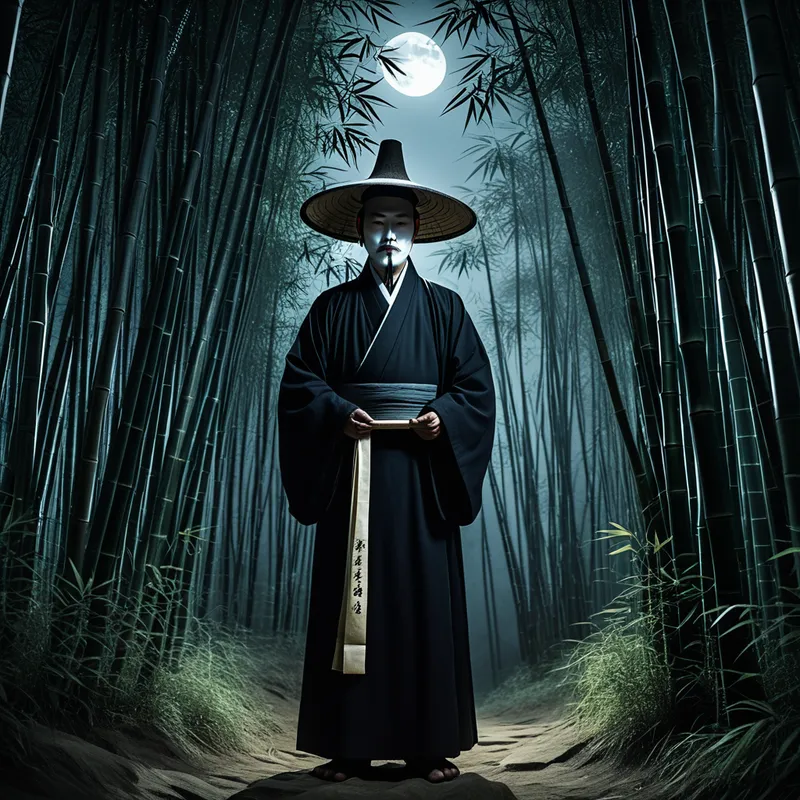
From this ripple steps a figure. He is tall, impossibly so, and clothed in the stark, formal robes of mourning—hanbok of deepest black and starkest white, colors that speak of void and purity, of ending and beginning. A wide-brimmed gat shadows his face, revealing only the severe line of a mouth that holds no smile, no frown, only the gravity of duty. In his hand, he does not carry a scythe, but a long scroll, ancient parchment that seems to glow with a light of its own, etched with names in a script that swims before the dying man’s eyes. This is Jeoseung Saja.
The messenger does not speak with a human tongue. His voice is the rustle of dry leaves, the creak of an old gate, the final sigh of a closing door. “Your name is written,” the sounds seem to say. “The path is prepared.” There is no malice in his presence, only the cold, clean truth of a summons that cannot be ignored. The man’s spirit, a wisp of silver and memory, feels itself detaching, drawn not by force, but by a profound and inevitable pull.
Together, they step across the threshold of the room, but the room is no longer there. They walk a path that is not a path, through a landscape of mist and shadow. Sometimes it resembles the san the man knew in life, but twisted, silent, and eternal. The Jeoseung Saja walks ahead, a constant, unwavering guide. The spirit looks back once, seeing the pinprick of light that was his home, his life, receding into an immense darkness. Fear, sharp and animal, rises in him. But the messenger’s pace never falters. He is the certainty in the uncertainty, the form in the formless journey.
They come to a river, wide and dark, its waters silent and swift. This is the Samdo River. On the other side, shapes move in a dim, otherworldly glow. This is the shore of the afterlife. The Jeoseung Saja gestures toward a boat, a simple skiff that waits as if it has waited for eternity. As the spirit boards, the messenger unfurls his scroll one last time. A single character, the man’s name, fades from the parchment like ink in water. The duty is complete. The messenger gives no farewell. He simply turns and is swallowed by the mists from whence he came, leaving the soul to face the final crossing alone, guided now only by the weight of his own life and the mysteries that lie beyond the dark water.
Cultural Origins & Context
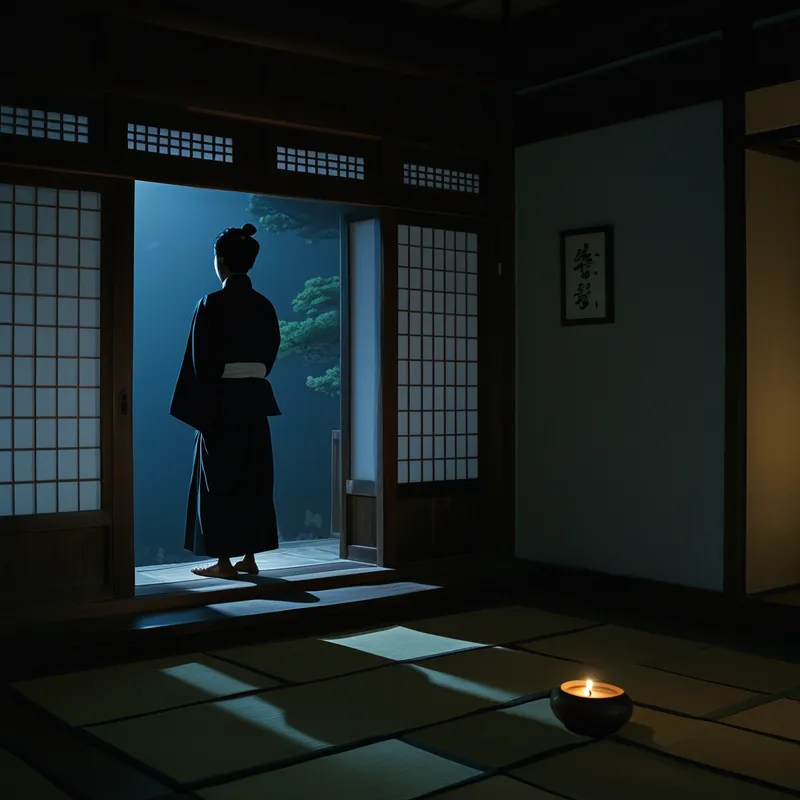
The myth of the Jeoseung Saja is woven deeply into the fabric of Korean folk belief, a strand connecting Muism (Korean Shamanism), Buddhist cosmology, and Taoist influences. He is not a god of death who decides fate, but a bureaucratic functionary of the afterlife, a psychopomp whose role is purely transactional: to locate, identify, and escort. This reflects a historical cultural worldview where the cosmos was seen as a vast, orderly bureaucracy, mirroring the rigid hierarchies of the earthly Joseon court.
The tales were passed down not in formal scriptures, but through oral tradition—by grandmothers at hearths, by shamans (Mudang) in rituals for the dead (*Jinogi), and in folk narratives meant to explain the inexplicable moment of death. His primary societal function was twofold: to provide a concrete, albeit terrifying, explanation for the transition of the soul, thereby structuring grief, and to reinforce moral order. The idea that one’s name was “on the scroll” served as a reminder that life was finite and that one’s actions would be tallied. He personified the ultimate accountability, making the abstraction of death into a figure one could almost negotiate with, fear, and, in some tales, even attempt to trick—though never successfully.
Symbolic Architecture
The Jeoseung Saja is the ultimate symbol of impersonal fate. He is not evil, but he is inexorable. He represents the aspect of reality that is utterly indifferent to our pleas, our projects, our loves. Psychologically, he embodies the autonomous, non-ego forces of the psyche that dictate profound transitions—not just physical death, but the death of identities, relationships, and life stages.
He is the embodiment of the threshold itself, the living door that must be passed through. His neutrality is more terrifying than any monster’s rage, for it cannot be swayed.
His scroll is the Cheonbugyeong (Heavenly Ledger), a symbol of destiny and the unalterable record of a life. The Samdo River he guides to is the classic symbol of the final boundary, the unconscious waters that must be crossed to reach a new state of being. His lack of a visible face underscores that he is not a person, but a function of the cosmos—a archetypal force wearing a cultural costume.
The Dreamer's Resonance
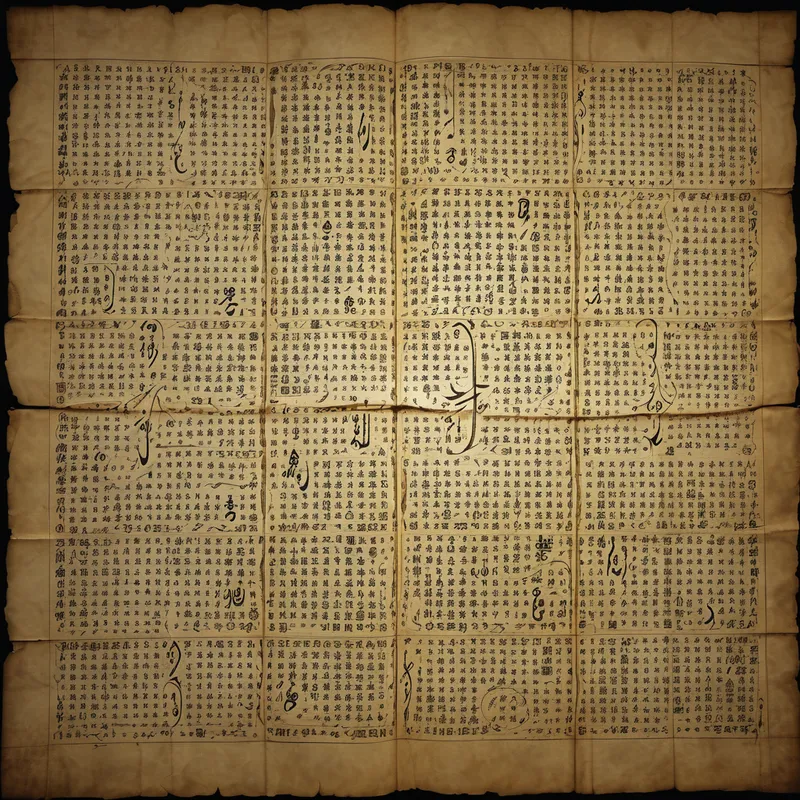
When the Jeoseung Saja appears in modern dreams, he rarely signifies literal physical death. Instead, he heralds a profound psychic death. The dreamer is often undergoing—or resisting—an inevitable ending. This could be the end of a career, the dissolution of a long-held self-image, the closing of a major life chapter, or the necessary death of a dependency.
Somatically, these dreams may be accompanied by sensations of chilling cold, paralysis, or a feeling of being summoned or watched. Psychologically, the process is one of brutal confrontation with an ending that the conscious mind has refused to acknowledge. The dream-Jeoseung Saja does not argue; he simply presents the scroll. The dream work lies in the dreamer’s reaction: the terror, the bargaining, the eventual recognition, and the first step onto that misty path. He appears when the psyche insists that a certain pattern, attachment, or way of being must die for growth to proceed.
Alchemical Translation
The journey with the Jeoseung Saja is a stark map for the alchemical stage of *nigredo—the confrontation with the shadow and the dissolution of the old, outworn self. In the process of individuation, we all must eventually meet our own personal psychopomp. This is the inner voice or impulse that coldly informs us that a cherished illusion, a toxic relationship, or a comfortable prison must be relinquished.
The alchemical gold of a more authentic self cannot be found without first consenting to the guided death of what is no longer true. The messenger is the agent of this necessary decay.
To integrate this myth is to learn to distinguish the messenger from the message of death. We cannot fight the Jeoseung Saja—the force of necessary ending—but we can choose how we meet him. Do we go kicking and screaming, or do we, with immense courage, acknowledge that our name is indeed on that scroll? The triumph is not in escape, but in the conscious, willing turn away from the fading light of the old life and toward the unknown crossing. In doing so, we stop being victims of fate and become participants in our own transformation. The messenger guides us to the river, but we must board the boat. In that act of acceptance lies the first spark of rubedo, the rebirth on the distant shore.
Associated Symbols
Explore related symbols from the CaleaDream lexicon:
- Death — The core theme the Jeoseung Saja embodies, representing not merely an end but the essential, transformative transition that all life and psychic processes must undergo.
- Messenger — The primary function of the Jeoseung Saja, representing the delivery of an unavoidable truth or summons from a deeper, transpersonal layer of reality to the conscious self.
- Scroll — The record of fate and destiny, symbolizing the fixed and unalterable aspects of a life's journey that must be acknowledged and accepted.
- River — The Samdo River, representing the final boundary between states of being, the unconscious waters that must be crossed to achieve transformation or reach the afterlife.
- Door — The threshold the Jeoseung Saja guards and personifies, symbolizing the moment of passage from one reality, identity, or psychological state into another.
- Bridge — The conceptual path the messenger provides across the abyss of the unknown, a guide through the terrifying transition from the known to the unknown.
- Fate — The impersonal, bureaucratic force that the Jeoseung Saja serves, representing the destined timing and nature of life's major transitions and endings.
- Journey — The essential movement from one state to another that the soul undertakes with the messenger, mirroring the inner journey of psychological transformation.
- Shadow — The Jeoseung Saja as an aspect of the personal and collective unconscious that we fear and reject, yet who holds the key to necessary change.
- Rebirth — The implicit promise on the far side of the river, the new state of being that is only possible after the guided death facilitated by the messenger.