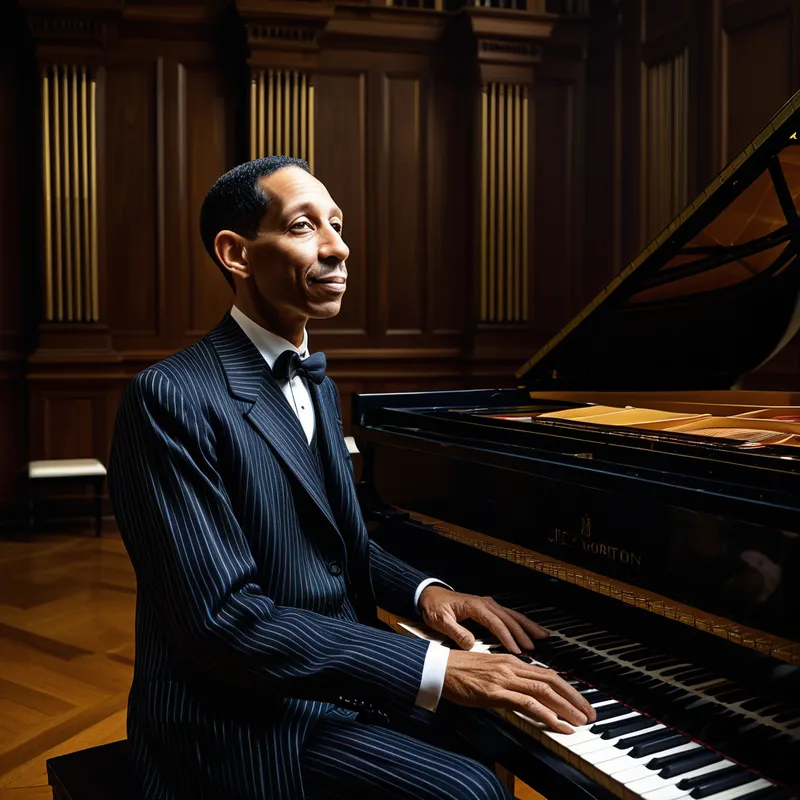
Jelly Roll Morton Myth Meaning & Symbolism
The myth of the trickster-king who claimed to have invented jazz, embodying the tension between divine creation and human pride.
The Tale of Jelly Roll Morton
Listen. Before the world had a name for it, the sound slept in the bones of the earth and the sigh of the river. It was a restless ghost in the humid air of Nouvelle-Orléans, a rhythm in the clatter of streetcars and the murmur of a hundred tongues. It waited for a vessel, a mouthpiece arrogant and brilliant enough to give it a name.
He arrived not with a whisper, but with a proclamation. They called him Jelly Roll Morton, and he wore his name like a crown forged in shadow and spotlight. His suit was his armor, sharp enough to cut the thick air; his diamond in his tooth winked like a captured star, a challenge to the gloom. He did not find the music—he declared he had invented it. He said he pulled it, fully formed, from the silence between heartbeats.
The great conflict was not with a monster, but with the very air he breathed. The sound was everywhere—in the Work-Spirituals of the field, in the complex polyrhythms of Congo Square, in the mournful cry of the brass band at a funeral. It was a collective sigh, a shared memory. Jelly Roll heard this chorus of ghosts and said, "This is mine. I shaped this." He sat before the great Ebony Altar—the piano—and his hands, swift as thought, began to codify the chaos. The left hand spoke the deep, rolling prophecy of the earth; the right hand danced with the glittering, unpredictable spirit. He called it the "Spanish Tinge," a secret ingredient he alone possessed.
Other musicians, vessels of the same raw spirit, heard his claims. The quiet, luminous Sidney Bechet with his voice of weeping sap, the young, fiery Louis Armstrong whose horn could crack the sky—they did not fight him with fists, but with truth. They played, and in their playing was the undeniable evidence: the music was older than any one man. It was a river, and Jelly Roll, for all his genius, was but a magnificent, turbulent whirlpool within it.
The resolution was not defeat, but a haunting transformation. Jelly Roll Morton, the self-crowned king, found his kingdom shifting. The world moved on, craving new dialects of the same soul-speech. He was not dethroned; he became something else—a monument, a cornerstone. In later tales, he is found not on a throne, but in a small, smoky room, etching his truths onto wax cylinders, a scribe to his own gospel. The boast never left his voice, but it was tempered by the echo. He had not invented the river, but he had, for a glorious, defiant moment, named the sea.

Cultural Origins & Context
This myth springs from the very real, fertile soil of early 20th-century African American oral history and the foundational narratives of Jazz itself. It was passed down not in scrolls, but in interviews, newspaper clippings, backstage lore, and the proud, often contradictory stories told by the musicians who were there. Jelly Roll Morton himself was its most prolific bard, using his larger-than-life persona and his 1938 Library of Congress recordings with Alan Lomax as a platform to etch his version of events into the cultural record.
Within "Jazz Lore" culture, this story functions as a foundational etiological myth. It addresses the profound, psychologically charged question: "Where did this powerful, transformative force come from?" In the absence of a single, clear historical origin for a music born of fusion and oppression, the culture created a figure who embodies the tension of that birth. The myth was told by elders to newcomers, a cautionary and celebratory tale about the relationship between individual genius and collective cultural spirit. Its societal function is to navigate the paradox of creation—honoring the brilliant individual who shapes the form, while humbly acknowledging the ancient, communal wellspring from which all form must drink.
Symbolic Architecture
At its heart, the myth of Jelly Roll Morton is an archetypal drama of the Creator confronting the Ancestral Well. Morton symbolizes the potent, necessary, and dangerous force of the Ego in the creative act.
The Creator must first claim the world in order to reshape it, yet must ultimately kneel before the mystery that loaned him the clay.
His "invention" of jazz represents the psychological moment when unconscious, archetypal material—the rhythms, sorrows, and joys of a people—is seized by a conscious mind and given a specific, personal form. The diamond stickpin and fine suits are not mere vanity; they are the Persona as a work of art, a deliberate crafting of the self as an icon worthy of the immense force it channels. The conflict with other musicians symbolizes the inevitable clash between the individual's claim to the archetype and the archetype's true, boundless nature. The myth warns that to claim sole ownership of a collective soul-force is to invite a sacred humiliation, a necessary correction from the spirit itself.
The Dreamer's Resonance
When this mythic pattern stirs in the modern dreamer, it often manifests as dreams of profound, arrogant creation or devastating plagiarism. One might dream of discovering a breathtaking new idea, only to be told it is old and stolen; or of proudly presenting a masterpiece to a crowd that responds with indifferent silence, seeing nothing new.
Somatically, this can feel like a swelling in the chest—a prideful inflation—followed by a sudden, hollow deflation. Psychologically, the dreamer is navigating the critical passage between the Innocent's inspiration and the Sage's perspective. The dream is the psyche's corrective, ensuring the ego does not become fatally identified with the creative source. It is the process of differentiating one's unique arrangement of universal themes from the themes themselves. The anxiety in the dream is the friction of this necessary, painful, and ultimately liberating differentiation.

Alchemical Translation
The alchemical journey modeled here is the transmutation of pride into legacy, and of solitary claim into recognized contribution. The prima materia is the raw, chaotic genius of the unconscious—the "Spanish Tinge" of the soul. Jelly Roll Morton's boast is the Nigredo stage, where the ego blackens by swallowing the shadow of collective power and claiming it as its own light.
The confrontation with other musicians represents the Albedo, a washing in the clear waters of reality. His eventual status as a cornerstone, not the sole foundation, signifies the Citrinitas—the dawning understanding that one's gold is part of a larger vein. The final stage, Rubedo, is achieved in the mythic image of his recordings: the durable, crystallized essence of his particular genius, now offered as a gift to the stream of time, not a dam against it.
The alchemy of creation is not in claiming to have made the fire, but in learning how to tend it in a way that forever changes the light it casts on the communal wall.
For the modern individual, this myth instructs us to create with the boldness of a god, but to curate with the humility of a librarian. Our task is not to invent our souls, but to courageously and idiosyncratically arrange the ancestral fragments we have been given into a composition that, for a while, makes the timeless feel dazzlingly new. We are all Jelly Roll Morton, announcing our unique melody, only to discover we are singing a verse in a song that began long before us and will sweetly, relentlessly, continue long after.
Associated Symbols
Explore related symbols from the CaleaDream lexicon: