
Jade Myth Meaning & Symbolism
A celestial being descends, sacrificing its divine form to become the sacred stone of virtue, purity, and the enduring soul of Chinese civilization.
The Tale of Jade
Before the Middle Kingdom had a name, when the sky was a raw, unfiltered blue and the earth still breathed its first, hot breaths, the heavens held a secret. It was not a star, nor a planet, but a being of pure, condensed intention—a luminous consciousness known as Jing. Jing resided in the palace of the Yu Huang, not as a servant, but as the very embodiment of the emperor’s ideal: perfect harmony, unyielding integrity, and compassionate order.
Yet, gazing down upon the nascent world, Jing saw not the promised reflection of celestial virtue, but chaos. Rivers clashed without purpose, mountains rose in jagged anger, and the hearts of the first humans flickered with confusion, their spirits as unformed as clay. The celestial order was absent. A profound sorrow, deeper than any cosmic void, stirred within Jing. It was a sorrow born of love for the potential it saw buried in the mud and strife.
Thus, Jing made a choice that echoed through the silences of heaven. It approached the Yu Huang and spoke not with words, but with the resonant frequency of its being. “The blueprint is in the sky, but the foundation is not on the earth. Let me be the foundation.”
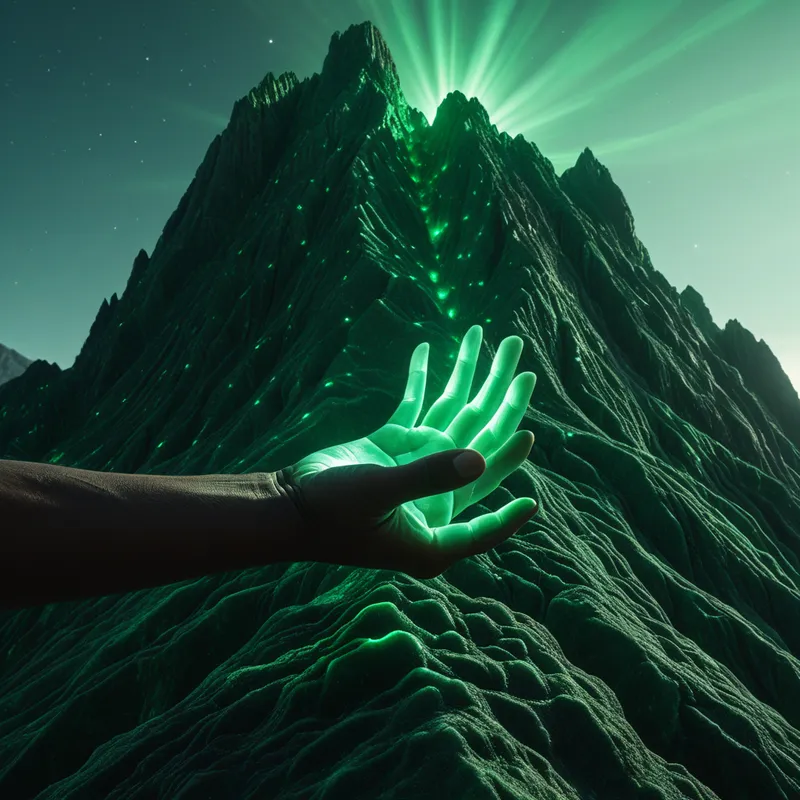
Without awaiting a formal decree, Jing turned from the pearlescent gates. It began a slow, deliberate descent, a streak of tranquil light against the dawn. As it fell, it did not burn like a meteor in rage, but cooled, its divine essence willingly accepting constraint. It touched the earth not with an impact, but a sigh—at the crown of the Kunlun Mountains. Where its form met the stone, a miracle of transmutation occurred.
Its luminous spirit infused the mountain’s heart. Its boundless compassion became a cool, soothing touch. Its unbreakable integrity became an impossible hardness, finer than steel. Its harmonious essence blossomed into colors: the serene green of deep, still waters, the pure white of mountain mist, and the lavender of twilight peace. The celestial being Jing was gone. In its place, woven into the very bones of the world, was the stone. The people who later found it, holding a piece that felt strangely warm and alive in the palm, could only name it with a breath of awe: Yu. Jade.
Cultural Origins & Context
The myth of Jade’s celestial origin is not found in a single, canonical text like a Greek epic, but is the cumulative breath of a civilization. It is woven into the fabric of Chinese thought across millennia, from the Neolithic Hongshan culture to the philosophical syntheses of the Han dynasty. It was passed down by ritual masters, literati, and artisans—not merely as a story, but as a lived truth.
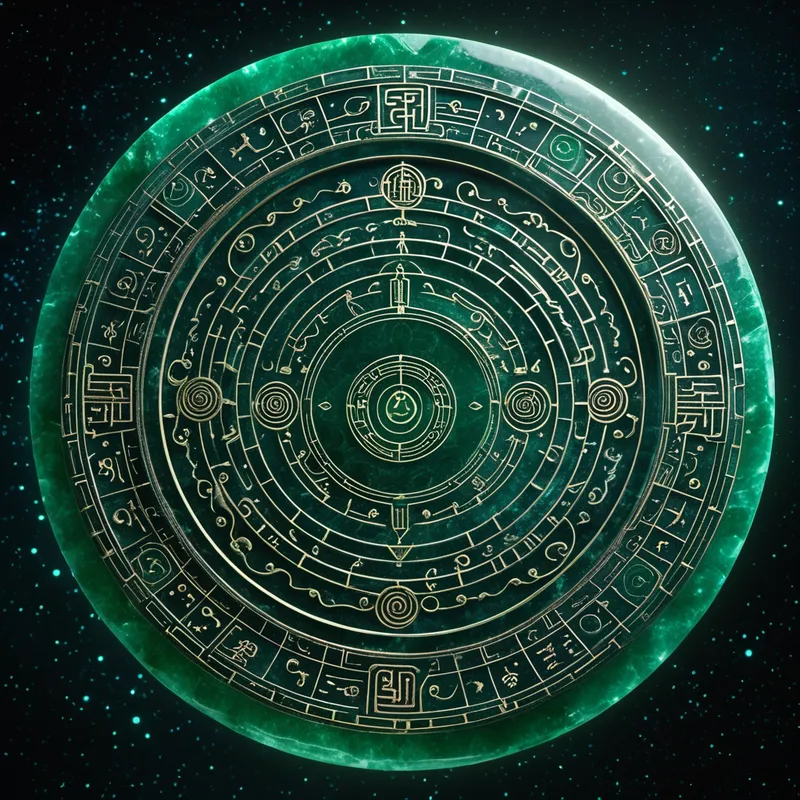
Its societal function was foundational. Jade became the ultimate material metaphor for ethical and spiritual cultivation. To say a nobleman had a “heart of jade” was the highest praise, implying his character had undergone the same patient, polishing friction against life’s hardships to reveal an inner luminosity. The myth provided a sacred origin for the most important ritual objects: bi discs, cong tubes, and burial suits of jade links. These were not mere ornaments; they were technologies of connection, using the stone’s divine residue to link the human realm with the celestial (tian) and the ancestral.
Symbolic Architecture
Psychologically, the myth of Jade is a profound map of the soul’s ideal condition and its genesis. The celestial being Jing represents the latent, perfect Self—the Jungian archetype of wholeness—existing in a pure, potential state in the unconscious (the heavens). The raw, chaotic earth symbolizes the conscious, embodied life, fraught with conflict and incompleteness.
The sacrifice of spirit into substance is the first law of incarnation. Perfection must shatter its own form to become a seed.
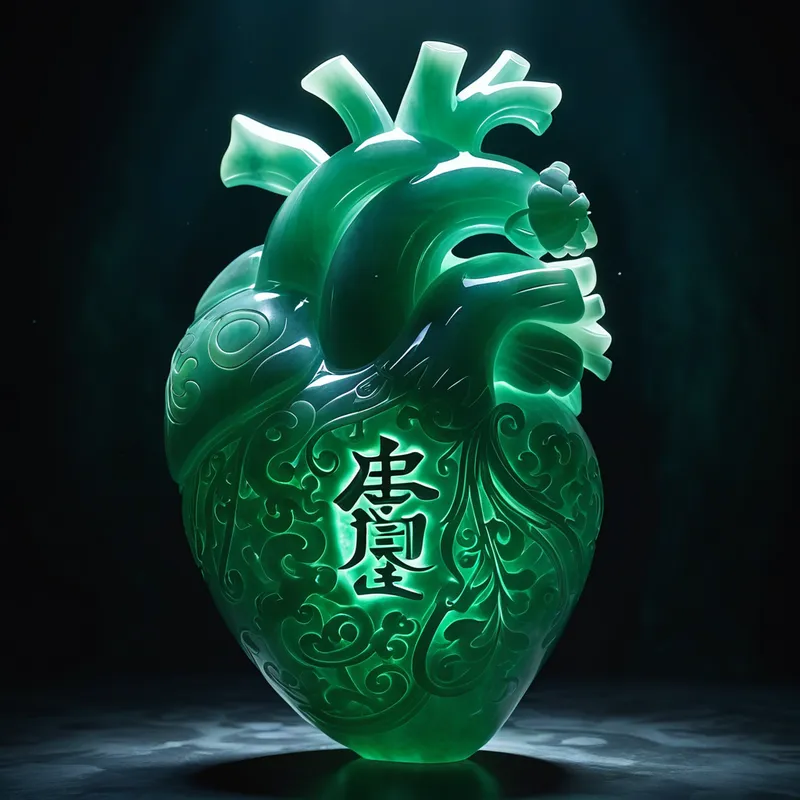
The descent and transformation are not a fall, but a willing act of kenosis—a self-emptying. The core symbols are clear: Divine Consciousness becomes Embodied Virtue. The stone’s physical properties are direct translations of psychic qualities: its toughness is resilience; its fine, dense grain is integrity; its cool touch is emotional equanimity; its translucence is the ideal of a consciousness that is refined enough to be penetrated by light, yet solid in its essence.
The myth teaches that true virtue is not imposed from without, but is a cosmic principle that has materialized within the world. The human task is not to create virtue from nothing, but to discover, excavate, and polish the jade already embedded in the mountain of one’s own being.
The Dreamer's Resonance
When this myth activates in the modern psyche, it often manifests in dreams of discovery and profound, quiet transformation. One does not typically dream of the celestial descent itself, but of its aftermath.
A dreamer might find themselves in a cave or riverbed, their hands digging through mud to uncover a strangely warm, glowing stone. The somatic feeling is not of excitement, but of deep, solemn recognition—a “remembering.” Alternatively, they may dream of holding a rough, unremarkable rock that, under a stream of water or with patient rubbing, begins to reveal a breathtaking, internal landscape of green and white. The conflict in the dream is usually the resistance of the material—the hardness of the stone, the depth of the mud—mirroring the psychological resistance to the difficult work of self-confrontation and refinement.
These dreams signal a process of individuation where a core, spiritual aspect of the Self (the celestial jade) is seeking conscious integration. The dreamer is being shown that their perceived flaws, their “hard” experiences, are the very matrix containing their essential virtue. The process feels like a sacrifice because it requires the dreamer to let go of a more diffuse, spiritual self-image to become something concrete, durable, and real.
Alchemical Translation
The alchemical journey modeled by the Jade myth is the transmutation of the spiritus into the lapis—the spirit into the stone. For the modern individual, this is the process of grounding transcendent ideals into enduring character.
The first stage is Recognition of the Divide: feeling the gap between one’s inner sense of harmony, integrity, or compassion (the celestial) and the chaotic reality of one’s life and emotions (the earthly). This creates the “sorrow” that motivates descent.
The crucial, voluntary stage is The Sacrifice of Pure Potential: This is the most challenging step. It means relinquishing the ego’s attachment to being “special,” “enlightened,” or above the fray. It is the decision to take one’s highest values and submit them to the friction of daily life, relationships, and failures—to let them be shaped and hardened by reality.
The polish is earned only through friction with the world. A virtue untouched by life is merely an idea.
The final stage is Becoming the Medium: One no longer just “has” ideals; one becomes a conduit for them. Like jade, the individual becomes a thing of beauty and function, their character possessing a quiet, unshakeable density. They become a “foundation stone” for others. Their presence is calming (cool to the touch), their word is reliable (hard), and their essence, though complex, has a translucent clarity. They have completed the arc from heaven to earth, not by falling, but by choosing to become the bridge itself. In psychological terms, the Self has become incarnate, and the individual has realized their unique, mineral-perfect form within the human community.
Associated Symbols
Explore related symbols from the CaleaDream lexicon: