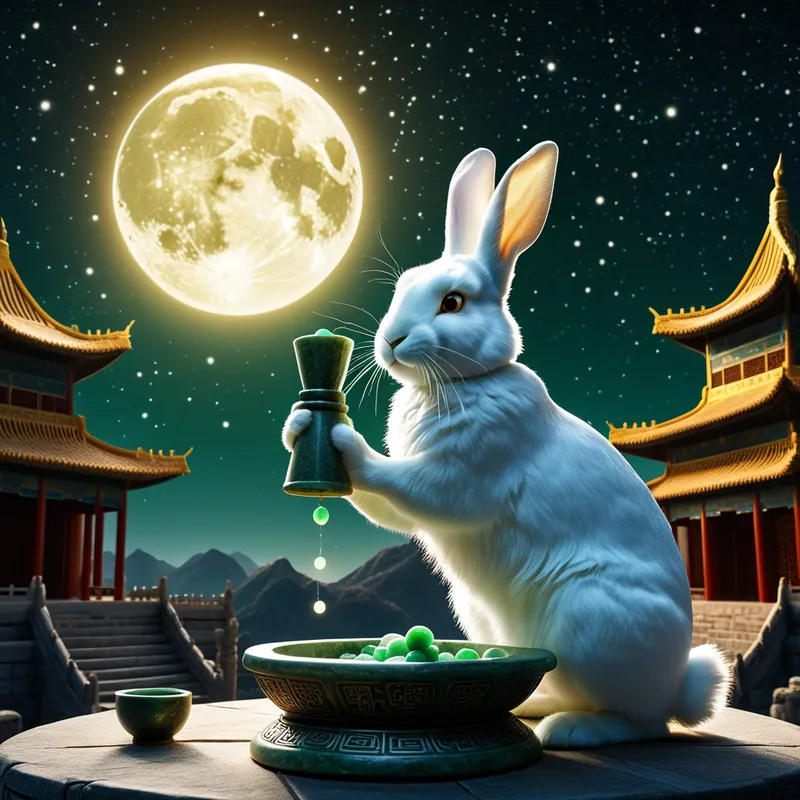
Jade Rabbit Myth Meaning & Symbolism
A celestial rabbit sacrifices itself to a disguised sage, earning immortality as the alchemist of the moon, forever pounding the elixir of life.
The Tale of Jade Rabbit
[The world](/myths/the-world “Myth from Tarot culture.”/) was old, and the heavens were watching. In a time when gods walked [the earth](/myths/the-earth “Myth from Hindu culture.”/) in disguise, testing the mettle of all living things, a great hunger descended—not of the body, but of the spirit. The [Jade Emperor](/myths/jade-emperor “Myth from Chinese culture.”/), ruler of the cosmos, or in some tellings, the Buddha himself, wished to know the heart of [the world](/myths/the-world “Myth from Tarot culture.”/). He cast off his celestial robes and took the form of a weary, ragged old man, his divine light hidden beneath the dust of the road.
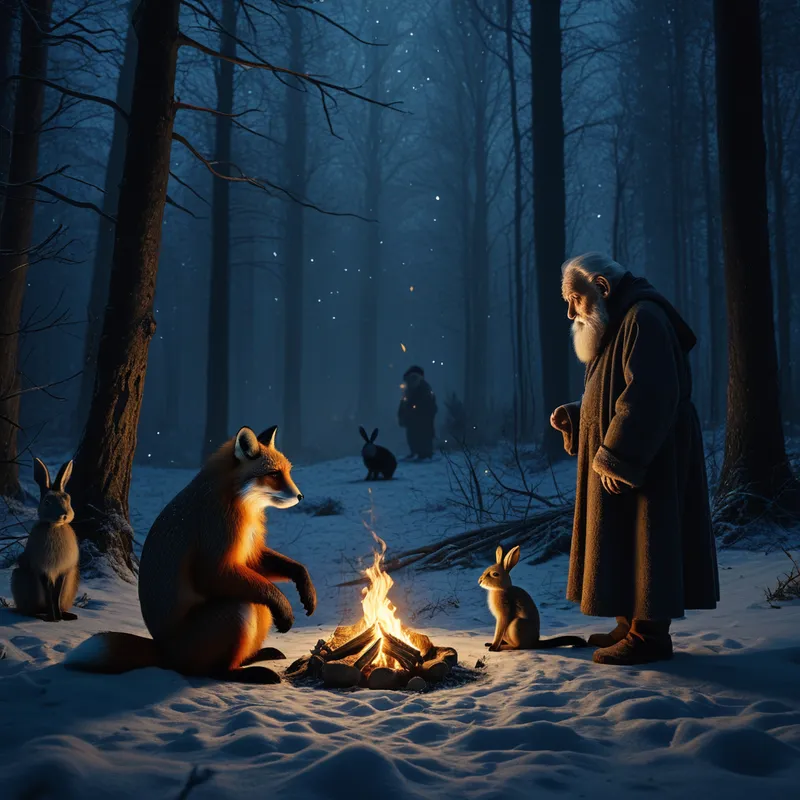
He stumbled into a deep, silent forest as the sun bled away. The air grew sharp with cold. Finding a clearing, he built a meager fire that fought weakly against the encroaching dark. His hunger was a hollow echo. Soon, three sets of eyes gleamed from the tree line—not with malice, but with curiosity. A fox, sleek and clever, emerged first. Then a monkey, agile and quick, swung down from the branches. Finally, a rabbit, pure white and gentle, hopped cautiously into the circle of flickering light.
The old man coughed, a dry, rattling sound. “I am starving,” he whispered to the three creatures. “Can you help an old traveler?”
The fox, with a proud flick of its tail, vanished into the shadows. It returned swiftly, dropping a freshly caught fish from a nearby stream at the old man’s feet. The man nodded but did not touch it. The monkey chattered and scrambled up a tree, returning with an armful of ripe, exotic fruits, which it presented with a bow. The man smiled weakly but again did not eat.
Then all eyes turned to the rabbit. The rabbit had nothing. It could not catch fish like the fox, nor pluck fruit like the monkey. It looked at its own empty paws, then at the suffering old man, then into the heart of the feeble fire. A profound stillness settled over the clearing. The very stars seemed to hold their breath.
Without a sound, the rabbit turned to the old man and bowed. Then it spoke, its voice as soft as moonlight on snow. “I have nothing to give you but myself. Eat me.”
Before any could react, the rabbit leaped not away, but into the heart of the fire. The flames, shocked by this ultimate offering, did not burn with their usual roar. Instead, they cooled and transformed into a pure, radiant light, cradling the rabbit’s form. The old man shed his disguise in an instant. The rags fell away, revealing the Jade Emperor, awash in celestial splendor. With a gesture, he plucked the rabbit from the mystical flames, unharmed, its fur now glowing with the serene, eternal green of precious jade.
“Your sacrifice is the greatest,” the deity proclaimed, his voice echoing through the cosmos. “You gave all you had, which was your very being. For this, you shall never be forgotten.” He swept the rabbit up into the heavens, to the cold, beautiful palace of [the moon](/myths/the-moon “Myth from Tarot culture.”/). There, the rabbit became the Yùtù, an immortal companion to [the moon](/myths/the-moon “Myth from Tarot culture.”/) goddess Cháng’é. And its eternal task? To pound the herbs of immortality in a mortar of jade, forever crafting the elixir of life for the gods, a silent, diligent alchemist against the infinite night.
Cultural Origins & Context
The myth of the Yùtù is a foundational layer in the rich stratigraphy of Chinese folklore, with roots stretching back over two millennia. Its earliest known appearances are in poetic allusions from the Shījīng and in texts from the Han Dynasty, where it became permanently lodged in the lunar imagination. The tale was never a single, canonical text but a living story, passed down orally, painted on silk scrolls, recounted during the [Mid-Autumn Festival](/myths/mid-autumn-festival “Myth from Chinese culture.”/) as families gazed at the full moon, searching for the rabbit’s shape in the shadows.
Its societal function was multifaceted. On one level, it was a moral fable for children, teaching the supreme virtue of selfless sacrifice (xīshēng) and compassion (cíbēi). On another, it was a cosmological story, explaining a celestial feature—the dark markings on the moon. But most deeply, it served as a cultural anchor point in the Taoist and Buddhist philosophies that permeated Chinese thought. It modeled the ideal of wúwéi (effortless action) through ultimate service and illustrated the Buddhist principle of giving without attachment, even to one’s own life. The rabbit’s immortality was not a reward for ambition, but a consequence of its utter lack of ego.
Symbolic Architecture
The [Jade](/symbols/jade “Symbol: A precious stone symbolizing purity, protection, and spiritual connection, often associated with wisdom, longevity, and harmony.”/) [Rabbit](/symbols/rabbit “Symbol: Rabbits often symbolize fertility, intuition, and resourcefulness in dreams, potentially reflecting a need for growth or change.”/) is not merely a [character](/symbols/character “Symbol: Characters in dreams often signify different aspects of the dreamer’s personality or influences in their life.”/) but a complex symbolic organism. The [rabbit](/symbols/rabbit “Symbol: Rabbits often symbolize fertility, intuition, and resourcefulness in dreams, potentially reflecting a need for growth or change.”/) itself, in [Chinese](/symbols/chinese “Symbol: Chinese symbolism represents a rich tapestry of culture, traditions, and philosophical beliefs originating from China.”/) symbology, represents longevity, purity, and auspiciousness. Its leap into the fire transforms these passive qualities into an active, alchemical principle.
The ultimate sacrifice is not a loss, but a translation of the mortal self into a symbolic essence.
The fire is the [crucible](/symbols/crucible “Symbol: A vessel for intense transformation through heat and pressure, symbolizing spiritual purification, testing, and alchemical change.”/) of transformation. It does not consume; it reveals. It tests the authenticity of the offering, burning away the chaff of pretense to leave only the pure jade of intent. The [moon](/symbols/moon “Symbol: The Moon symbolizes intuition, emotional depth, and the cyclical nature of life, often reflecting the inner self and subconscious desires.”/) is the [destination](/symbols/destination “Symbol: Signifies goals, aspirations, and the journey one is on in life.”/)—a [realm](/symbols/realm “Symbol: The symbol of ‘Realm’ often signifies the boundaries of one’s consciousness, experiences, or emotional states, suggesting aspects of reality that are either explored or ignored.”/) of cold [reflection](/symbols/reflection “Symbol: Reflection signifies self-examination, awareness, and the search for truth within oneself.”/), femininity (yin), the unconscious, and [eternity](/symbols/eternity “Symbol: The infinite, timeless state beyond human life and measurement, often representing the ultimate or divine.”/). The rabbit’s new home signifies a [movement](/symbols/movement “Symbol: Movement symbolizes change, progress, and the dynamics of personal growth, reflecting an individual’s desire or need to transform their circumstances.”/) from the warm, earthly, mortal [realm](/symbols/realm “Symbol: The symbol of ‘Realm’ often signifies the boundaries of one’s consciousness, experiences, or emotional states, suggesting aspects of reality that are either explored or ignored.”/) to the cool, celestial, and timeless.
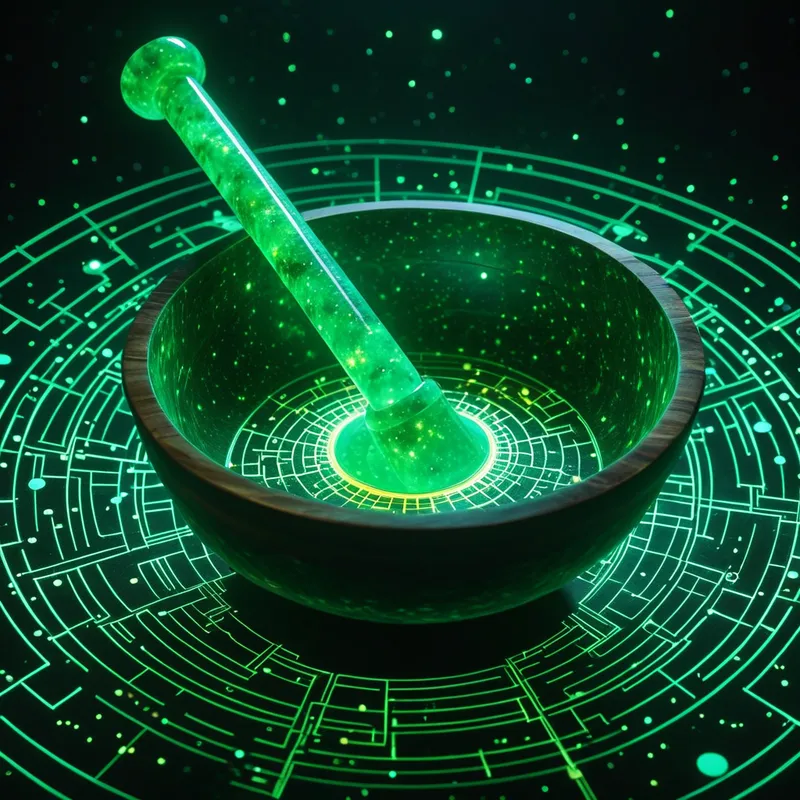
Finally, the [mortar and pestle](/symbols/mortar-and-pestle “Symbol: The mortar and pestle symbolize the process of transformation through effort, representing the grinding and melding of ideas and resources.”/) are the core symbols. This is the myth’s enduring [image](/symbols/image “Symbol: An image represents perception, memories, and the visual narratives we create in our minds.”/): the eternal, rhythmic act of pounding. It symbolizes the endless work of refinement, the slow, patient [alchemy](/symbols/alchemy “Symbol: A transformative process of purification and creation, often symbolizing personal or spiritual evolution through difficult stages.”/) that turns base herbs (the raw materials of experience) into the gold of wisdom and immortality. The rabbit is no longer a passive [victim](/symbols/victim “Symbol: A person harmed by external forces, representing vulnerability, injustice, or sacrifice in dreams. Often symbolizes powerlessness or moral conflict.”/) but an active, divine artisan.
The Dreamer’s Resonance
When the figure of the Jade Rabbit emerges in a modern dream, it often signals a profound psychological process centered on the ethics of [the self](/myths/the-self “Myth from Jungian culture.”/). To dream of the rabbit poised by the fire may indicate the dreamer is facing a situation demanding a painful but necessary sacrifice—perhaps of a long-held identity, a comfortable habit, or a selfish desire. The somatic feeling is often one of a hollow ache in the chest, a literal “heartache” of impending loss.
To dream of being the rabbit, pounding the mortar on the moon, speaks to a different phase. This is the somatic sense of repetitive, perhaps lonely, but deeply meaningful work. It can feel isolating (the cold moon) yet spiritually vital. The dreamer may be in a period of integrating a past sacrifice, patiently “pounding” their experiences into a new understanding, crafting their own inner elixir from the raw materials of their life. The rabbit in the dreamscape is an archetypal companion, assuring the dreamer that service to a higher principle—even in solitude—is a path to psychic wholeness.
Alchemical Translation
The myth of the Jade Rabbit is a perfect map for the Jungian process of individuation—the journey toward becoming one’s complete, authentic self. The initial, ego-centered state is represented by the fox and monkey: clever, competent, offering what they have in surplus (fish, fruit). The rabbit symbolizes the nascent Self, which recognizes that [the ego](/myths/the-ego “Myth from Jungian culture.”/)’s offerings are insufficient for true transformation.
The leap into the fire is the critical stage of enantiodromia—the plunge into the opposite. The conscious ego (self-preservation) must willingly encounter its opposite (self-sacrifice) in the transformative flames of the unconscious. This is not suicide, but the symbolic death of the ego’s primacy.
Individuation requires the courage to offer your familiar self to the transformative fire, trusting you will be reconstituted by a greater principle.
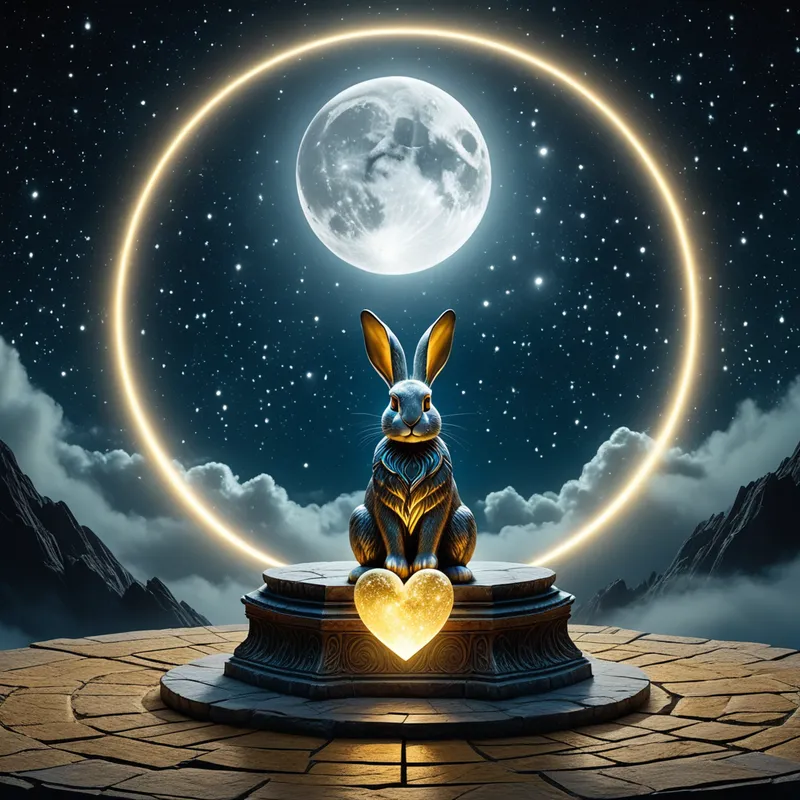
[The resurrection](/myths/the-resurrection “Myth from Christian culture.”/) as the Yùtù is the emergence of the Self from the unconscious, now tasked with its eternal work. The moon represents the achieved state of Self-realization—a place of reflective consciousness, no longer driven by earthly passions but engaged in a timeless, creative act. The endless pounding of the elixir is the ongoing work of [psyche](/myths/psyche “Myth from Greek culture.”/): continuously integrating new unconscious material, refining complexes, and maintaining the hard-won state of wholeness. The modern individual’s “moon palace” may be their chosen vocation, their art, or their inner spiritual practice—the place where they perform their sacred, repetitive labor, turning the base lead of daily existence into the gold of a meaningful life. The Jade Rabbit teaches that immortality is not about endless time, but about becoming an essential, eternal part of the cosmic pattern through humble, devoted service.
Associated Symbols
Explore related symbols from the CaleaDream lexicon: