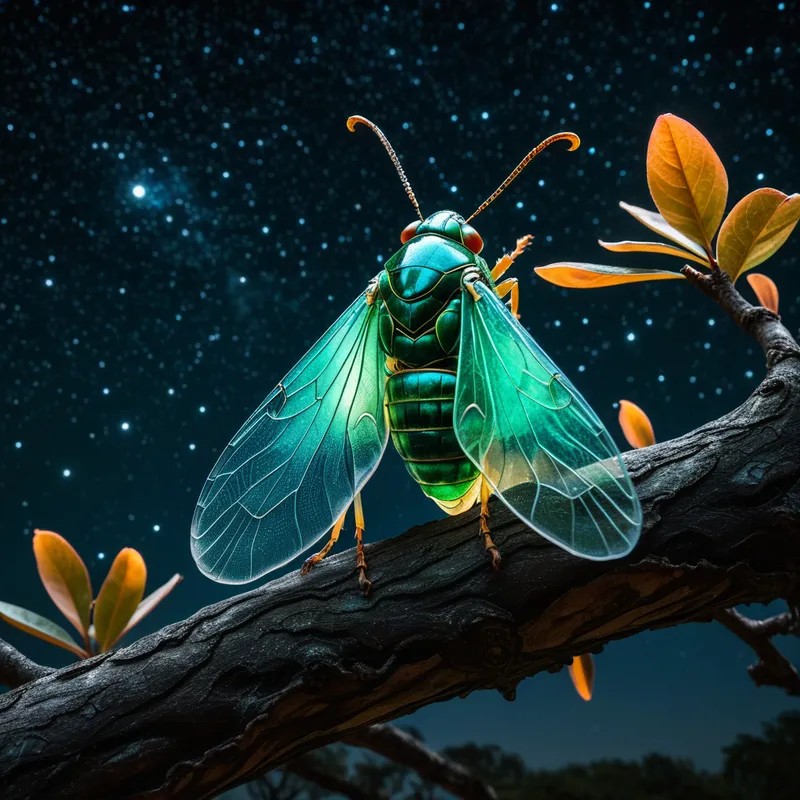
Jade Cicada Myth Meaning & Symbolism
A celestial artisan's quest to capture the song of immortality, forging a jade cicada that holds the secret of the soul's journey beyond death.
The Tale of the Jade Cicada
In the time before time was measured, when the Hundun had just begun to stir, there lived an artisan in the celestial courts. He was not a warrior, nor a sage, but a shaper of silence and singer of form. His name is lost, for names are for mortals, but his longing echoed in the halls of Jade Emperor. He longed to capture not beauty, but a transition—the very moment a soul slips from one world to the next.
He wandered the Nine Heavens and descended to the mist-wrapped peaks of the mortal realm. There, he heard it: a sound like cracking ice and ringing crystal. It was the song of the cicada, but not of life. It was the husk-song, the empty-shell hymn sung as the creature emerged, leaving its earthly skin clinging to the bark of an ancient peach tree—the Peach Tree of Immortality. He saw the ghost of the insect, a spirit of pure sound, ascending on iridescent wings towards the moon. Here was the secret: a life that proclaimed its own death to be born into a higher, resonant form.
The artisan fell into a profound stillness. He journeyed to the Kunlun Mountains, to the very source where earth-veins bled nephrite. For nine years and nine days, he fasted and meditated, his hands hovering over a raw stone of deepest green. He did not carve. He listened. He listened until he could hear the stone’s memory of water and time, until he could hear the silent scream of the cicada larva buried for seventeen years in the dark earth.
Then, with tools of moonlight and breath, he began. He was not removing stone; he was midwifing a form trapped within. As his tool touched the jade, the ghost-song of ten thousand cicadas filled the air. The workshop trembled. The jade grew warm, then cool, then translucent. Finally, as the morning star pierced the dawn, he held it in his palm: a cicada of perfect jade, so lifelike it seemed to vibrate with a captured hum. It held no features of a living beast, but the perfect essence of its transformation—the hollow abdomen, the folded wings, the poised silence of something about to sing or depart.
He presented it to the celestial court. It made no sound, yet all who beheld it heard the echo of their own potential for metamorphosis. The Jade Emperor declared it a treasure of heaven and earth, a bridge between states of being. It was placed in the care of Xi Wangmu, a guardian for souls navigating the great change. And so, the Jade Cicada was never just an artifact. It became a promise, a map, and a companion for the journey every being must one day take.

Cultural Origins & Context
The myth of the Jade Cicada is woven from multiple strands of ancient Chinese thought. It is not a single, codified narrative from one text, but a potent symbolic complex that emerged from the confluence of early animism, Daoist alchemical pursuits, and later mortuary practices. Its primary carriers were likely fangshi (Daoist masters) and master artisans.
The cicada itself was a powerful natural symbol observed for millennia. Its long subterranean life followed by a brief, resonant aerial adulthood made it a perfect metaphor for the qi-based worldview of cyclic death and rebirth. In elite burial practices from the Han dynasty onward, jade cicadas were placed on the tongues of the deceased. This was not mere decoration; it was a ritual technology. The jade, believed to preserve the body, combined with the cicada’s symbolism, was intended to protect the soul’s essence (hun) and ensure its successful metamorphosis and ascent, preventing its decay or descent into a ghostly state. The myth provided the cosmological "user manual" for this artifact, transforming a burial object into a divine tool for transcendence.
Symbolic Architecture
The myth’s power lies in its layered symbolism, each element a piece of psychic architecture.
The Cicada represents the soul itself—specifically, its capacity for radical metamorphosis. Its life cycle (long earth-bound dormancy, dramatic shedding, brief winged song) mirrors the human journey: a life of earthly toil, the "death" of the ego or old self, and the liberation of the spirit.
The Jade is the vessel of preservation and perfection. In Chinese cosmology, jade is the crystallized essence of mountain and water, embodying durability, purity, and spiritual potency. It does not corrupt. Thus, the Jade Cicada symbolizes the indestructible core of identity that undergoes transformation.
The myth teaches that we do not possess a soul; we are a soul currently wearing an earthen husk. The goal is not to decorate the husk, but to hear the jade-song within it.
The Celestial Artisan is the archetypal force of conscious intention—the ego in service of the Self. His nine-year meditation is the disciplined work of introspection, listening for the authentic pattern of one’s own being beneath the layers of persona and conditioning. He does not invent the cicada; he discovers it within the raw stone of potential.
The Dreamer's Resonance
When the Jade Cicada emerges in modern dreams, it signals a profound somatic and psychological process of incubation and emergence. The dreamer is often in a state of transition that feels both buried and inevitable.
Dreaming of being underground or in a dark, confined space, sensing a pressure to break out, directly parallels the cicada larva’s tenure. This is the somatic experience of a latent potential or a repressed aspect of the self pushing for expression. The body itself feels like a husk that has become too tight.
To dream of finding or holding a jade cicada often coincides with a moment of spiritual or creative insight—the "capture" of one’s own true form or purpose. It can feel like a cool, calming certainty amidst inner turmoil. Conversely, dreaming of a cicada struggling to shed its skin may reflect anxiety about a life change, a fear that the new self will not be able to fully emerge or function.
These dreams are the psyche’s ritual. They are the inner fangshi placing the jade on the tongue of the dying old identity, preparing it for the great change.
Alchemical Translation
The myth models the complete process of Jungian individuation—the psychic transmutation of the lead of the ego-personality into the gold of the Self.
The Raw Stone (The Unconscious Life): We begin identified with our "earthen" existence—our roles, traumas, and inherited patterns. This is the unshaped nephrite, the larva in the dark soil. Life is lived reactively, unconsciously.
The Artisan’s Listening (Active Imagination & Introspection): This is the crucial, often neglected phase. It is the disciplined turning inward, the fasting from external distractions, to hear the "ghost-song" of the Self. What pattern wants to emerge? What form is trapped within my stony habits? This requires tolerating silence and uncertainty.
The Carving (Differentiation & Sacrifice): This is the painful, precise work of shedding. Using the tools of conscious choice (moonlight) and breath (awareness), we carve away what is not essential—defensive patterns, outgrown identities, compulsive behaviors. This feels like a death, because it is.
The alchemy occurs not in becoming something new, but in allowing the eternal, jade-like essence to be revealed by the courageous removal of all that obscures it.
The Poised Cicada (The Integrated Self): The result is not a fixed state of perfection, but a dynamic poise. The Jade Cicada is always depicted ready for flight, yet eternally still. This is the state of the individuated person: grounded in their essential, incorruptible nature (jade), yet fluid and ready for the next phase of the soul’s journey (cicada). They hold the tension between being and becoming, mortal and immortal, sound and silence. They have become the artisan, the artifact, and the journey itself.
Associated Symbols
Explore related symbols from the CaleaDream lexicon: