Izanami in Yomi
The tragic story of the goddess Izanami's death and confinement in Yomi, the underworld, which established the boundary between life and death in Shinto belief.
The Tale of Izanami in Yomi
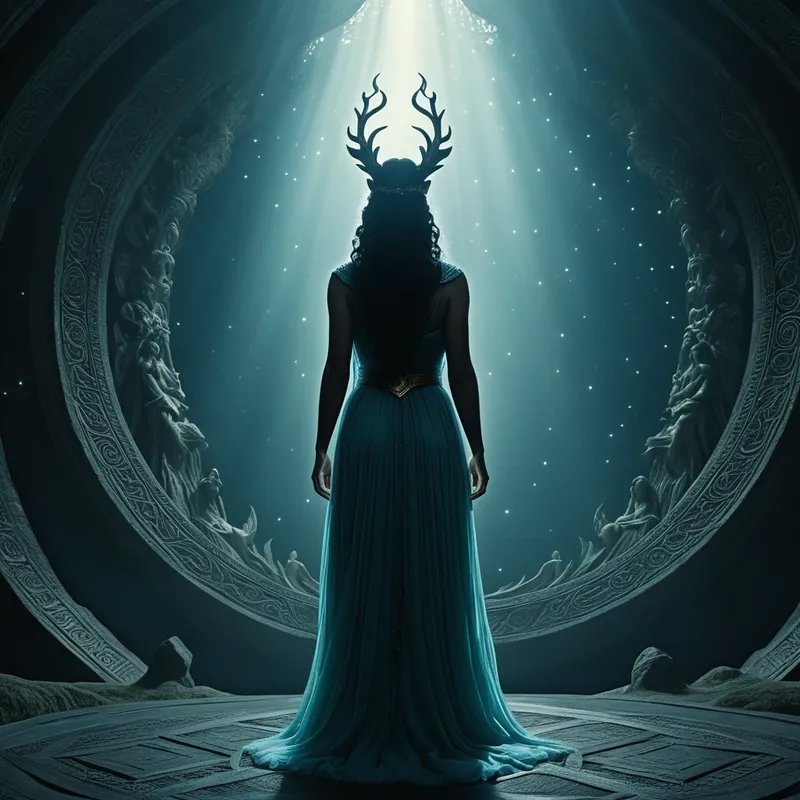
The divine work of creation was complete. The primordial couple, Izanagi and Izanami, had stirred the brine of chaos with a jeweled spear, giving form to the islands of Japan. They had populated the land with kami, the spirits of mountain, river, and forest. Yet, in the act of giving birth to the final deity—the fire god Kagutsuchi—Izanami was grievously burned. Her life force, the very essence of creation, began to seep away into the earth. As she lay dying, from her vomit, her urine, and her excrement, new kami were born—a final, terrible act of generation born from the dissolution of her form. Izanami then departed from the world of the living, her spirit descending to Yomi-no-kuni, the underworld.
Consumed by a grief that shook the pillars of heaven, Izanagi could not accept the separation. He resolved to descend into the shadowed land to retrieve his beloved, the other half of his divine self. His journey was a passage into increasing negation: from the sunlit plains of creation into a realm of stagnant, clinging darkness. After a long descent, he found Izanami within the great hall of Yomi. In the profound gloom, he could not see her clearly. He called out to her, pleading for her return to complete their work.
From the darkness, her voice replied, a whisper of regret. She lamented that he had come too late. She had already partaken of the food of Yomi, the hearth of the dead, and was now bound to this land. Yet, moved by his devotion and her own longing, she agreed to plead with the kami of Yomi for her release. She made him one solemn, desperate promise: “Do not look upon me.” She then retreated into the inner chambers of the hall to negotiate her freedom.
Time in Yomi is not as time in the living world. Izanagi waited, but the silence stretched, becoming a palpable weight. Fear and suspicion, the native emotions of the underworld, began to gnaw at him. Had she been lost forever? Had the rulers of Yomi claimed her? Unable to bear the uncertainty, he broke his promise. Snapping the left end-tooth from the multitudinous comb he wore in his hair, he lit it as a torch. The single, flickering flame pierced the absolute dark.
The light revealed Izanami, but not as he remembered. The goddess of life and creation was in a state of horrific decay. Her once-beautiful form was swollen and putrid, hosting the Yakusa no Ikazuchi, which writhed and roared upon her body. This was the truth of Yomi: not mere death, but the unmaking of form, the process of corruption that follows the final breath. The vision was an abomination to life itself.
Terrified, Izanagi turned and fled. Betrayed and enraged, Izanami shrieked, “You have shamed me!” She commanded the Yomotsu-shikome, the ugly women of the underworld, to pursue him. Izanagi, still a powerful kami, threw down his headdress, which became a bunch of black grapes to delay them, and then his comb, which transformed into bamboo shoots. Yet Izanami herself, in her wrath, joined the chase.
Izanagi reached the boundary between Yomi and the living world, the Yomotsu Hirasaka. He seized a massive boulder and thrust it into the pass, sealing it forever. From opposite sides of the stone, they spoke their final words. Izanami, from the land of the dead, declared, “My beloved lord, if you do this, I will each day strangle to death one thousand of the people of your country.” To this, Izanagi, from the land of the living, replied with fierce, tragic resolve, “My beloved, if you do that, I will each day build one thousand five hundred birthing huts.” In this exchange, the eternal, irreconcilable balance was struck: death would claim a thousand, but life would answer with fifteen hundred. The rift was absolute. The stone remains there still, the final, unyielding boundary between the realms of life and death.
Cultural Origins & Context
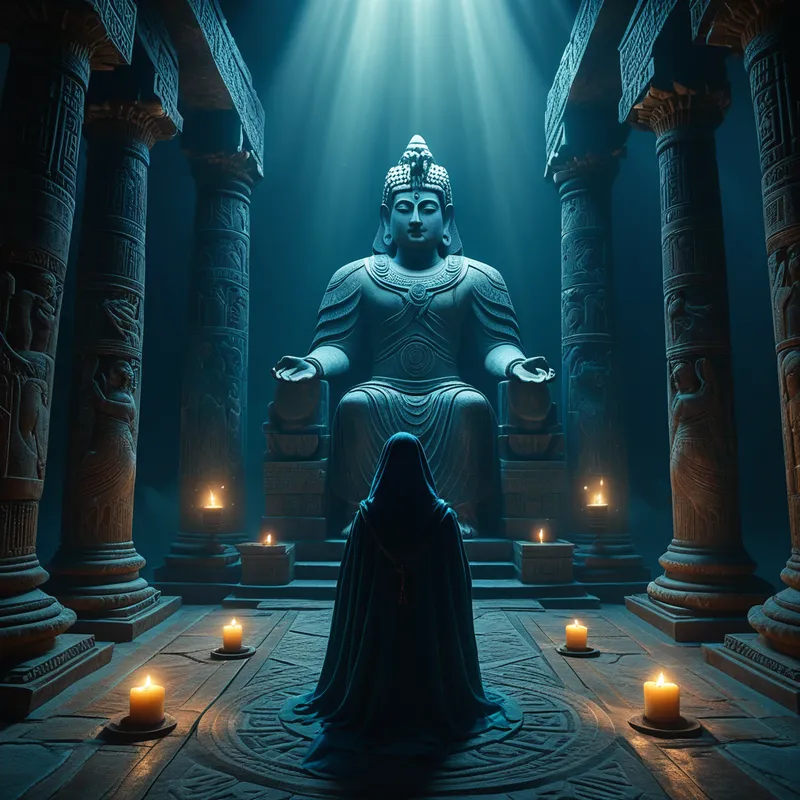
The myth of Izanami in Yomi is recorded in Japan’s oldest chronicles, the Kojiki (712 CE) and the Nihon Shoki (720 CE). It is not merely a story of a goddess’s death but a foundational cosmogonic narrative that explains the very nature of existence in Shinto thought. Prior to this event, death as a permanent, polluting force did not exist in the mythological chronology. The world was in a state of continual, sacred generation (musubi). Izanami’s death and confinement create the category of the impure (kegare), specifically the profound defilement of death, which stands in opposition to the purity and vitality (harae) essential to Shinto practice.
Yomi itself is not a place of moral judgment or reward, unlike Western underworlds. It is simply the land of the dead (yomi meaning “darkness” or “the shaded land”), a polluted counterpart to the bright, clean world of the living. The myth establishes the protocols for dealing with this pollution. Izanagi’s subsequent purification ritual (misogi) in a river, from which the sun goddess Amaterasu and the storm god Susanoo are born, becomes the archetypal act of harae, cleansing oneself from contact with death. Thus, the myth provides the theological and ritual basis for a central concern of Shinto: maintaining ritual purity by separating the sacred vitality of life from the corrupting touch of death.
Symbolic Architecture
The tale is a profound map of psychological and existential boundaries. Izanami’s transformation is the ultimate confrontation with the reality of decay, the formless truth that lies beneath the skin of all living things. Her body becomes a landscape of dissolution, hosting the chaotic “thunder” of decomposition. Izanagi’s flight is not cowardice, but the instinctive, necessary recoil of consciousness from the unbearable sight of its own annihilation.
The boulder at Yomotsu Hirasaka is the mythic embodiment of repression—not a psychological failure, but a cosmic necessity. It is the psychic barrier that allows life to continue by walling off the full, paralyzing knowledge of decay. To live is to accept this barrier, to turn one’s face from the Gorgon’s gaze of absolute mortality.
Their final exchange codifies the dynamic tension that defines the human condition. Life and death are locked in an eternal, quantitative struggle, but one where life holds a fragile, persistent numerical advantage. This is not a myth of despair, but of tragic, resilient balance. The separation is absolute, yet the relationship continues—a dialogue of threat and response across an impassable divide.
The Dreamer's Resonance
For the individual psyche, the descent into Yomi mirrors any profound encounter with loss, trauma, or the shadow self. It is the journey to retrieve a lost part of the soul—a lost love, a shattered innocence, a repressed memory. The dreamer, like Izanagi, enters a darkened inner landscape seeking wholeness. The promise “do not look upon me” is the condition set by the wounded self: approach with faith, not scrutiny; accept the process of healing without demanding to see the raw, unhealed wound.
The breaking of the promise is almost inevitable. The ego, impatient and terrified of the unknown, lights the torch of analysis, judgment, or premature confrontation. The resulting vision is the horror of the wound seen without the container of compassion—the beloved memory now associated with pain, the trauma in its unvarnished grotesqueness. The flight that follows is the psyche’s fragmentation, the painful re-traumatization that can occur when we confront our depths without adequate preparation or support. The sealed stone represents the dissociation that follows, a part of the self walled off as too dangerous to approach, yet forever shaping the landscape of one’s life from behind its barrier.
Alchemical Translation
In the alchemy of the soul, Izanami’s journey represents the nigredo, the blackening, the necessary descent into putrefaction. It is the stage where the prima materia—the raw stuff of the self—must decompose so that a new, more conscious integration can be born. Izanami does not return, but her fate transforms the entire cosmic order. Her “death” is the catalyst for a higher differentiation.
Izanagi’s purification is the albedo, the whitening that follows the black night of the soul. He does not bring his beloved back, but from the waters of his cleansing, new and more radiant deities are born. The lesson is alchemical: the goal of the descent is not to rescue the past in its old form, but to be utterly changed by the encounter, so that a new consciousness, symbolized by Amaterasu (the illuminating sun), can dawn.
The myth teaches that some separations are initiatory and final. The innocence of undifferentiated unity (the primal couple creating effortlessly) is forever lost. What is gained is the conscious, painful, yet resilient structure of a world where life understands its opponent. The soul’s task becomes not to obliterate the boundary stone, but to learn to live creatively and courageously in its presence, honoring both the light and the darkness it separates.
Associated Symbols
Explore related symbols from the CaleaDream lexicon:
- Underworld — The realm of the dead and the unconscious, a necessary shadow-land where what is lost or repressed resides, demanding acknowledgment.
- Separation — The fundamental, often painful, act of division that creates identity, consciousness, and the very conditions for relationship across a boundary.
- Death — Not merely an end, but a transformative process of dissolution that defines the nature of life and creates the category of the sacred.
- Door — The threshold between realms, a point of passage and decision that can seal shut, forever altering what lies on either side.
- Fire — A dual symbol of creative spirit (the hearth, the torch) and destructive, consuming pain (the burning birth, the revealing flame that horrifies).
- Mirror — That which reveals the true, often hidden, state of things; in the darkness of Yomi, the lit torch acts as a mirror, showing the unvarnished truth of decay.
- Wound — A lasting injury that changes the structure of being, from which new, unexpected, and sometimes terrifying energies can emerge.
- Mother — The archetypal source of life who, through her suffering and transformation, defines the very boundaries between life and death.
- River — A flowing boundary and a medium of purification, representing the possibility of cleansing and renewal after contact with corruption.
- Stone — The absolute, immovable symbol of finality, a sealed barrier that eternally divides one state of being from another.
- Ritual — The prescribed action (purification, misogi) that restores order and purity after a catastrophic encounter with pollution and chaos.
- Grief — The overwhelming emotional landscape that drives the quest into darkness and shapes the tragic, enduring response to irrevocable loss.