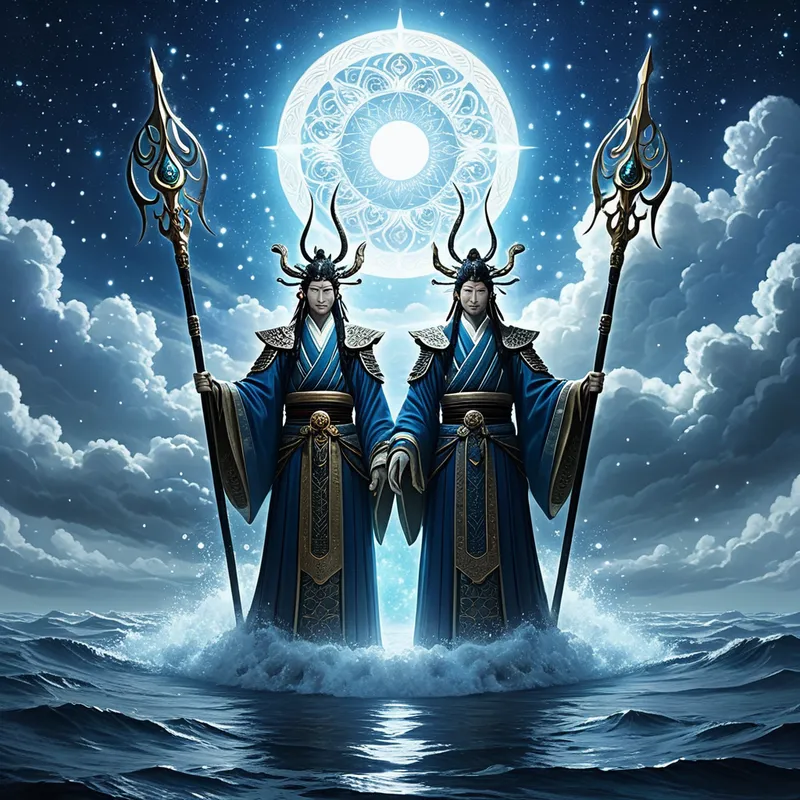
Izanagi and Izanami Myth Meaning & Symbolism
The primordial deities who birthed the Japanese islands and gods, whose story of love, broken taboo, and final separation defines life, death, and the sacred.
The Tale of Izanagi and Izanami
In the beginning, when heaven and earth were not yet parted, and the world was a formless, oily sea, the Kami called forth two beings from the pure essence of creation. They were Izanagi and Izanami. They stood upon the Floating Bridge of Heaven, and looked down into the swirling, silent brine below.
The heavenly deities gave them a task: to give shape to the land. Izanagi thrust his magnificent spear, Ame-no-nuboko, into the chaotic waters. He stirred and stirred. When he lifted the spear, the brine that dripped from its tip coagulated and formed the first island, Onogoro. The two deities descended to this newborn land.
They built a great pillar, Ame-no-mihashira, and a palace. To unite and give birth to the world, they must perform a ritual of circumambulation. Izanami, the female, spoke first: "What a fine and handsome youth!" Then Izanagi, the male, spoke: "What a fine and lovely maiden!" Their union was consummated.
But their first children were malformed, a leech-child and a floating island. Distraught, they consulted the heavenly kami. The verdict was clear: the female had spoken first, breaking the natural and divine order. The ritual was flawed. They must perform it again.
This time, Izanagi spoke first upon meeting his bride around the pillar. "What a fine and lovely maiden!" Then Izanami replied, "What a fine and handsome youth!" From this correct union, the eight great islands of Japan were born, one after another, rising from the sea like jewels. Then they birthed the kami of the mountains, rivers, grasses, and trees. The world was lush and full.
But in giving birth to the kami of fire, Kagutsuchi, Izanami was terribly burned. She fell mortally ill. From her vomit, her feces, and her urine, new deities sprang forth as she faded. Izanagi wept, but could not save her. She departed to the Land of Yomi.
Blinded by grief and love, Izanagi could not accept her loss. He journeyed to the dark, foul realm of Yomi to retrieve her. In the gloom, he heard her voice. "My lord and husband, you have come too late. I have eaten of the hearth of Yomi. I cannot return with you. But I will plead with the kami of this place. Do not look upon me."
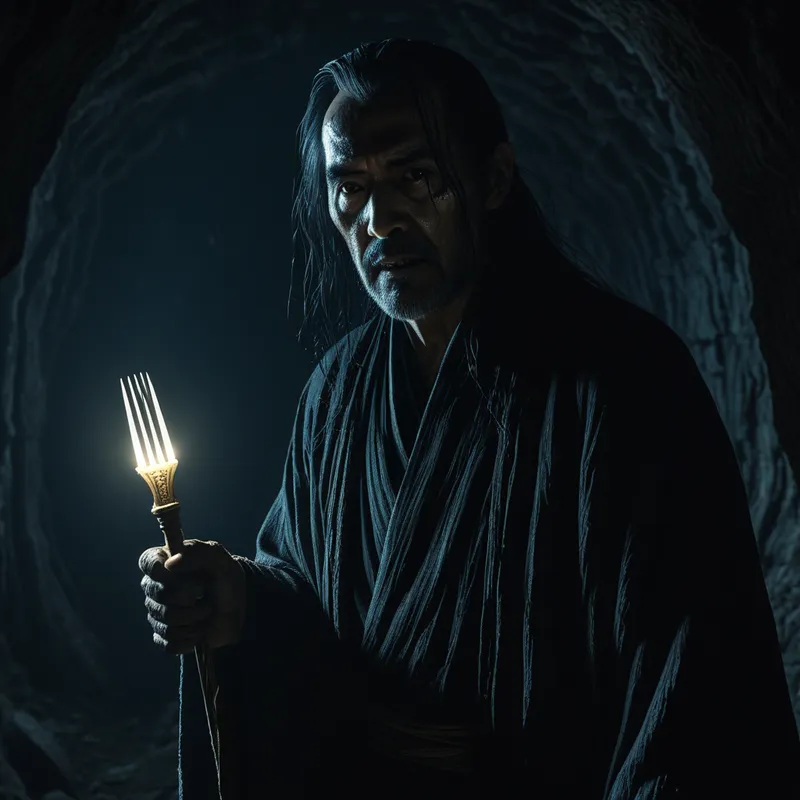
He waited in the darkness, but impatience and longing overcame him. Breaking a tooth from his comb, he lit it as a torch. The flickering flame revealed a horrifying sight: Izanami’s once-beautiful form was now a rotting, swollen mass, crawling with maggots and thunder deities. He cried out in terror and fled.
Humiliated and enraged, Izanami shrieked, "You have shamed me!" She sent the Yomotsu-shikome to chase him. Izanagi threw his headdress, which became grapes to distract them, then his comb, which became bamboo shoots. Finally, Izanami herself pursued him. Izanagi reached the boundary between Yomi and the living world, the Yomotsu Hirasaka, and rolled a massive boulder to seal it forever.
From opposite sides of the eternal stone, they spoke their final words. Izanami declared, "My beloved husband, if you do this, I will strangle one thousand of the people of your land each day." Izanagi replied, "My beloved wife, if you do that, I will cause one thousand and five hundred to be born each day."
Purifying himself in the river, from his discarded garments and the waters he washed in, new and mighty kami were born. From the washing of his left eye came Amaterasu. From his right eye came Tsukuyomi. And from his nose came the impetuous Susanoo. Izanagi, his work complete, withdrew from the world.
Cultural Origins & Context
This foundational myth is recorded in Japan's oldest extant texts, the Kojiki (712 CE) and the Nihon Shoki (720 CE). These works were commissioned by the imperial court to establish a divine lineage for the sovereign, tracing it back to Amaterasu, and thus to Izanagi and Izanami themselves. The myth served a crucial societal function: it provided a sacred cosmology that explained the origins of the Japanese archipelago (a potent political concept), its natural features, and the hierarchical order of the kami, which mirrored and legitimized the earthly imperial structure.
Passed down by court scribes and ritualists, the tale is not merely a "story" but a mytho-historical charter. It encodes ancient understandings of ritual purity (harae) and pollution (kegare), the correct order of social and cosmic relationships, and the profound, dangerous power of death. The incorrect ritual circumambulation that leads to malformed births underscores the ancient belief that proper form and sequence in ceremony are essential to generating life and harmony.
Symbolic Architecture
At its heart, this is a myth of differentiation. From the undifferentiated chaos of the primordial sea, order is born through the sacred, gendered interplay of Izanagi (active, penetrating principle) and Izanami (receptive, formative principle). Their union is not just procreative but cosmogonic—the world is literally born from their relationship.
The first act of creation is an act of separation: the spear parts the waters, the pillar establishes a center, and the ritual walk establishes a sacred circumference.
The tragedy unfolds through a breach of taboo—first in speech, then in gaze. Izanami speaking first inverts the perceived natural order, resulting in "bad births." Izanagi's gaze in Yomi is the ultimate transgression. He looks upon what should remain hidden: the raw, unvarnished truth of death and decay. This look shatters the idealized memory of the beloved, forcing a painful but necessary psychic separation. The sealed boulder at Yomotsu Hirasaka is the ultimate symbol of this necessary boundary between life and death, consciousness and the unconscious, the remembered and the real.
The prolific birth of deities from Izanami's death and Izanagi's purification illustrates a core psychological truth: from profound loss and the conscious engagement with pollution (grief, horror, guilt), new aspects of the psyche are born. Amaterasu (the conscious ego, clarity), Tsukuyomi (reflection, perhaps the unconscious), and Susanoo (raw, chaotic emotion) all emerge from the ordeal.

The Dreamer's Resonance
When this myth stirs in the modern soul, it often manifests in dreams of profound separation, forbidden looking, and frantic purification. To dream of a once-beautiful partner or parent now revealed as monstrous is not prophecy, but the psyche presenting the shadow side of an attachment—the decaying form of a relationship or ideal we have refused to release. The dreamer is Izanagi, confronting the fact that the person or situation they mourn no longer exists as they remember it; it has been transformed by the "hearth of Yomi," the irreversible processes of time, betrayal, or death.
Dreams of being chased through labyrinthine darkness by a furious, weeping feminine presence may signal a confrontation with what psychologist James Hillman called the "senex mother"—the possessive, guilt-inducing aspect of the maternal complex or a relationship that refuses to let consciousness move on. The act of throwing personal items (headdress, comb) that transform into sustenance represents the dream ego's attempt to buy time, to feed the pursuing complexes with fragments of one's identity to escape total engulfment.

Alchemical Translation
The journey of Izanagi is a perfect map for the alchemical process of individuation, specifically the ordeal of nigredo—the blackening, the confrontation with the shadow and the reality of mortality.
The conscious personality (Izanagi) begins in a state of creative partnership (the conjunctio). A traumatic loss—the death of a loved one, the end of a foundational life chapter—plunges the psyche into the underworld of depression, grief, and the unconscious (Yomi). The instinct is to recover the lost state, to restore the old world. But the psyche demands a deeper truth.
The pivotal moment of transformation is not the descent, but the illuminated gaze—the courageous, if terrifying, act of seeing the truth of the situation without the veil of nostalgia.
Seeing the "maggots"—the decay, the bitterness, the unavoidable reality—is horrifying, but it provides the catalytic shock needed for flight and separation. The ego must then perform a radical act of self-boundary setting (rolling the stone). This is not cruelty, but self-preservation and the establishment of a necessary distinction between the living psyche and the psychic dead.
The final purification is the albedo, the whitening. Izanagi washes away the pollution of the underworld. This is the conscious, often ritualistic, work of integrating the experience—through therapy, art, journaling, or spiritual practice. From this cleansing, new dominant psychological forces are born: a clarified sense of self (Amaterasu), a capacity for deep introspection (Tsukuyomi), and a liberated, if unruly, vitality (Susanoo). The myth teaches that from the courageous engagement with loss, decay, and taboo, a more complete and resilient consciousness is forged. The creator archetype is not just about making something new from nothing, but about recreating the self from the ashes of what could not survive.
Associated Symbols
Explore related symbols from the CaleaDream lexicon: