Iskandar Alexander in Islamic Tradition Myth Meaning & Symbolism
A righteous king journeys to the world's edge, seeking immortality, only to find a greater truth about fate, power, and the limits of mortal ambition.
The Tale of Iskandar Alexander in Islamic Tradition
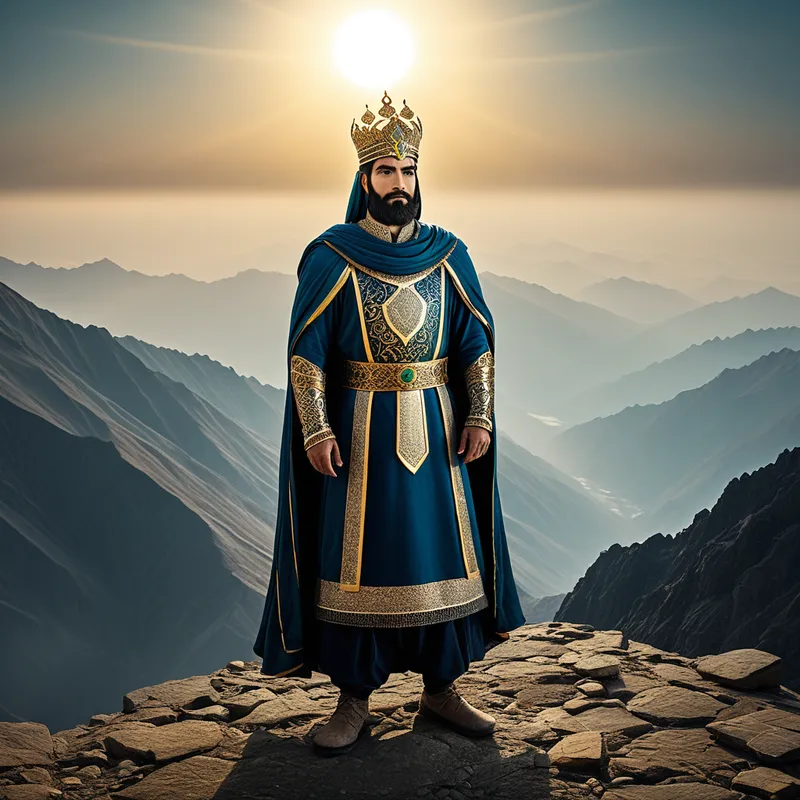
Hear now the tale of the Two-Horned King, Iskandar, a ruler blessed with the light of prophecy and the burden of an empire that stretched from the setting to the rising sun. His heart was a vessel of two desires: to order the world with justice, and to conquer the final, silent frontier that taunted every great soul—the frontier of death itself.
Whispers, carried on the winds from the lips of ancient hermits and encrypted in the stars, spoke of the Water of Life, hidden in the Land of Darkness. It was a place where the sun dared not shine, where direction was lost, and the soul was laid bare. Driven by a divine imperative and a very human yearning, Iskandar assembled his host. Not for pillage, but for pilgrimage. They marched beyond the maps, beyond the last outpost of men, following a celestial guidance that faded with each step into the thickening gloom.
In that absolute dark, where eyes were useless, Iskandar commanded his men to release the royal mares. “Follow the instinct of life,” he said. For where there is water, there is life, and life would seek its source. They stumbled, blind and fearful, hands on the shoulders of the man before them, a chain of humanity groping through eternity. Then, a scent of damp earth, a sound—the gentle, impossible trickle of water in the void. They had found a spring. The army drank, reviving their parched bodies, but Iskandar’s spirit remained thirsty. Was this the immortal draught? Or merely a waystation?
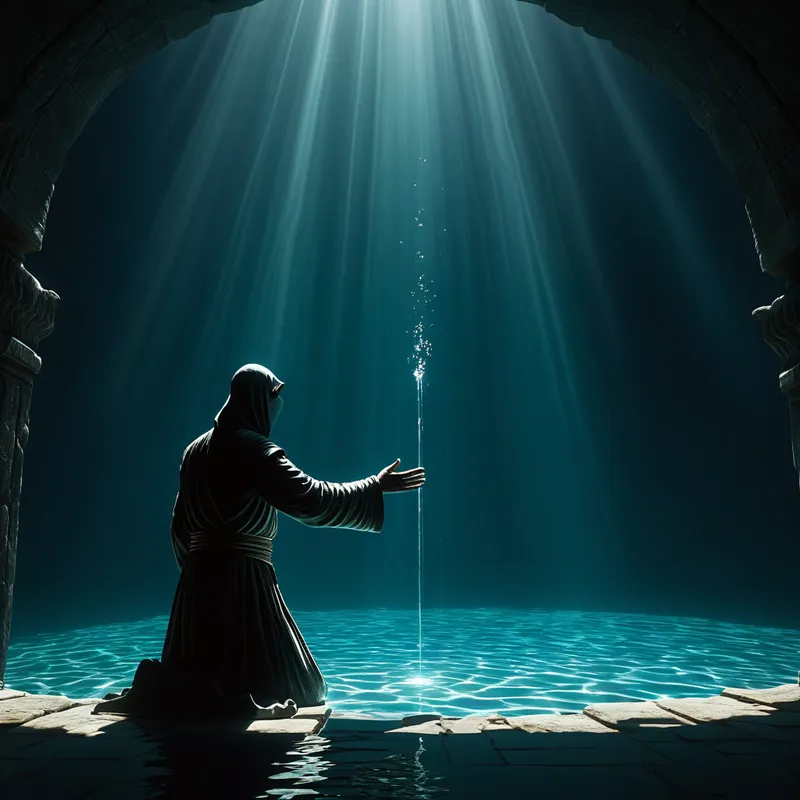
It was here, in the penumbra between worlds, that the guide appeared. Not a soldier, but a saint: al-Khidr, the Green One, whose knowledge was drawn from the divine source itself. Silently, Khidr led Iskandar to the true spring, its waters glowing with a soft, internal light. As Khidr drank and bathed in the waters, becoming one with their timeless essence, Iskandar was detained. Some tales say he turned aside to wash a salted fish, and the fish leapt to life, swimming away, stealing his moment. Others say a divine decree stayed his hand. He watched, frozen, as his guide attained the secret he sought. The Water of Life flowed, and then it was gone, hidden once more by the shifting veils of the world.
Iskandar emerged from the Darkness not with immortality in his flask, but with a heavier wisdom in his heart. He continued his journeys, building the mighty Wall of Gog and Magog to hold back chaos, a monument to order against the tide of oblivion. He soared to the heavens in a chariot pulled by griffins, seeing the earth as a platter and the ocean as a serpent, a vision of cosmic scale that shrunk his royal pride. And finally, in a quiet room, the angel of death, Izra’il, came not as a foe to be battled, but as a visitor to be welcomed. Iskandar, the conqueror of kingdoms, prepared for his final, unconquerable journey. He ordered his hands to be left outside his coffin, empty palms facing the sky, a silent testament to all who passed: See, I took nothing with me.
Cultural Origins & Context
The figure of Iskandar entered the Islamic imagination not as a foreign invader, but through a process of narrative assimilation and spiritual re-contextualization. Primarily sourced from the Qisas al-Anbiya traditions and solidified in the Quranic mention of Dhul-Qarnayn in Surah Al-Kahf, he was transformed from a Hellenistic conqueror into a righteous, monotheistic ruler and a proto-Islamic prophet-king. This was not historical revisionism, but mythopoesis—the weaving of a powerful historical memory into the moral and cosmological fabric of a new civilization.
Storytellers (qussas) in marketplaces and scholars in mosques narrated his tales. They served a crucial societal function: illustrating the proper use of power (justice over tyranny), the importance of divinely guided wisdom (‘irfan), and the ultimate submission of even the greatest king to divine will. Iskandar’s journey became a mirror for the soul’s journey, his external conquests reflecting the internal struggle for piety and understanding in the face of an immense and mysterious creation.
Symbolic Architecture
At its core, the myth of Iskandar is not about geography, but about psychology. It maps the trajectory of the heroic ego—brilliant, capable, and destined for greatness—as it confronts the boundaries of its own domain.
The hero’s ultimate adversary is not a monster at the world’s end, but the reflection of his own limitless desire in the pool of fate.
Iskandar represents the conscious ego at its most expansive. His quest for the Water of Life is the ego’s desire for permanence, to conquer death and secure its legacy eternally. The Land of Darkness is the uncharted territory of the unconscious, where logic and sight (the ego’s primary tools) fail. Here, he must rely on instinct (the mares) and surrender to a guide from the unconscious itself—al-Khidr.
Khidr embodies the archetype of the wise guide, a personification of the Self that operates on a timeless, intuitive plane. Iskandar’s failure to drink is not a punishment, but a necessary initiation. It symbolizes the moment the ego realizes it cannot possess the wholeness and timelessness of the Self; it can only witness it, be guided by it, and ultimately submit to its larger order. The building of the wall against Gog and Magog is then the ego’s necessary, but ultimately temporary, function of creating order and consciousness against the chaotic, undifferentiated contents of the psyche.
The Dreamer's Resonance
When this myth stirs in the modern dreamer, it often manifests as a profound crossroad in one’s life journey. To dream of being a powerful leader on an impossible quest may reflect a conscious life dominated by achievement and expansion—the corporate “conquest.” The dream may then plunge this figure into a disorienting darkness (a maze, a featureless landscape, a lost highway), signaling that the ego’s map has expired.
The somatic feeling is one of profound disorientation mixed with a compulsive forward momentum. The appearance of a silent, knowing figure (a stranger, an animal, a deceased elder) represents the emerging guidance of the Self, the inner Khidr. The critical moment—reaching a goal only to have it vanish, or being prevented from taking something—is the psyche’s enactment of the mythic lesson. The dreamer awakens not with frustration, but often with a strange, melancholic peace. The feeling is not of failure, but of a burden being lifted: the exhausting burden of needing to conquer one’s own fate, to be the author of one’s own eternity.

Alchemical Translation
The alchemical process modeled here is the transmutation of the heroic ego into a vessel for the Self. The base metal is the raw, identificatory pride of “I, the conqueror.” The journey through darkness is the nigredo, a necessary dissolution of the ego’s certainty.
The king must lose his crown to find his sovereignty. He must be emptied of his conquests to be filled with his kingdom.
Meeting Khidr is the beginning of the albedo—the illumination that comes not from the sun of conscious ambition, but from the moon of reflected, intuitive wisdom. Iskandar’s witnessing of Khidr’s union with the water is the pivotal moment of coniunctio. It is not a marriage he consummates, but one he observes: the conscious mind (Iskandar) witnessing the union of the guiding spirit (Khidr) with the eternal source (the Water). This observation is the integration.
The final stage, the rubedo, is not immortality of the body, but the realization of the soul’s place in the cosmic order. Building the wall represents the conscious personality now rightly ordered—strong, protective, and in service to the whole. His final acceptance of death, with empty hands, is the ultimate act of the redeemed hero: the ego, having served its purpose, willingly returns its authority to the greater Self. The individuated person is no longer a tyrant ruling the inner kingdom, but a wise steward, aware of both their power and their profound limits.
Associated Symbols
Explore related symbols from the CaleaDream lexicon:
- Journey — The central motif of Iskandar’s life, representing the soul’s progression through stages of power, quest, disillusionment, and ultimate wisdom.
- Water — Symbolizes the Water of Life itself, the ultimate goal representing immortality, divine knowledge, and the unconscious source of all being.
- Darkness — Represents the Land of Darkness, the necessary descent into the unknown unconscious where the ego’s tools fail and transformation begins.
- Mountain — The edge of the known world, a boundary between the human and divine realms, and a place of revelation and testing.
- Key — The guidance of al-Khidr, which unlocks the path to the hidden spring, but not the possession of the spring itself.
- Shadow — The unseen, chaotic forces of Gog and Magog, representing the repressed or untamed contents of the psyche that must be contained by the wall of consciousness.
- Crown — Iskandar’s kingly authority and worldly power, which must ultimately be relinquished in the face of a higher sovereignty.
- Door — The threshold of the Land of Darkness and the moment of choice at the Water of Life, representing points of irreversible psychic transition.
- Mirror — The reflective surface of the Water of Life, which ultimately shows the seeker not immortality, but the truth of their own mortal nature and limits.
- Destiny — The divine decree that guides Iskandar’s actions and sets the limits of his quest, framing his free will within a larger, inscrutable pattern.