Ishidōrō Myth Meaning & Symbolism
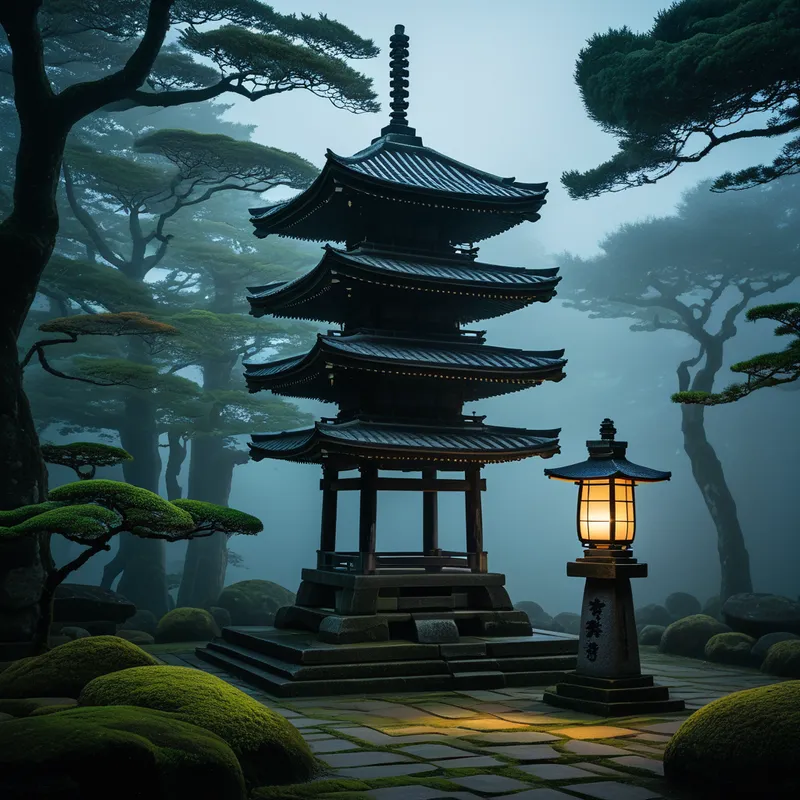
A stone lantern, witness to centuries of prayers, becomes a spirit, embodying the silent endurance of memory and the slow alchemy of grief into light.
The Tale of Ishidōrō
Listen, and hear the story not of a god or a hero, but of a witness. In a time when the mountains were younger and the rivers sang clearer songs, there stood a lantern of stone. It was not born, but placed—raised by human hands at a temple gate, or perhaps beside a grave where the cedars wept. They called it Ishidōrō.
For a hundred years, it did not move. Rain carved its shoulders. Snow settled in its cap. Moss stitched a velvet gown across its granite skin. It knew the touch of dawn and the embrace of deepest night. It heard the whispered prayers of the bereaved, the rustle of monks' robes, the laughter of children who did not see it, and the silence that followed when they were gone. It absorbed the sorrows poured out before it, the memories entrusted to the air around its unfeeling form. Each tear that fell on its base, each incense stick smoldered at its feet, each murmured name—these were not lost. The stone drank them in, a silent vessel for the world's unspoken grief.
Then came the night of the great storm. Winds howled like forgotten gods, tearing leaves from ancient trees. In the violent dark, a single, desperate prayer rose—not from a human throat, but from the accumulated longing held within the stone itself. It was a wordless cry of all it had witnessed, a surge of memory and empathy so potent it could no longer be contained.
In that moment, the boundary between object and essence dissolved. The stone did not crack, but softened. From within its light-box chamber, where for a century only borrowed moonlight had dwelled, a gentle, golden luminescence kindled. It was not fire, but something older: the condensed light of ten thousand remembered days, the warmth of a million unvoiced hopes. The storm raged on, but around the lantern, the air grew still and reverent. A presence now inhabited the form—a slow, deep, patient consciousness. The kami of the Ishidōrō had awakened. It did not speak, for its language was the offering of light. It did not walk, for its duty was to stand vigil. It had become the guardian of the threshold, the living memory of the place, a sentinel whose sole purpose was to hold the fragile, human light against the endless dark.
Cultural Origins & Context
The Ishidōrō is not a figure from a single, codified epic like the Kojiki. Its myth emerges from the animistic heart of Japanese spirituality, known as Shintō. This worldview holds that spirit, or kami, resides in natural phenomena and objects of particular age, beauty, or utility—mountains, waterfalls, ancient trees, and indeed, venerable stones.
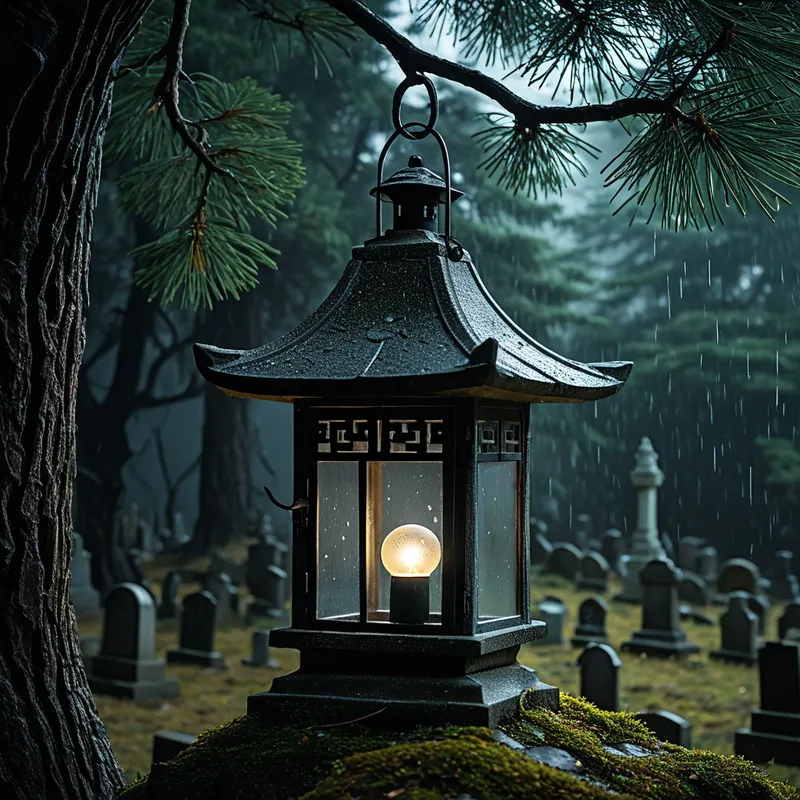
Stone lanterns were introduced from China via Korea, initially as practical Buddhist temple fixtures. In Japan, they were adopted and transformed, becoming integral to chanoyu gardens, Shintō shrines, and family gravesites. Their mythologization is a folk process, a story told not in books but felt in the atmosphere of a moonlit garden. It is the story an old gardener might hint at, or a feeling a solitary visitor receives in a quiet cemetery. The tale validates a common human experience: the eerie sense that a long-standing, attentive object has absorbed the emotions of a place and developed a presence of its own. Societally, the myth functions to sanctify memory and endurance. It teaches that places hold emotional residue, that witnessing is a sacred act, and that even the most inert elements of our world participate in a slow, spiritual ecology.
Symbolic Architecture
Psychologically, the Ishidōrō is a supreme symbol of the container. Its primary function is to hold light, but in the myth, it first becomes a container for human experience—for projected grief, joy, and memory. It represents the part of the psyche that must receive and hold difficult emotions without initially understanding or processing them. The stone is the unconscious itself, dense, patient, and seemingly immutable.
The first transformation is not from stone to spirit, but from emptiness to vessel. The soul must first learn to be a grave, to hold the weight of what is buried, before it can become a lantern.
The lantern's structure is deeply symbolic: a solid base (the foundation of the body and the past), a central pillar (the spine of enduring experience), a platform for the light chamber (the heart or mind where illumination occurs), and a roof (protection, the overarching spirit). Its awakening signifies the moment when the accumulated contents of the unconscious—the "prayers" we have whispered to ourselves in the dark—achieve a critical mass and begin to glow with their own consciousness. The light is not imported; it is released from within the stored experiences. This is the light of insight, born from processed memory and acknowledged feeling.
The Dreamer's Resonance
To dream of an Ishidōrō is to encounter the psyche's own memorial. It often appears in dreams during periods of grief, prolonged stress, or when processing deep-seated memories. The dream image may vary: a familiar garden lantern glowing with an odd light, a stone in a forest that feels intensely "watchful," or even becoming the lantern itself, feeling rooted and heavy yet illuminated from within.
Somatically, this dream pattern correlates with a felt sense of weight in the chest or shoulders—the "stone" of burdens carried. The psychological process is one of containment reaching its limit. The ego has been dutifully holding experiences it cannot yet integrate. The dream of the awakening lantern signals that the unconscious is ready to begin the alchemical work of transmuting this dense weight into usable light. It is a call to acknowledge what has been witnessed and stored, often silently, for too long. The dream may carry a mood of melancholic peace, suggesting that endurance itself is preparing to blossom into a new form of awareness.

Alchemical Translation
The myth of the Ishidōrō models the individuation process as one of profound patience and gradual illumination. It counters the heroic, active quest with the path of the steadfast witness. The modern individual is often a collection of unmetabolized experiences—traumas, joys, losses—all packed into the inner stone of the body and psyche. We are, initially, mere vessels for these events.
The alchemical operation begins with placement: consciously situating oneself in the context of one's life (the temple, the grave, the garden). Then comes the century of weathering: allowing time, life, and emotion to do their work of erosion and accumulation. This is the often frustrating stage where nothing seems to change. But the myth assures us that this weathering is not passive decay; it is the slow saturation of the soul with the raw material of life.
The spirit does not descend upon the stone; it emerges from the communion between the stone's endurance and all that has touched it. Enlightenment is remembered light.
The critical transmutation is the storm—the inner crisis or breaking point. This is not a failure, but the necessary catalyst that allows the saturated stone to finally react. The prayer that arises is the ego's surrender, acknowledging it can no longer merely contain; it must transform. The resulting light is the birth of a new psychic function: the Self as a source of inner illumination, fueled not by borrowed beliefs or external validation, but by the fully integrated, alchemized substance of one's own lived experience. One becomes a guardian of one own's threshold, able to hold a steady, compassionate light that guides without demanding, and witnesses with eternal, stone-born grace.
Associated Symbols
Explore related symbols from the CaleaDream lexicon: