Isfandiyar the Invincible Hero Myth Meaning & Symbolism
A prince made invincible by divine ritual is undone by his own destiny, a story of fatal pride, paternal betrayal, and the paradox of perfect power.
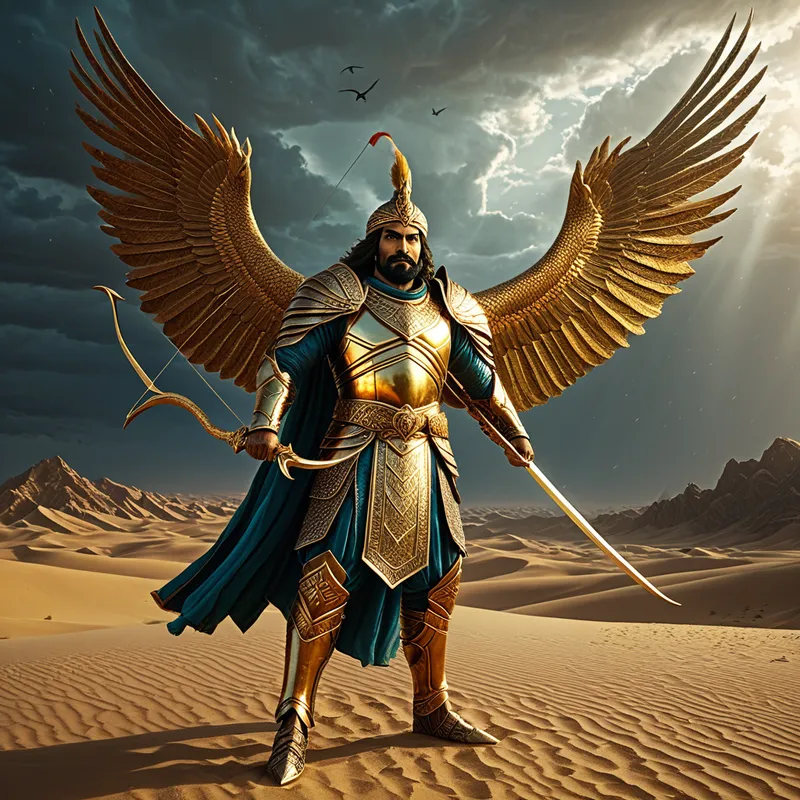
The Tale of Isfandiyar the Invincible Hero
Hear now the tale of the prince who became a fortress, whose flesh was turned to a living citadel, and whose destiny was written not in ink, but in a single, impossible flaw.
In the court of the mighty Goshtasp, ambition hung thick as incense. The Shah, gripped by a restless pride, demanded his son, the noble Isfandiyar, march to the farthest reaches of the empire and subdue the rebellious Rostam of Zabol. Isfandiyar, a hero of peerless might and virtue, had already performed the Haft Khan, slaying wolves, sorcerers, and dragons. Yet his father’s command was a bitter cup. To chain the lion of Iran was a sin against the very land he swore to protect.
But Goshtasp held a cruel leverage. He promised the throne, the ultimate prize, only upon Rostam’s capture. Torn between filial duty and heroic honor, Isfandiyar set forth, his heart a battlefield. His journey was a symphony of force; armies scattered before him like autumn leaves. Yet, a deeper magic protected him. In his youth, the divine bird Simurgh had performed a sacred ritual. She washed his body in a celestial alloy, in the glowing Holy Simurgh Copper, rendering his skin impervious to all weapons of earth—iron, steel, and stone. He was invincible. A walking monument to divine favor.
He arrived at Rostam’s stronghold not with a siege, but with a parley. The air between the two titans crackled with reluctant respect. “Come willingly to my father’s court,” Isfandiyar pleaded, his voice heavy with foreknowledge. “Spare us this conflict.” But Rostam, the ancient pillar of Iran, could not bow. “To be bound is a death for a man like me,” he rumbled. “And to bind me is a death for you, Prince, though you know it not.”
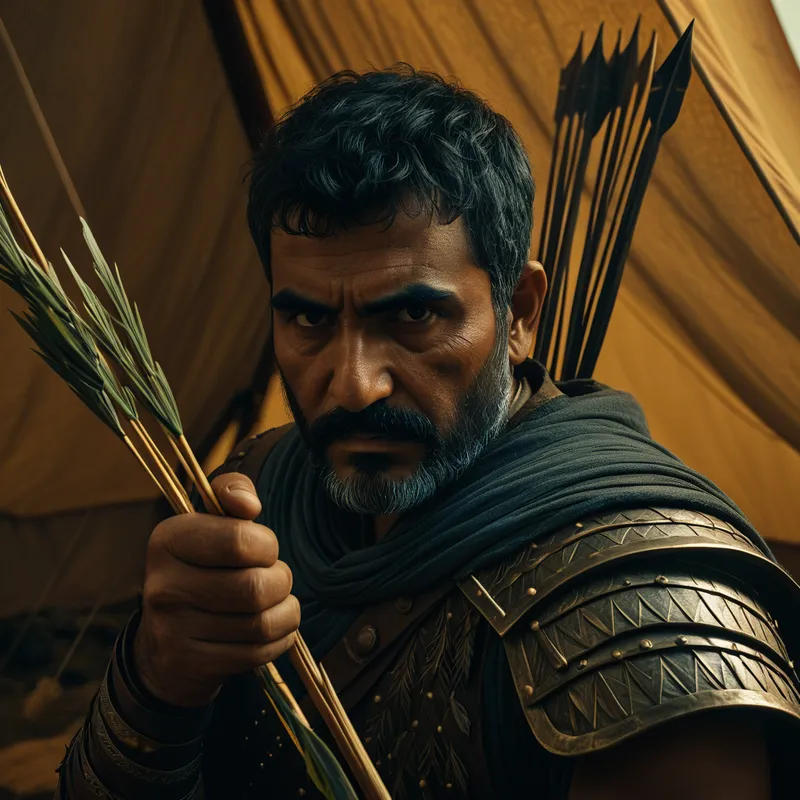
Three times they met in single combat. Three times Rostam’s legendary strength, his arrows and his blade, shattered against Isfandiyar’s copper-blessed skin. The prince stood unmarked, a demigod amidst the dust. Despair gripped Rostam. In the silence of his pavilion, an old memory stirred—a whispered secret from the Simurgh herself, who had once healed his own father. The invincibility had a condition, a cosmic loophole. Isfandiyar’s eyes were the gates to his soul, and thus, the only part left vulnerable.
With a sorrow as deep as the Farakhkert, Rostam crafted a weapon not of war, but of fate. He took a branch of tamarisk, the tree of the desert, and carved it into a forked arrow. At dawn, in the final confrontation, he did not aim for the body, but for the light of the world reflected in the prince’s eyes. The arrow flew, a whisper of destiny. It found its mark, piercing through the eye and into the brain.
Isfandiyar fell, not with a cry of pain, but with a sigh of profound recognition. The invincible hero was felled not by a superior foe, but by the very design of his power, a design known only to the wise and the divine. In his final moments, with Rostam weeping at his side, he forgave his slayer and cursed the paternal pride that had engineered his doom. The fortress was breached not from without, but through the window it was given to see the world.
Cultural Origins & Context
The epic of Isfandiyar is a central pillar of the Shahnameh (“The Book of Kings”), penned by the poet Ferdowsi in the 10th century CE. Ferdowsi synthesized earlier Sassanian chronicles and oral traditions into a unified Persian national epic, composed in a conscious effort to preserve Persian language, history, and identity following the Arab conquest.
The story functions on multiple cultural levels. On the surface, it is a thrilling heroic tragedy, told by naqqals in coffeehouses for centuries. On a deeper level, it is a profound political and ethical commentary. It dramatizes the catastrophic conflict between two legitimate forms of authority: the royal, hierarchical power of the Shah (Goshtasp/Isfandiyar) and the ancient, charismatic, and tribal authority of the champion (Rostam). The story asks: what happens when the king’s command violates the deeper laws of honor and the land? The tragedy serves as a warning about the corruption of power, the danger of paternal exploitation, and the inevitable downfall that comes from forcing a righteous man to act against his nature.
Symbolic Architecture
Isfandiyar is the archetype of the Persona taken to its absolute extreme—a perfect, impenetrable mask of strength and divine sanction. His copper skin is not just armor; it is a symbolic encapsulation of a life lived according to an external, flawless ideal. He is the ultimate loyal son, the perfect warrior, the divinely appointed heir.
The ultimate defense becomes the ultimate prison. Invincibility is the state of being perfectly defined, and thus, perfectly knowable—and in the realm of fate, to be fully known is to be vulnerable.
The Holy Simurgh Copper represents a blessing that is also a curse. It is the gift of the Great Mother (the Simurgh as nurturing, magical force) that severs the hero from the common human condition. It grants him a god-like status but at the cost of his humanity and his capacity for genuine relationship. He cannot be touched, and therefore, cannot truly connect.
His vulnerable eyes are the symbolic key. The eyes are the organs of perception, of receiving the world. They represent consciousness itself, the one part of us that must remain open and soft to function. Psychologically, this is the point where the outside world—the truth, a painful insight, a moment of empathy—can penetrate even the most fortified ego. Isfandiyar’s flaw is that he sees. His doom comes not from a weakness of body, but from the necessary vulnerability of consciousness.
The Dreamer's Resonance
When this myth stirs in the modern unconscious, it often manifests in dreams of impregnable fortresses, perfect bodies that feel like shells, or situations where one feels tragically bound to a duty that will destroy one’s soul. The dreamer may experience somatic sensations of stiffness, of being coated in something heavy, or of having a “blind spot” that is terrifyingly exposed.
Psychologically, this signals a confrontation with what we might call the “Invincible Complex.” This is a psychic structure built on a foundation of perfect performance, often established in response to paternal (or authoritarian) demands. The individual feels they must be flawless, unassailable, and beyond reproach to earn love, security, or a throne (success/status). The dream is the soul’s rebellion against this copper cage. The feeling of being “fated” to fail in a specific, pinpoint way is the unconscious revealing the built-in release valve—the eye, the vulnerable truth—that is the only path to liberation from the complex, even if that liberation initially feels like a catastrophic wounding.
Alchemical Translation
The alchemical process modeled here is the solve et coagula—the dissolution of the perfected form to release the trapped spirit. Isfandiyar’s copper body is the coagulatio, the fixed, metallic state of a personality that has identified completely with its heroic role and its divine mandate. It is brilliant, ordered, and dead.
The arrow of tamarisk is the agent of solve. It is not brute force, but precise knowledge—the insight that dissolves the illusion of total invulnerability. It is the painful, specific truth that one has avoided seeing about oneself or one’s situation.
For the modern individual, the “alchemical translation” of this myth is the journey from being the Hero who is invincible to becoming the human who is whole. The process requires:
- Acknowledging the Copper: Recognizing the ways we have armored ourselves with perfectionism, titles, or ideologies to feel safe and powerful.
- Confronting the Paternal Command: Identifying the internalized voice (of a parent, society, or our own super-ego) that demands this impossible, soul-killing perfection as the price for belonging or worth.
- Accepting the Flaw of Perception: Allowing our point of vulnerability—our true feelings, our doubts, our softness—to be seen, first by ourselves. This is the “eye” that must be risked.
- The Wounding Liberation: The inevitable crisis where the armored identity is pierced by reality. This is not a failure, but the necessary death of the invincible persona. Like Isfandiyar, in this moment we see the truth of our bondage and, in that seeing, are freed from it, even as the old self dies.
The ultimate transmutation is the realization that true strength lies not in being impervious, but in being permeable—able to be affected, to learn, to grieve, and to connect. The soul is reborn not as copper, but as living flesh and spirit.
Associated Symbols
Explore related symbols from the CaleaDream lexicon:
- Hero — The central archetype of Isfandiyar, representing the ego's quest for perfection and glory, which ultimately becomes its own tragic trap when divorced from human vulnerability.
- Father — Represents the external authority (King Goshtasp) and the internalized super-ego whose impossible demands set the fatal destiny in motion, pitting duty against authentic selfhood.
- Fate — The inescapable design woven into the blessing of invincibility, symbolizing the psychological truth that a strength over-developed becomes a predestined weakness.
- Wound — The piercing of the eye, the necessary and fatal penetration of the armored persona that alone can liberate the trapped spirit from its perfect prison.
- Sacrifice — Isfandiyar's life is the ultimate sacrifice, not chosen but engineered, representing the catastrophic cost paid when one's life is lived solely to fulfill an external mandate.
- Pride — The driving force of both Goshtasp's command and Isfandiyar's acceptance of it, the hubris that believes divine favor or perfect performance can override deeper moral and personal laws.
- Bird — Manifest as the Simurgh, the divine agent who bestows the fatal blessing, representing the transcendent, magical force of the unconscious that intervenes in human destiny with ambiguous gifts.
- Tree — The tamarisk branch, a humble piece of the natural world, becomes the instrument of fate, symbolizing how the raw, organic truth (the unconscious) can dismantle the most refined artificial construct (the invincible persona).
- Light — Associated with the vulnerable eyes, representing consciousness, perception, and the unavoidable point of exposure where the outer world meets and transforms the inner self.
- Shadow — Rostam, the heroic adversary, acts as Isfandiyar's shadow, the carrier of the fatal knowledge and the reluctant agent of the destiny the prince cannot see for himself.
- Death — Not merely an end, but a profound initiation and recognition in the myth; Isfandiyar's death is the moment of ultimate clarity and release from his bound destiny.
- Hero's Journey — A dark inversion of the classic monomyth, where the hero's triumphant return is corrupted by paternal manipulation, and the final threshold becomes a fatal confrontation with his own perfected image.