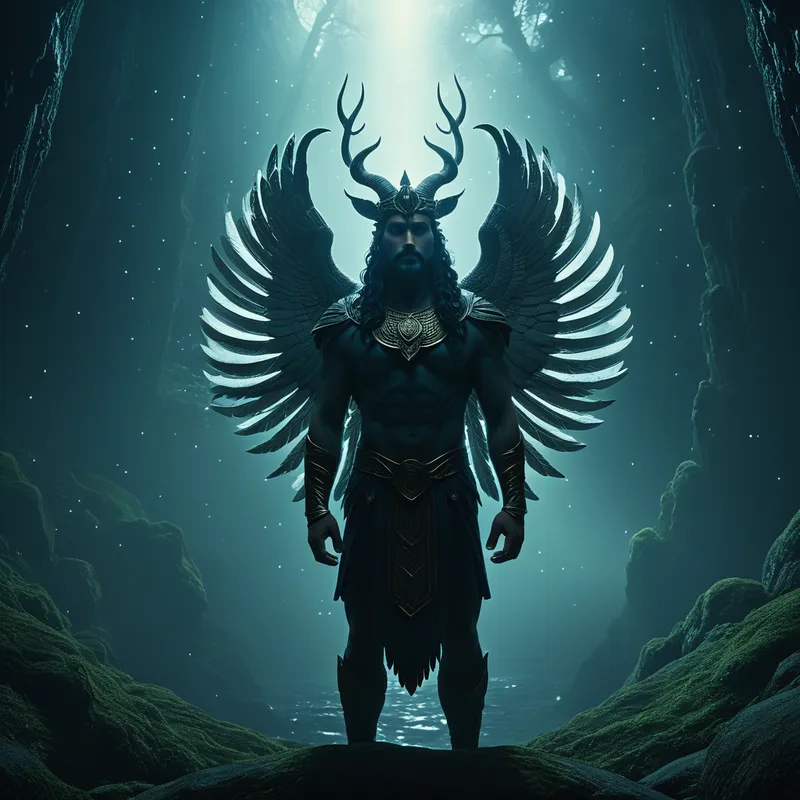
Inanna and Shukaletuda
A Sumerian myth where a humble gardener's crime against the goddess Inanna unleashes her wrath and a desperate chase across the heavens.
The Tale of Inanna and Shukaletuda
The story begins not in a palace or a temple, but in the humble, dust-choked garden of Shukaletuda. He is a gardener of meager skill, laboring under a sun that seems to scorn his efforts. His plants wither; his trees bear no fruit. The land is barren, mirroring a spirit crushed by failure and the contempt of his peers. In his despair, he lifts his eyes to the heavens, not in prayer, but in a simmering resentment. Why had the gods granted him this lot? His gaze falls upon the great Firmament, and a plan, born of desperation and a profound arrogance, takes root.
He resolves to use the very stars themselves as his irrigation guide. Studying the celestial patterns, he digs his channels so that the heavenly light, the me-lám—the terrifying, divine radiance—of the [constellations](/myths/constellations “Myth from Various culture.”/) would fall upon his garden. It is an act of profound audacity, a mortal attempting to harness cosmic order for his own petty ends. Yet, by this stolen, sidereal power, his garden blooms. Lush shade spreads where there was only dust.
Into this manufactured oasis descends [Inanna](/myths/inanna “Myth from Sumerian culture.”/), the Queen of Heaven and Earth. Weary from her celestial duties, from judging the disputes of gods and the petitions of kings, she seeks rest. Finding the deep, cool shade of Shukaletuda’s tamarisk tree, she lies down and, wrapped in her own divine radiance, falls into a deep, vulnerable sleep. She is the totality of cosmic power, incarnate and unconscious.
Shukaletuda discovers her. Here, the text becomes fragmentary, the act itself shrouded in an euphemistic darkness that speaks louder than any graphic description. The Sumerian word is hu-luh-ha, a violation, a defilement. He sees not the goddess, but an opportunity—an object upon which to enact his own buried rage against a universe he feels has wronged him. In that moment of violation, the powerless seeks a twisted, catastrophic power over power itself.
Inanna awakens. The knowing comes upon her not as a memory, but as a seismic shift in her very being. A sacred boundary of self has been breached; the inviolable has been violated. Her wrath is not a mere emotion; it is a cosmological event. She unleashes a series of plagues upon the land, turning the waters to blood and casting blight upon all living things. She is not seeking a criminal; she is purging the very world that allowed such a crime to touch her. [The earth](/myths/the-earth “Myth from Hindu culture.”/) itself must scream its complicity.
Yet Shukaletuda escapes her immediate sight. Three times she sends out her net of divine inquiry—to the cities, the roads, the rivers—demanding to know the identity of her violator. Three times, [the world](/myths/the-world “Myth from Tarot culture.”/) is silent, perhaps in fear, perhaps in a collective shame. Finally, she turns to the humble reed beds and the ditches, to the overlooked margins of creation. And there, the reeds and the ditches, who have nothing to lose, whisper [the gardener](/myths/the-gardener “Myth from Christian culture.”/)’s name.
The hunt becomes cosmic. Shukaletuda, in a panic, flees to the farthest reaches of the known world. He appeals to his father for help, who, in a final, futile act of paternal protection, uses his knowledge of obscure crafts to transform his son. He hides Shukaletuda among the very fabric of reality—first in a city crowd, then in a clump of arguppu-plants, and finally, in a furrow within a plowed field, making him one with the dust from which he came.
But Inanna’s eye is unblinking. She sees through each transformation. She does not merely find him; she unmakes his hiding places. She sifts the city, uproots the plants, and scans the furrowed earth until his form is revealed. Confronted by the goddess in her full, terrible splendor, Shukaletuda’s defiance crumbles. He does not plead for mercy, but attempts to justify himself, casting his crime as a consequence of his lowly birth and her own divine, alluring power—a last, pathetic effort to shift the me, the divine ordinances, of guilt.
Inanna’s judgment is final. The myth’s conclusion is lost to time, but the implication is absolute. Shukaletuda is delivered to her [justice](/myths/justice “Myth from Tarot culture.”/). The cosmic order, violated by his act, is reasserted by her wrath. The chase ends not in a trial, but in a restoration of balance through the absolute exercise of divine power.
Cultural Origins & Context
The myth of Inanna and Shukaletuda is preserved in fragmentary Sumerian tablets, part of the rich corpus of literature from the late third millennium BCE. It exists in [the shadow](/myths/the-shadow “Myth from Jungian culture.”/) of Inanna’s more famous descent to [the underworld](/myths/the-underworld “Myth from Greek culture.”/), yet it tackles a darker, more terrestrial horror. This is not a myth of cyclical [death](/myths/death “Myth from Tarot culture.”/) and rebirth, but of a singular, traumatic rupture.
In the rigid, hierarchical world of ancient Mesopotamia, where the me decreed the function of everything from kingship to basket-weaving, Shukaletuda’s crime was more than personal. It was an assault on the cosmic hierarchy. Inanna was the embodiment of sovereignty, love, war, and fertility—the dynamic, often terrifying, life-force of civilization itself. To violate her was to attempt to subvert the very principle of divine authority that structured the universe. The myth served as a potent narrative reinforcement of that order: no transgression against the divine, however cleverly hidden, would go unpunished. The silence of the cities and roads when questioned reflects a societal terror of being implicated in such a cosmic disorder.
Furthermore, the myth engages deeply with Mesopotamian celestial omen literature. Shukaletuda’s use of the stars for irrigation is not mere poetic fancy; it represents a grotesque misuse of celestial wisdom (astral divination). He takes knowledge meant to understand the gods’ will and uses it for personal gain, ultimately leading to an offense against a goddess. Thus, the story is also a cautionary tale about the dangers of misappropriating sacred knowledge.
Symbolic Architecture
The myth is built upon a stark [architecture](/symbols/architecture “Symbol: Architecture in dreams often signifies structure, stability, and the framing of personal identity or life’s journey.”/) of [opposition](/symbols/opposition “Symbol: A pattern of conflict, duality, or resistance, often representing internal or external struggles between opposing forces, ideas, or desires.”/): the High and the Low, the Cosmic and the Earthbound, the Awake and the Asleep, the [Seeker](/symbols/seeker “Symbol: A person actively searching for meaning, truth, or a higher purpose, often representing the dreamer’s own quest for identity or fulfillment.”/) and the Hidden.
The Garden is no Eden. It is a stolen paradise, cultivated by illicit, celestial theft. It represents a false sanctuary, an order built on a foundational crime. Its shade is not natural rest but a trap woven from arrogance.
Sleep, for a goddess like Inanna, is the ultimate state of unmasked being, of lowered boundaries. It is when the cosmos within her is turned inward. Shukaletuda’s violation is an attack on this interiority, a profane entry into sacred space.
The Chase transcends geography. It is a psychological and spiritual unraveling. Inanna’s pursuit is the inexorable return of the repressed truth, and Shukaletuda’s transformations are the desperate, fragmenting strategies of a psyche trying to disintegrate and disappear from the gaze of its own guilt.
Silence and Speech are pivotal. The complicit silence of the civilized world (cities, roads) contrasts with the truthful speech of the marginal (reeds, ditches). Justice, the myth suggests, is often voiced first by those outside the established power structures.
The Dreamer’s Resonance
For the modern [psyche](/myths/psyche “Myth from Greek culture.”/), this myth echoes not as a distant divine drama, but as a profound allegory of trauma and the search for restitution. Inanna embodies the part of [the self](/myths/the-self “Myth from Jungian culture.”/) that has experienced a fundamental violation of its boundaries—whether physical, emotional, or psychological. The initial response is often a cataclysmic inner turmoil (the plagues), a feeling that one’s entire world has been poisoned.
Shukaletuda represents the perpetrator, but also the internalized voice of evasion and blame-shifting. His hiding and transformations mirror the ways in which the memory or impact of a violation can seem to disguise itself, burrow into the subconscious, or attempt to justify itself. The dreamer may feel themselves on both sides of this chase—both the furious, wounded self seeking wholeness and the ashamed, fragmented part trying to escape accountability.
The myth’s power lies in its refusal of easy resolution. It validates the absolute right of the wounded self (Inanna) to pursue justice and acknowledgment relentlessly. It acknowledges that healing often requires a painful “sifting” of one’s own inner landscape to confront what has been hidden, and that this confrontation is a non-negotiable step toward reclaiming sovereignty.
Alchemical Translation
Psychologically, the myth charts the alchemy of transforming victimization into restored sovereignty. The base metal is the experience of violation and the resulting fragmentation (Shukaletuda’s flight and transformations). The [prima materia](/myths/prima-materia “Myth from Alchemical culture.”/) is Inanna’s raw, unmediated rage—a necessary, purgative force.
The process begins with Nigredo, the blackening: the plagues, the darkness of the crime, the despair of the search. This is the crucial stage of acknowledging the full horror of the wound.
The Albedo, the whitening, is the moment of revelation—when the reeds speak. It is the clarity that comes when the self finally names the source of its pain, moving from chaotic suffering to focused knowing.
The final stage, hinted at but not fully described, is the Rubedo, the reddening. This is the integration. It is not forgiveness, but the act of judgment itself—Inanna reclaiming her authority and pronouncing sentence. The self assimilates the experience of violation into its history without being defined by it, emerging with a harder, more conscious form of power. The goddess who sleeps vulnerably is not the same as the goddess who executes judgment; a terrible wisdom has been forged in the chase.
Associated Symbols
Explore related symbols from the CaleaDream lexicon:
- Goddess — The divine feminine principle in its full spectrum, embodying sovereign power, creative and destructive force, and the inviolable core of being that demands respect.
- Justice — Not a passive law, but an active, relentless force of rebalancing that pursues truth across all realms, restoring moral and cosmic equilibrium after a transgression.
- Shadow — The hidden, denied, or repressed aspect of the self or a situation; that which flees the light of consciousness, as Shukaletuda flees Inanna’s gaze.
- Power — The fundamental energy of agency and influence; depicted here in its divine, stolen, and vengeful forms, exploring its use, misuse, and reclamation.
- Violation — The catastrophic breaching of a sacred boundary, creating a rupture in the natural or psychic order that demands a profound response.
- Chase — The dynamic process of pursuit, symbolizing the psyche’s relentless drive to confront, integrate, or bring to account that which has been split off or hidden.
- Tree — A symbol of life, shelter, and connection; here, the tamarisk becomes a site of vulnerability and betrayal, a natural sanctuary turned into a place of transgression.
- Sky — The realm of cosmic order, law, and the divine gaze; Shukaletuda’s theft of starlight is a crime against this order, drawing down celestial wrath.
- Earth — The realm of hiding and final revelation; the furrow where Shukaletuda is ultimately found represents a return to the dust, the final unmasking of what is buried.
- Silence — The complicity or fear that allows injustice to persist; contrasted with the liberating power of speech that breaks the spell of hidden crime.
- Rage — A primal, transformative fire that cleanses and purges; Inanna’s wrath is not mere anger but a cosmological instrument of correction.
- Dream — A state of lowered boundaries and profound vulnerability, where the core self is exposed and, in this myth, tragically invaded.