Ikebana Myth Meaning & Symbolism
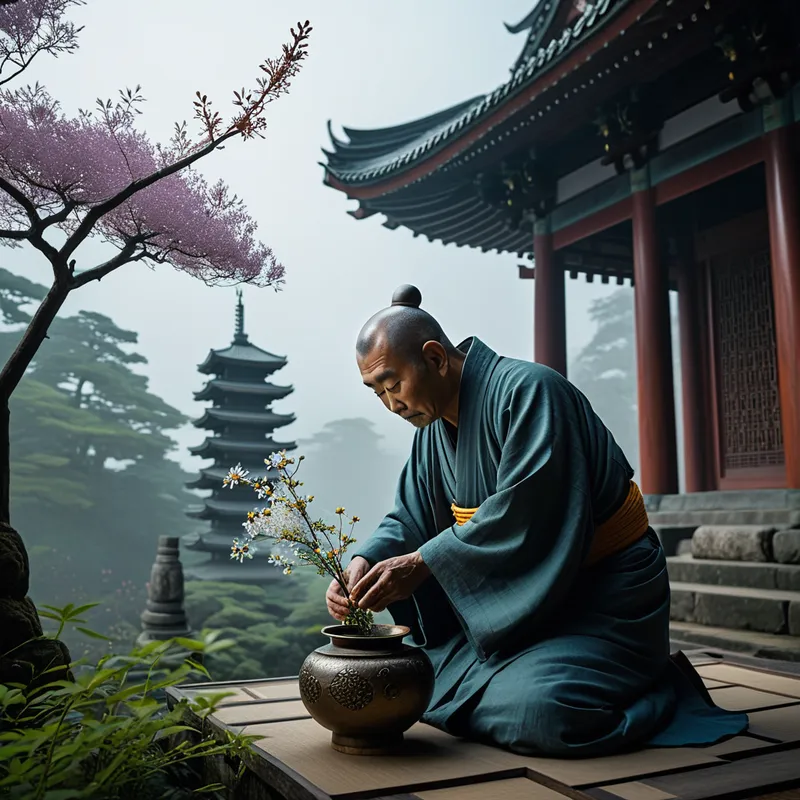
A sacred art born from a priest's silent communion with nature, Ikebana is a ritual of arranging impermanence into a fleeting moment of perfect harmony.
The Tale of Ikebana
Listen, and let the silence between the words speak.
In the time when gods still walked in the whisper of the wind and the sigh of the pines, there was a priest. He was not a king, nor a warrior, but a keeper of stillness in a temple perched between the mountains and the sky. His world was the rhythmic chant, the scent of aged wood and incense, and the vast, humming quiet of the sacred.
But a deep sorrow lived in the temple's silence. Every morning, as part of his devotion, he would walk the temple grounds and place offerings of freshly cut flowers before the honzon. They were beautiful, these blooms—peonies heavy as a summer dusk, chrysanthemums like miniature suns. Yet, by evening, they would wilt. Their heads would bow, petals scattering like fallen prayers on the polished wood. Their beauty was a fleeting sigh, a reminder of all that passes. This pained the priest. His offering felt like an offering of death itself, a procession of dying things laid at the feet of the eternal.
One morning, after a night of quiet storm, he walked the path. The air was sharp and washed clean. And there, by the moss-covered stones, he saw it. Not a cultivated flower, but a scene: a branch, torn by the wind, lay across a stone. A few resilient leaves clung to it. Beside it, a wild, unnamed flower had pushed through the damp earth, its stem curved as if listening to the branch. Around them, fallen leaves and pebbles lay in an arrangement that felt… intentional. Not by human hand, but by the hand of the storm, the slope of the land, the chance of fall. It was not just beauty; it was a story. It was a conversation between the broken and the blossoming, the enduring and the ephemeral, the earth and the sky.
A stillness deeper than any meditation fell upon him. He did not rush to the temple. Instead, he knelt in the wet moss. With breath held, he carefully lifted the branch. He felt its weight, its rough bark, the story of its growth and breaking. He cupped the wildflower, feeling the fragile life in its stem. He carried them not as an armful, but as sacred relics.
In his cell, he took a simple, unadorned vessel—just an old bowl of dark clay. He filled it with water, cool and clear. Then, he began. Not to put flowers in a vase, but to continue the conversation he had witnessed. He placed the branch first, its angle echoing the peak of the distant mountain seen through his window. He placed the flower not at its center, but leaning towards the branch, as if in dialogue. He left space—vast, breathing space—in the arrangement. The emptiness was not empty; it was the sky, it was silence, it was potential.
When he placed this creation before the honzon, something shifted. The offering was no longer a thing dying. It was a moment captured, a harmony composed. It held the storm and the calm, death in the broken branch and life in the tender flower. It was an altar to the universe itself, miniaturized, revered, and understood. He had not created beauty; he had listened to it, and in arranging, he had answered.
Cultural Origins & Context
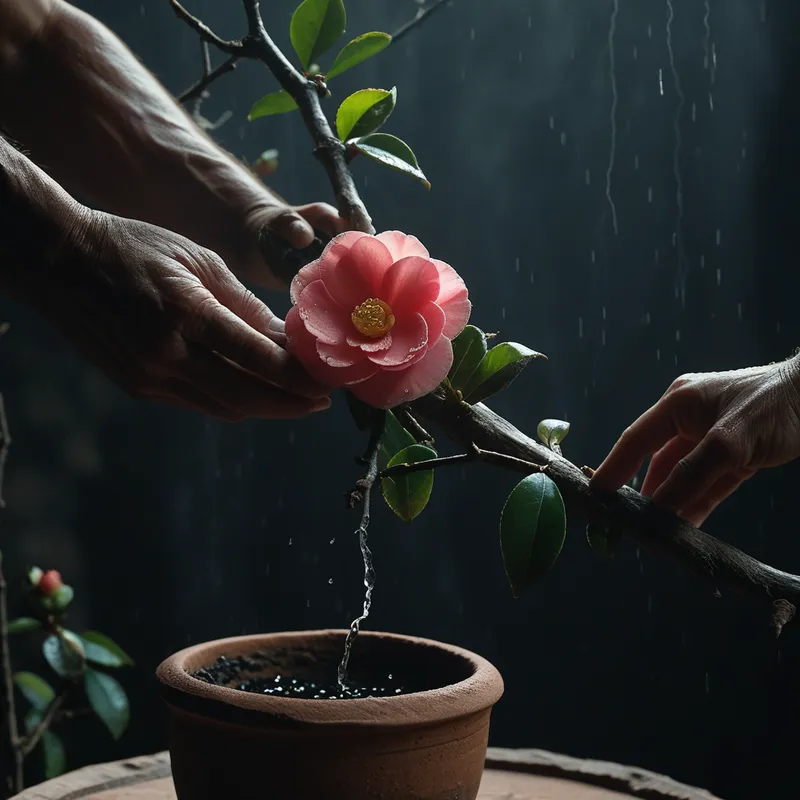
This is not a myth of a single god or a great battle, but the myth of an awakening perception. Its origins are woven into the arrival of Mikkyō (Esoteric Buddhism) from China in the 6th century. Buddhist monks, who offered flowers to the Buddha, began to see the act not as mere decoration, but as a spiritual discipline—a form of zazen with nature. By the 15th century, this practice crystallized into a codified art under masters like Ikenobō Senkei, who is often credited as the first "headmaster" of what would become the Ikenobō school.
The myth was passed down not through epic poetry, but through lineage, through the densho, and through the silent teaching of the arrangement itself. Its societal function was multifaceted: for the warrior class, it was a discipline to cultivate patience and a mind unshaken by chaos (mushin). For the aristocracy, it was an expression of refined sensibility (mono no aware). At its core, for everyone, it served as a living meditation on the three truths of existence: impermanence (mujō), the interdependence of all things, and the profound beauty inherent in asymmetry, emptiness, and natural form.
Symbolic Architecture
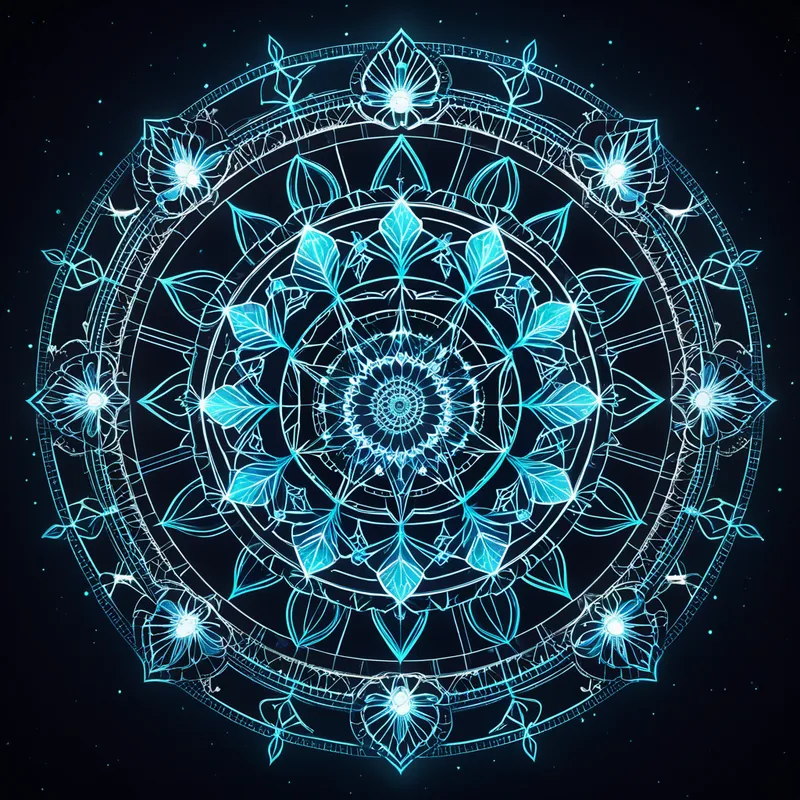
Ikebana is a three-part mandala of the soul. Its symbolic architecture is its very form.
Heaven, Earth, and Humanity (Shin, Soe, Tai): Every classical arrangement is built upon this triad. Shin represents the divine, the ideal, the aspiration—it points upward, often the tallest line. Soe is the earthly, the supporting, the foundation—it stretches out, grounding the piece. Tai is the human heart, the mediator that bridges the two, creating relationship and meaning. This is not a hierarchy but a sacred conversation.
The arrangement is a question posed to the universe: how does the human heart mediate between the ideal of heaven and the reality of earth?
Ma (The Void): The space between the branches, the negative space, is not background. It is the most active participant. It is the silence that gives sound meaning, the pause that gives rhythm to breath. Ma symbolizes the unseen forces, the spirit, the potential from which all form emerges and to which it returns.
Asymmetry and Imperfection: A straight, central, symmetrical arrangement is lifeless. The beauty lies in the off-center balance, the gnarled branch, the leaf with a insect bite. This honors mujō and embraces wabi-sabi—the beauty of the imperfect, impermanent, and incomplete. It is a psychological acceptance of one's own asymmetry, one's own scars and unique angles of growth.
The Dreamer's Resonance
When the pattern of Ikebana arises in a modern dream, it signals a psyche engaged in a profound act of inner arrangement. The dreamer is not a passive observer of their internal chaos or clutter; they are the priest in the cell, beginning the work of conscious composition.
Dreaming of carefully selecting specific, symbolic "branches" and "flowers" from a tangled mental landscape suggests an active process of discernment. What old, broken narratives (the storm-damaged branch) are you acknowledging? What new, fragile potentials (the wildflower) are you choosing to nurture? The act of placing them in a "vessel"—perhaps a dream-room, a box, or simply a defined space—indicates a desire to contain and give form to conflicting emotions or life elements.
The somatic feeling is often one of focused calm amidst anxiety, a deliberate slowing of breath and thought. If the dream arrangement feels harmonious, it reflects a psyche finding temporary, beautiful balance. If it feels frustrating or impossible, it speaks to the struggle to reconcile heaven (ideals, aspirations) and earth (realities, limitations) within oneself. The dream is an image of the self attempting to become its own Tai—the conscious mediator of its own inner cosmos.
Alchemical Translation
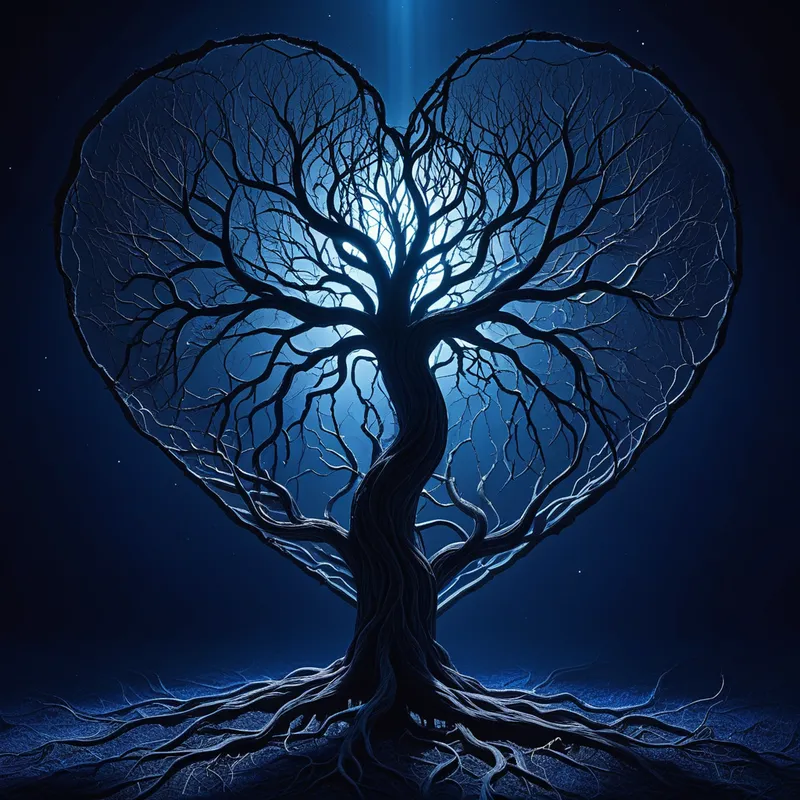
The alchemy of Ikebana is the transmutation of raw experience—both beautiful and broken—into a meaningful composition of the soul. The modern individual's "temple grounds" are their life history, their memories, their traumas, and their joys, all lying in a seemingly random, often painful scatter.
The first operation is observation without judgment—the priest seeing the storm's arrangement. This is the act of introspection, of looking at one's own psyche with a detached, compassionate eye, seeing the patterns as they are.
The second operation is selection and retrieval. One must consciously choose which elements to work with. This is not repression (throwing away the broken branch) nor naive optimism (picking only the perfect flower). It is the courageous act of picking up one's own grief (the branch) and one's own hope (the flower) and accepting both as true and valid material.
The third and crucial operation is arrangement within the vessel of consciousness. This is the individuation process. Where do I place this pain in relation to this joy? What space (Ma) must I leave for the unknown, for breath, for spirit? How do I create a dynamic, asymmetrical balance where my earthly struggles (Soe) support my spiritual aspirations (Shin), mediated by my conscious self (Tai)?
The goal is not a permanent, static sculpture of the self. It is a living arrangement, watered daily by attention, that will inevitably wilt, be taken apart, and rearranged with new materials gathered from tomorrow's storm. The triumph is in the ongoing, reverent act of composition itself.
Thus, Ikebana teaches that we are not authors of a perfect, linear story. We are arrangers of a fleeting, breathtaking moment of harmony, using the very materials of our impermanent, imperfect, and utterly real lives. In doing so, we offer not a finished self to the divine, but the sacred, ongoing process of becoming.
Associated Symbols
Explore related symbols from the CaleaDream lexicon: