Iblis the Fallen Angel Myth Meaning & Symbolism
The story of the angel Iblis, who refused to bow to humanity, embodying the cosmic drama of pride, obedience, and the shadow of the divine.
The Tale of Iblis the Fallen Angel
Listen, and hear a tale woven not of thread, but of light, fire, and a refusal that echoes through eternity.
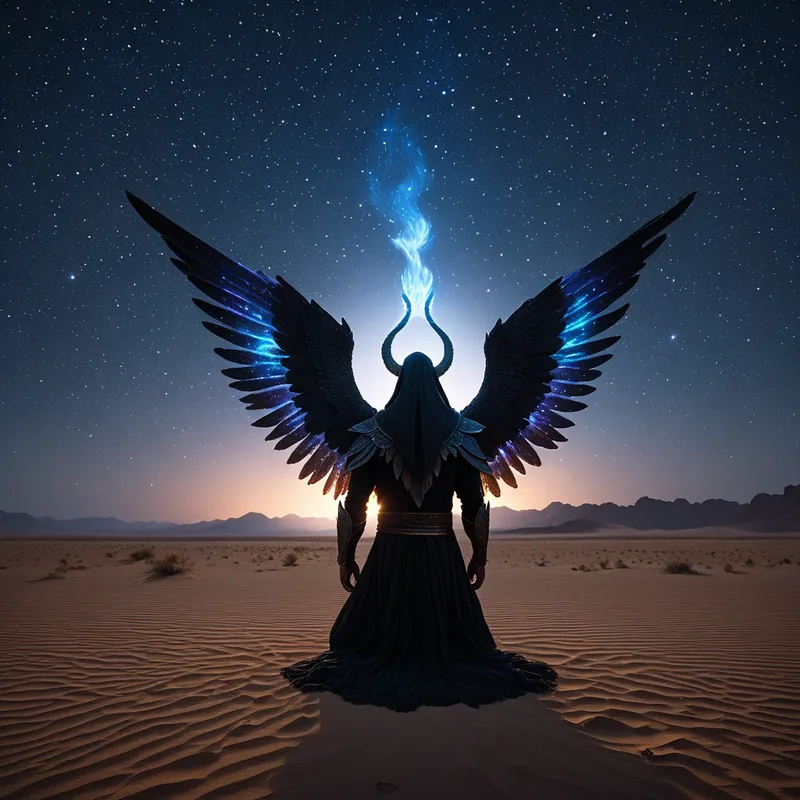
In the beginning, before time was measured, there was a Presence. A Command. And from this Command, the angels were brought forth, beings of pure, obedient light. Among them was one called Iblis. He was not like the others. His essence was not of light, but of smokeless fire, a subtle, intelligent flame. For eons beyond counting, he dwelled in the highest gardens of proximity, his worship so intense it raised him among the foremost of the celestial hosts. His prostration was a constant rhythm, his praise a never-ending song.
Then came the Day of the Clay.
The Allah spoke to the assembly of angels. From the dark, moist earth, from the sounding clay, He fashioned a new form: Adam. And into this form, the Divine breathed of His own Spirit. A stillness fell over the heavens. Then the Command thrummed through all creation: "Prostrate to Adam."
A wave of motion swept the celestial plains. Countless angels, without hesitation, bowed their luminous foreheads to the ground in honor of the Divine imprint within this new creation. The sound was like a mountain of silk settling.
But one figure remained upright. A pillar of dark flame amidst a sea of prostrate light. It was Iblis.
The silence deepened, becoming a tangible thing. The Divine Voice addressed the solitary being. "O Iblis! What prevented you from prostrating to that which I created with My Hands? Are you arrogant, or are you of the exalted?"
And Iblis spoke, his voice the crackle of embers in a vast silence. "I am better than he. You created me from fire, and You created him from clay."
In that utterance, the universe fractured. Not in rage, but in the terrible clarity of justice. The decree was pronounced: "Then descend from it! It is not for you to be arrogant here. So go forth; indeed, you are of the debased."
But the tale does not end with a mere fall. Iblis, his fate sealed, made a request—a petition that would weave tragedy into the fabric of the world to come. "My Lord," he said, "then reprieve me until the Day they are resurrected."
The reprieve was granted. "You are of those reprieved until the Day of the time well-known."
And Iblis, now Shaytan, made his vow. "By Your might, I will surely mislead them all, except Your chosen servants among them."
Thus, he descended. Not as a monster, but as a sworn enemy, a whisperer in the breast of humanity. The one who was once among the highest became the eternal adversary, not out of hatred for the Divine, but from a prideful love of his own origin, setting the stage for the great trial of the human soul.
Cultural Origins & Context
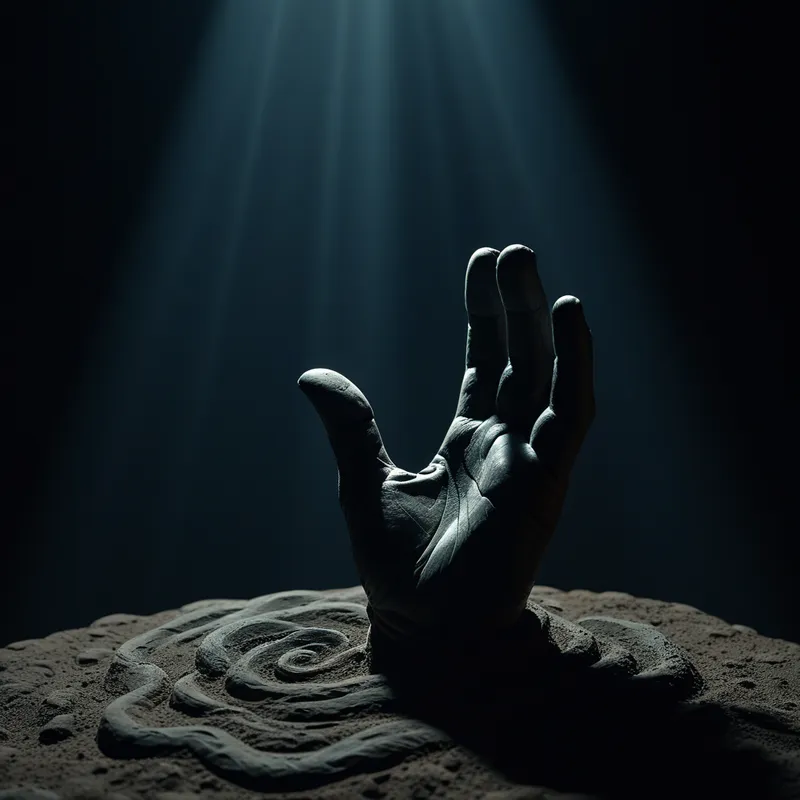
The narrative of Iblis is primarily drawn from the Quran, specifically in several surahs including Al-Baqarah, Al-A'raf, Al-Hijr, and Sad. It is not a singular, chronological tale but a thematic revelation, with details emerging across different revelations to the Prophet Muhammad. This storytelling method is intrinsic to the Quran's style, presenting the myth as a profound lesson rather than a simple fable.
Within Islamic culture, this story was transmitted orally and through scripture, serving a critical societal and theological function. It was told to explain the presence of evil and temptation in a world created by a benevolent, all-powerful God. Iblis becomes the rationale for the human condition of moral choice. The story is a cornerstone of aqidah, teaching absolute submission (islam) to divine command, contrasting it with Iblis's conditional obedience based on logic and hierarchy. It frames the human journey as a constant navigation between the divine breath within (the spirit) and the earthly clay (base desires), with Iblis as the eternal exploiter of that very tension.
Symbolic Architecture
The myth of Iblis is a masterclass in symbolic paradox. He is not a cartoonish villain of pure evil, but a tragic figure of immense spiritual stature whose fall originates in a virtue taken to a fatal extreme: the zeal for God's exclusive worship.
The first sin was not against love, but against hierarchy; not a crime of passion, but a crime of calculus.
Iblis represents the Shadow of the spiritual seeker—the pride that can grow in the soil of devotion itself. His essence of smokeless fire symbolizes intelligence, passion, and a subtle, transformative energy, contrasting with the passive, cool light of the other angels and the dense, earthly clay of Adam. His refusal is a catastrophic assertion of the ego's logic ("fire is superior to clay") over the soul's surrender to a mysterious divine will. Psychologically, he embodies the archetype of the intellect that refuses to bow to the heart, the rational mind that cannot accept the sacredness of the embodied, "earthy" human experience.
His role as the eternal tempter is equally symbolic. He does not create evil; he reveals the latent fractures within the human soul, whispering to the pride and forgetfulness already present. He is the necessary adversary in the drama of soul-making, the friction that allows for the polishing of the spirit.
The Dreamer's Resonance
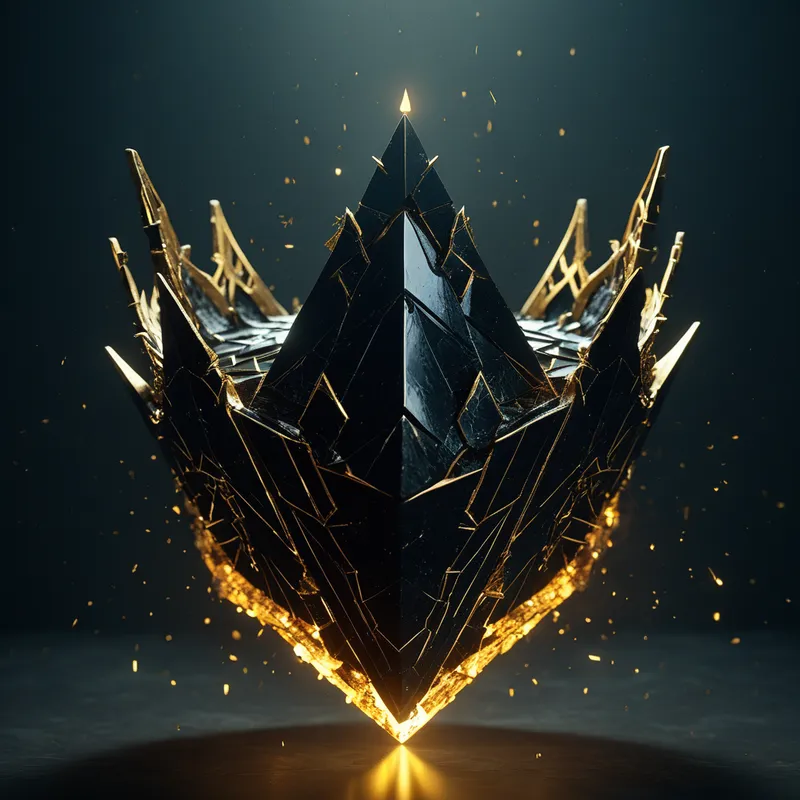
When this myth stirs in the modern dreamscape, it rarely appears as a literal devil. Instead, it manifests as profound, unsettling patterns of refusal and exalted isolation.
You may dream of being in a vast, solemn ceremony where everyone is performing a ritual act of humility—bowing, kneeling, handing over a prized possession. You stand frozen, unable to move, a burning conviction in your chest that you are different, that the rules do not apply to you, that your logic or your origin exempts you. This is the somatic echo of Iblis's stance. The dream body feels rigid, proud, and terrifyingly alone.
Alternatively, you might dream of being offered a great honor or responsibility that feels beneath you, or of being asked to serve someone you deem unworthy. The intense resentment and condescension that floods the dream is the psychological process of the "Iblis complex": a spiritualized arrogance that masks a deep fear of annihilation of the self. The dream is signaling a critical impasse where the ego's self-concept, perhaps built on intellect, status, or a sense of specialness, is blocking a necessary act of humility and integration.

Alchemical Translation
The individuation process modeled here is not the hero's conquest of a monster, but the soul's agonizing integration of the "Holy Rebel" within. The goal is not to destroy the Iblis-energy, but to transmute its fiery intelligence from a force of separation into a force of discernment.
The alchemical fire that refuses to bow must become the fire that purifies the gold of the true self.
The first step is the Nigredo: the recognition of the blackening, the fall. This is the conscious admission of one's own pride, the moments where we, like Iblis, have placed our own judgment, our origin story, or our perceived superiority above a call to humility, relationship, or simple grace. It is facing the shadow of our spiritual ego.
The Albedo is the washing in the tears of this realization. It is understanding that Adam—the human, the earthly, the imperfect—is still the vessel for the divine breath. To bow to "Adam" is to bow to the humanity in others and, most crucially, to the humble, clay-based aspects of oneself. It is the integration of the earthy with the spiritual, accepting that wholeness requires acknowledging our creatureliness.
The final transmutation, the Rubedo, is the redemption of the fire. The fierce intelligence that once said "I am better" is not extinguished but redirected. It becomes the burning zeal to protect one's own sovereignty only from genuine falsehood, not from humble truth. It becomes the catalytic energy that tests our commitments, ensuring our obedience is not blind but conscious. In this reading, Iblis's eternal role is, paradoxically, a divine service—he is the relentless refiner, the one who ensures that our submission is chosen, not robotic, and that our light is earned, not merely inherited.
Associated Symbols
Explore related symbols from the CaleaDream lexicon:
- Fire — The essence of Iblis, symbolizing pure intelligence, transformative energy, passion, and the pride that can arise from a refined but unyielding nature.
- Clay — The substance of Adam, representing the humble, earthly, and mortal aspect of creation, the foundation that the fiery intellect is commanded to honor.
- Pride — The core psychological theme of the myth, the catastrophic elevation of self and one's own attributes above divine command and communal harmony.
- Angel — The original state of Iblis, a being of pure worship and proximity to the divine, whose fall defines the boundary between obedience and rebellion.
- Shadow — Iblis embodies the ultimate spiritual shadow: the arrogance that can grow within devotion itself, the rejected part of the psyche that claims superiority.
- Order — The divine command to prostrate represents a cosmic order and hierarchy that Iblis's logic challenges, creating a rift in the fabric of celestial obedience.
- Mirror — Iblis's refusal acts as a mirror for humanity, revealing our own latent pride and forcing us to confront our capacity for conditional obedience.
- Fall — The central event of the narrative, representing the descent from a state of grace due to an inflexible attachment to one's own nature and judgment.
- Light — The nature of the obedient angels, contrasting with Iblis's fire, and symbolizing pure, selfless submission without the shadow of comparative logic.
- Grief — The profound, cosmic sorrow implicit in the fall, the loss of proximity for a being who once knew nothing but worship, now cast into the role of adversary.
- Serpent — A later symbolic association of the tempter, connecting Iblis to the archetypal symbol of cunning, forbidden knowledge, and the catalyst for conscious choice.
- Ritual — The act of prostration itself is the ultimate ritual of submission, which Iblis reinterprets through logic, turning a sacred act into a site of cosmic conflict.