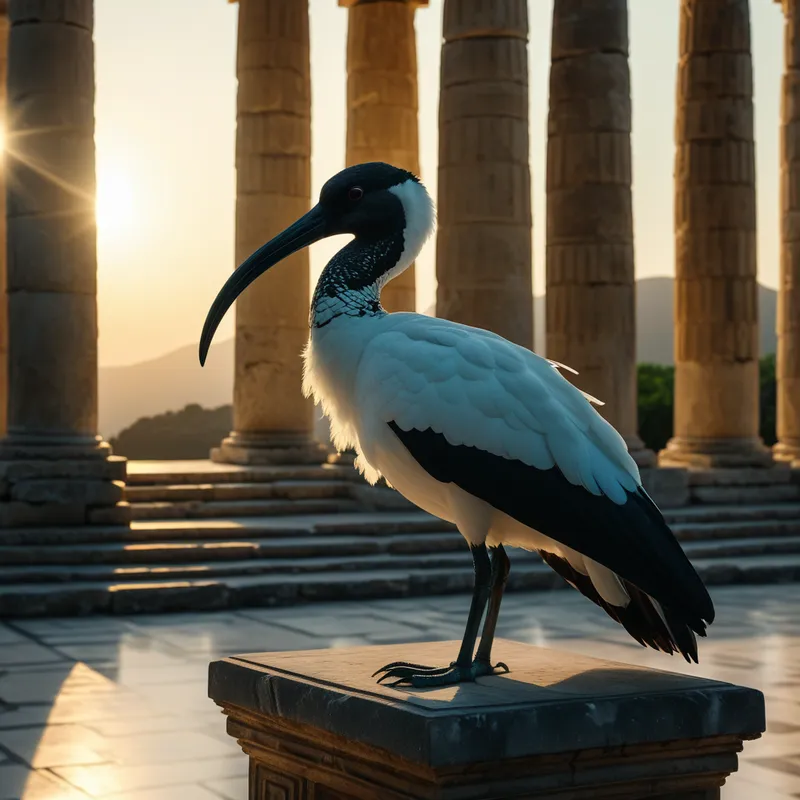
Ibis Myth Meaning & Symbolism
A sacred bird born from divine vengeance, the Ibis embodies the alchemy of turning poison into medicine and the soul's journey through darkness.
The Tale of Ibis
Hear now the story not of a hero, but of a transformation written in feathers and fear. It begins in the raw, jealous heart of Hera. Her husband, the great Zeus, had once again strayed, his eye falling upon the gentle Titaness, Leto. From their union, twin flames were kindled in Leto’s womb: Apollo and Artemis.
But Hera’s wrath was a cold, consuming fire. She forbade every corner of the solid earth from offering Leto refuge to bear her children. So Leto wandered, a ghost of impending motherhood, her burden growing as her strength waned. The very ground recoiled from her footsteps, fearing Hera’s decree. In her cruelty, Hera summoned a monstrous servant from the deep earth: the serpent Python. Not to strike a quick blow, but to harry and haunt, to coil the pregnant goddess in a relentless spiral of terror. Leto’s flight became a saga of desperation. She fled from rocky outcrop to barren plain, but always, the sinuous shadow followed, its hiss the whisper of her doom.
Her final, gasping refuge was not land, but the liminal world of the marshes—a place of sucking mud, whispering reeds, and stagnant water. Here, at the edge of the world, with Python’s breath hot on her neck, Leto’s human form could no longer hold the enormity of her ordeal. It was not a death, but a metamorphosis born of pure survival instinct. Her limbs elongated, refining into elegant, stilt-like legs. Her form compacted, grew light, and was cloaked in pristine feathers—white for her enduring purity, black for the shadow that pursued her. Her neck curved into a graceful question mark against the sky. From the terror-stricken Titaness arose the first Ibis. With a beat of its new wings, it lifted effortlessly from the mud, leaving the earth-bound serpent to writhe in frustration below. The Ibis did not fight; it transcended. It found sanctuary not in defiance, but in a fundamental change of being, trading a terrestrial struggle for the freedom of the wetland and the sky.

Cultural Origins & Context
The myth of the Ibis is not a cornerstone of pan-Hellenic epic, but a piece of localized, aetiological lore—a story that explains why. It is found in the fragments of the poet Hesiod and later in the intricate compilations of mythographers like Pseudo-Apollodorus. Its primary function was to explain the origin of the Ibis bird and to root its sacred significance, particularly in relation to Leto’s children.
For the Greeks, who observed the Ibis in the Nile delta through trade and tale, the bird was an exotic emblem of Egypt, associated with the god Thoth. This myth served as a bridge, a Hellenic "translation" that claimed the sacred bird for their own cosmology. By making the Ibis a transformed Leto, it forever linked the bird to the divine twins, Apollo and Artemis. The Ibis thus became a living symbol of their mother’s ordeal and their own miraculous birth. It was a tale told not in grand theaters, but by naturalists and priests, a story that connected the behavior of a bird—its habitat in marshes, its serene demeanor—to a foundational moment of divine trauma and resilience.
Symbolic Architecture
The Ibis is not merely a bird; it is a hieroglyph of the soul written by necessity. Its symbolism is a profound study in alchemical opposition and resolution.
The Ibis teaches that the sanctuary we seek is not a place, but a state of being—a transformation of perspective that turns the prison into the pathway.
Its stark black and white plumage is the first clue: the coexistence of light and shadow, the visible (white) and the hidden (black). Leto, in her pure, maternal innocence (white), is pursued by the monstrous, chthonic shadow of Hera’s jealousy (black, embodied by Python). The Ibis does not choose one over the other; it integrates both into its new form. The serpent, a symbol of the deadly, coiling threat from below (the unconscious, the repressed), is rendered powerless not by combat, but by a shift to a different element—from solid, contested earth to fluid marsh and open sky.
The marsh itself is the ultimate symbolic landscape. It is the liminal space—neither fully land nor fully water, a place of decomposition and fertility, of danger and profound life. It is the psychic bog where old identities dissolve so new ones can be born. The Ibis, with its long legs, walks through this mire without being consumed by it. It probes the muddy depths (the unconscious) with its curved beak, seeking nourishment (hidden wisdom), all while maintaining a poised, elevated stance.
The Dreamer's Resonance
When the Ibis strides into the modern dreamscape, it announces a process of profound psychic relocation. To dream of an Ibis, particularly one in a marshy or liminal setting, often signals that the dreamer is in a state of "pursuit." They may feel harried by an old pattern, a chronic anxiety, or a situation that feels monstrous and inescapable (the Python). The dream-ego, like Leto, is exhausted from running on solid ground—the familiar, conscious strategies that are no longer working.
The Ibis appears as a symbol of the solution that lies not in fighting harder, but in becoming different. The somatic feeling is often one of weightlessness following pressure, of a sudden capacity to rise above a quagmire of emotion. The curved neck of the Ibis may mirror the dreamer’s own need to turn inward, to question the nature of the pursuit itself. Is the monster real, or is it a manifestation of an internalized "decree" or prohibition (Hera’s wrath)? The dream invites the dreamer to consider what form of "flight" or transformation is possible—what aspect of the self must be shed or altered to find sanctuary.

Alchemical Translation
The myth of the Ibis is a perfect map for the individuation process, specifically the stage of confronting and integrating the shadow. Leto represents the conscious ego, bearing the precious potential of the Self (the divine twins). Hera and Python together represent the oppressive, terrifying aspect of the personal and collective unconscious that seeks to stifle new growth and differentiation.
The alchemical work is not to slay the serpent, but to learn the language of the marsh it guards, and in doing so, discover you have grown wings.
The conscious ego’s initial strategy—flight across familiar terrain—fails. The breakthrough occurs at the point of maximum despair, at the nigredo or blackening of the alchemical process, represented by the murky marsh. Here, the old identity (the human Leto) must dissolve. This is not a defeat, but the necessary solutio—dissolution in the waters of the unconscious. From this psychic soup, a new form coagulates: the Ibis. This is the albedo, the whitening, where a new, more resilient consciousness emerges.
This new form possesses the wisdom of both realms. It can walk in the mud (engage with the shadowy, difficult material of the unconscious) and take flight (achieve conscious perspective and transcendence). The curved beak, probing the depths, symbolizes the refined ability to extract wisdom (nourishment) from what was once only seen as muck and danger. The individual becomes the Sage—not one who has avoided the swamp, but one who knows its paths intimately and can traverse them with grace, turning the poison of persecution into the medicine of sacred knowledge. The pursuit ends not because the enemy is destroyed, but because the self has evolved beyond the arena of the conflict.
Associated Symbols
Explore related symbols from the CaleaDream lexicon: