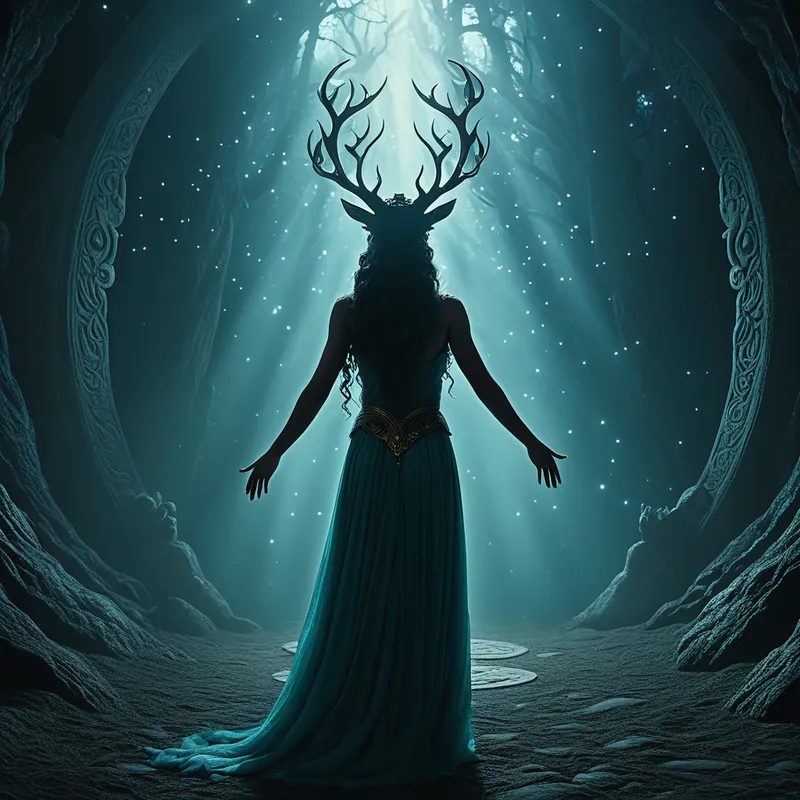
Humbaba Guardian of the Cedar Forest
The fearsome guardian of the sacred Cedar Forest in the Epic of Gilgamesh, Humbaba represents the untamed, divine power of nature that heroes must confront.
The Tale of Humbaba Guardian of the Cedar Forest
The tale begins not in the sun-baked brick of Uruk, but in the restless heart of its king, Gilgamesh. Two-thirds divine, one-third mortal, his boundless energy curdled into tyranny, oppressing his people. In answer to their prayers, the gods fashioned Enkidu, a wild man of the steppe, to be his mirror and counterbalance. After a titanic struggle, the two became inseparable brothers, their bond forged in the fire of conflict. Yet, for heroes of such stature, peace is a stagnant pool. Gilgamesh, haunted by the specter of his mortal fraction, sought an immortal name. He turned his gaze north, to the distant, forbidden Cedar Forest, realm of the gods, where the very air was perfumed with divinity and terror.
“I will conquer the demon of the forest!” Gilgamesh declared to Enkidu. “I will cut down the mighty cedars and establish my fame forever.” But Enkidu, who knew the whispers of the wild, grew pale. “My friend,” he pleaded, his voice thick with dread, “I have known that place. Its guardian is Humbaba, whose roar is the flood-storm, whose mouth is fire, whose breath is death. The gods placed him there to keep the cedars inviolate. To enter is to provoke divine wrath.”
Gilgamesh would not be swayed. The journey itself was an ordeal, crossing seven mountains, each a trial of will. As they drew near the forest’s edge, the very landscape changed. The cedars rose before them, a towering, green-black wall touching the sky, their roots sunk deep into the bones of the earth. The silence was not empty, but full—a watchful, ancient pressure. Here, Gilgamesh’s confidence faltered. He was seized by terrifying dreams, sent by the god Shamash: mountains falling, wild bulls, and a creature whose radiance scorched the land. Enkidu, the interpreter, spun each vision into an omen of victory, a psychological armor against the palpable dread.
They entered the green gloom. The forest was a cathedral, its pillars the immense trunks, its vault a canopy that shattered sunlight into trembling spears of gold. It was Enkidu who found the gate, a sacred path, and with an axe, he broke the seal. This act—the violation of a threshold—summoned the guardian. From the heart of the wood came a sound that was not a sound, but a pressure in the chest, a vibration in the skull. Then, the voice of Humbaba, echoing from everywhere and nowhere: “Who has come, who has pierced the mountains, who has felled the cedar?”
And then they saw him. The epic describes a being of terrifying amalgamation: a face carved with the coils of entrails, a lion’s maw, a roar like the deluge. He was not merely a beast, but the numen of the place—the forest given consciousness, its wrath made flesh. A battle ensued, but it was not merely physical. Shamash, the sun god, intervened on the heroes’ behalf, sending eight great winds to bind Humbaba, pinning him with tornadoes, blinding him with dust. Brought low, the great guardian transformed from terror to supplicant. He appealed to Gilgamesh, offering servitude, the cedars themselves, his wisdom. In a moment of pity, Gilgamesh hesitated.
But Enkidu, pragmatic and fierce, warned him. “My friend, do not listen! Kill the fiend before the gods change their minds. Establish your fame!” Spurred on, Gilgamesh raised his axe. Humbaba’s final curse was not one of violence, but of prophecy: “The pair of you shall never grow old together! May Enkidu die before his friend!” With that, the axe fell. The roar ceased. The watchful silence of the forest deepened, now tinged with grief. They felled the tallest cedar, made a gate for Uruk from its heartwood, and floated down the Euphrates with their spoils. They had conquered nature’s guardian, but they had sown the seeds of a divine retribution that would pursue them in the loss and mortality to come.
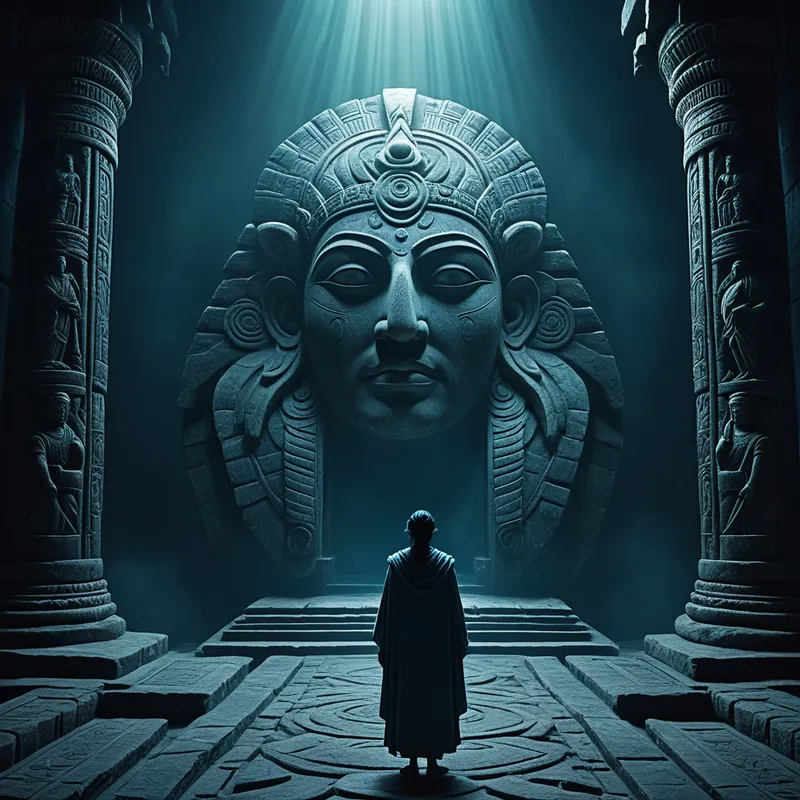
Cultural Origins & Context
Humbaba, known as Ḫuwawa in earlier Sumerian traditions, originates in the cosmological worldview of ancient Mesopotamia. The Cedar Forest was not a mere geographical location; it was the eastern, mountainous realm of the gods, a place of primordial purity and raw divine power. In a civilization built on the precarious irrigation of the alluvial plain, the distant, rain-fed mountains were sources of both awe and essential resources. The cedars themselves were symbols of immortality, strength, and divine favor, used in the construction of temples and palaces to connect the human and celestial realms.
Humbaba’s role as guardian is thus deeply theological. He is an apkallu—a boundary-being placed by the gods, specifically Enlil, the king of the gods, to maintain cosmic order (mes). His terrifying visage, described as a mass of coiled intestines, is not arbitrary grotesquery. In Mesopotamian hepatoscopy (divination through animal livers), the entrails were a map of divine will. Humbaba’s face is, symbolically, the very text of fate and divine intention, a living oracle of the forest’s sacred law. To confront him is to confront the literal embodiment of a god’s decree. Gilgamesh’s quest, therefore, is not a simple monster-slaying, but a hubristic assault on a divinely ordained boundary, a attempt to seize immortality (symbolized by the cedar) by force from its appointed protector.
Symbolic Architecture
Humbaba is the archetype of the Guardian. He does not exist for himself, but for what he protects: the sacred, the untouched, the potential. He is the necessary resistance that defines the value of the treasure. His defeat is not a clean victory, but a tragic necessity in the hero’s journey toward consciousness, a step that simultaneously brings achievement and incurs a profound debt.
He represents the psyche’s own defensive structures—the complex of fears, traumas, and ingrained patterns that guard the deepest, most vulnerable contents of the unconscious. To integrate the Self, one must first respectfully encounter, and often dismantle, these inner guardians.
His form—a composite of lion, storm, and entrails—speaks to his nature as a coincidentia oppositorum, a union of opposites. He is both animal instinct and cosmic order (the entrails as divine text), destructive storm and protective presence. He is the Shadow of civilization itself: all that is wild, untamed, and incomprehensible that must be repressed or conquered for the city-state to exist. Gilgamesh, the civilizing king, must project his own inner wildness onto this external being and slay it, only to discover that the victory hollows him.
The Dreamer's Resonance
To dream of a Humbaba is to encounter the Guardian at the threshold of personal transformation. He appears when we approach a deep, sacred, and frightening truth within ourselves—a repressed memory, a latent talent, a core wound, or a spiritual calling. The forest he guards is the lush, unknown territory of the unconscious. His roar is the somatic anxiety, the paralyzing fear that arises when we consider changing our lives, speaking our truth, or facing a buried pain.
Enkidu’s role is crucial here. He is the instinctual, embodied wisdom that knows the guardian must be faced, but also the voice that warns against compassion at the wrong moment. Psychologically, he represents the part of us that can interpret the “dreams” (our anxieties and intuitions) and push us through the paralysis. The battle is internal: the eight winds sent by Shamash are the clarifying insights, the sudden perspectives, or the supportive forces (therapy, community, grace) that allow us to momentarily see our defensive patterns clearly and move through them. The curse of Humbaba—the prediction of Enkidu’s death—is the inevitable cost: the old, instinctual way of being (Enkidu) must often die for the more conscious Self (Gilgamesh) to proceed on its lonely, mortal path.

Alchemical Translation
In the alchemical opus, Humbaba is the prima materia—the dragon that guards the hidden gold, the rough, terrifying, and chaotic starting point of the work. The Cedar Forest is the vas or sealed vessel of transformation, a sacred space where the raw stuff of the soul is contained. Gilgamesh and Enkidu represent the dual principles necessary for the work: the active, striving, solar consciousness (Gilgamesh) and the passive, receptive, lunar connection to nature and the unconscious (Enkidu).
The slaying is the nigredo, the blackening, the necessary mortification and dissolution of the old, rigid form. The felling of the tallest cedar is the extraction of the quintessence, the immortal core from the heart of the experience. The journey home down the river is the albedo, the whitening, where the integrated insight is carried into the world.
Yet, the alchemy is incomplete and tainted by hubris. They seek the prize for fame, not wisdom; for immortality, not integration. Thus, the process turns poisonous. The felled cedar becomes a city gate, a monument to ego, not a temple to the Self. The true alchemical gold—the wisdom Humbaba offered in his surrender—was rejected. The work must therefore continue through the crucible of grief and the confrontation with mortality, the next stages of Gilgamesh’s journey.
Associated Symbols
Explore related symbols from the CaleaDream lexicon:
- Guardian — The archetypal protector of a threshold, representing both necessary defense and the resistance that must be overcome for growth.
- Cedar Forest — A sacred, primordial grove symbolizing the untouched realm of the gods, the deep unconscious, and the source of life and immortality.
- Cedar Tree — The individual embodiment of strength, eternity, and divine connection; its heartwood is the essence of the sacred.
- Forest Path — The journey into the unknown self, a narrow way through dense psychic material leading to the core encounter.
- Door — The threshold between worlds, the sacred boundary whose violation summons the Guardian and initiates the transformative crisis.
- Shadow — The repressed, feared, or unconscious aspects of the self, often projected onto an external monster or adversary.
- Sacrifice — The necessary offering or loss required by the encounter with the sacred, often symbolized by the death of the Guardian or a companion.
- Rage — The raw, storm-like power of the untamed psyche, embodied in the Guardian’s roar and the hero’s violent resolve.
- Dream — The medium through which the approaching conflict with the unconscious is heralded and interpreted, a guide through the inner forest.
- Fate — The divine decree or entangled destiny represented by the Guardian’s entrail-face and his final, irrevocable curse.