Hubal the Arrow God Myth Meaning & Symbolism
The story of a deity who cast arrows to divine fate, embodying the tension between cosmic order and human agency in the ancient Arabian soul.
The Tale of Hubal the Arrow God
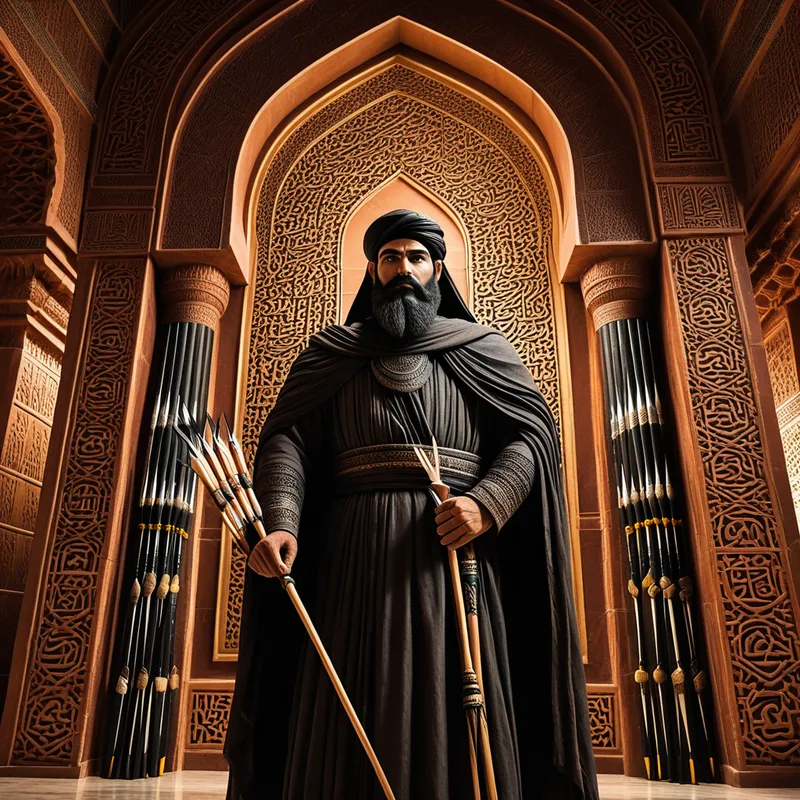
Listen, and hear the whisper of the sand. Before the One Voice filled the desert, the people of the Jazirat al-Arab knew a different kind of silence—a silence pregnant with questions. Into this silence stood Hubal.
He was not a god of thunder or of the life-giving rain. His domain was the space between the question and the answer, the breath held before the step is taken. His temple was the very heart of al-Ka'bah in Mecca, a place of deep shadow and older stones. There, he resided not as a distant star, but as a presence of polished carnelian or agate, a towering idol brought from the lands of Moab, his right hand severed and replaced with a hand of gold.
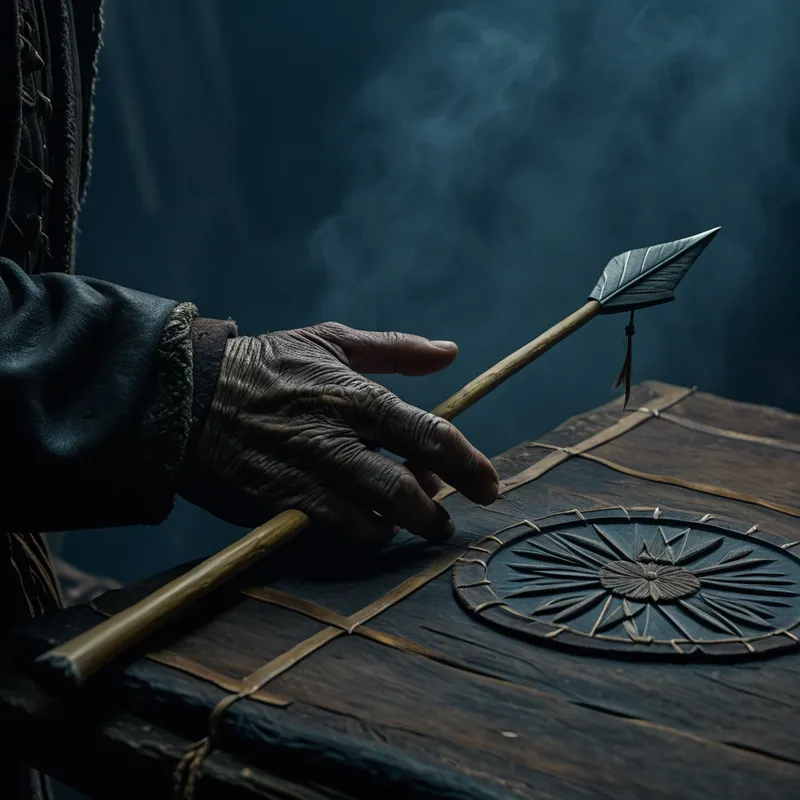
But his true voice was not in his form. It was in the seven arrows that lay at his feet. They were not for war. They were for the casting of lots, the divine gamble. Each arrow was inscribed with a single, stark command: Mubrim or Ghair Mubrim—"Of the blood" or "Not of the blood." "Yes" or "No." "Proceed" or "Abandon."
When a chieftain pondered war, his envoy would come. The air, thick with the scent of myrrh and animal sacrifice, would grow still. The priest, his face veiled in reverence, would lift the quiver. The only sound was the dry rustle of the shafts. A question was uttered into the silence, hanging like dust in a sunbeam. Then, a hand would plunge into the quiver’s darkness, fingers closing around a single, fateful shaft.
The arrow was drawn forth. All eyes upon it. The priest would turn it in the dim light, seeking the etched words. A verdict, cold and final, delivered not by a prophet’s vision, but by the blind chance of the draw. Was the proposed raid blessed? Mubrim. Then let the blood be spilled. Was the marriage auspicious? Ghair Mubrim. Then let the union be undone. The god had spoken through the fall of the arrow. Destiny was not written in the stars, but held in the palm of a trembling hand.
Cultural Origins & Context
Hubal was a central deity of the Jahiliyyah, worshipped by the Quraysh tribe as the chief god of the Kaaba. His origins are believed to be Mesopotamian, likely introduced to Arabia via trade routes, embodying the ancient Near Eastern tradition of divination through cleromancy—the casting of lots. This was not mere superstition; it was a sophisticated social and religious technology for navigating an uncertain world.
In a culture where tribal survival hinged on perilous decisions—raids, migrations, marriages, and treaties—Hubal’s arrows provided a mechanism to transcend human bias and conflict. The ritual transferred the burden of a potentially divisive choice from the shoulders of a sheikh to the impersonal, sacred authority of the god. The priest acted as a mediator, but the outcome was understood as the direct will of Hubal. This practice created a binding social consensus, a "divine mandate" that all parties were compelled to accept, thus maintaining tribal cohesion in the face of potentially fractious choices.
Symbolic Architecture
At its core, the myth of Hubal represents the human psyche’s confrontation with the unknown and its desperate need to find pattern and intention in chaos. The arrow is the perfect symbol for this: it is directional, intentional, and irreversible. Once loosed, its path is set.
The arrow does not choose its target; it is the embodiment of the choice itself, frozen in flight.
Hubal, as the Arrow God, personifies the archetypal principle of Order—but not a benevolent, moral order. It is the cold, impartial order of fate, of cause and effect. The seven arrows may hint at celestial or planetary associations, a link between the microcosm of human dilemma and the macrocosm of cosmic law. The ritual transforms paralyzing ambiguity into a binary, actionable reality. Psychologically, it externalizes the inner conflict between opposing impulses (to act or to wait, to fight or to flee), projects it onto a sacred object, and receives back an answer that the conscious ego can accept as fate, thereby resolving the inner tension.
The Dreamer's Resonance
When this myth stirs in the modern unconscious, it rarely appears as a stone idol. Instead, one might dream of standing before a crucial, life-altering choice represented by identical, ominous objects—doors, keys, files, pills. There is a profound somatic sensation of paralysis, of "drawing a blank," coupled with an oppressive awareness that the choice must be made. The dream ego waits for a sign, for some external force to dictate the way, mirroring the ancient pilgrim awaiting the arrow’s verdict.
This dream state signifies a moment of existential suspension where the individual’s usual decision-making apparatus (logic, values, desires) has failed. The psyche reaches back for the archaic template of divination, seeking to hand the burden of agency over to the Self, to the deeper, transpersonal layer of the psyche that the ancients called "the god." The anxiety in the dream is the friction between the modern ego’s demand for autonomy and the soul’s ancient familiarity with surrender to a larger will.

Alchemical Translation
The individuation process, the journey toward psychic wholeness, requires confronting what Jung called the "transcendent function"—the capacity to hold the tension of opposites until a third, transformative solution emerges. The Hubal ritual is a primitive, externalized model of this internal alchemy.
Initially, the ego is identified with one side of a conflict (e.g., "I must do this"). The opposing impulse is repressed, becoming a shadow. The ritual space (the Kaaba, the dream) becomes the vas hermeticum, the sealed container where this tension is held. The act of drawing the arrow is the critical moment of submission. The ego relinquishes control, allowing the unconscious (Hubal) to speak.
The true alchemical gold is not the answer on the arrow, but the courage to accept the oracle’s decree as one's own deepest, though previously unknown, direction.
The "answer"—Mubrim or Ghair Mubrim—is the symbolic birth of the transcendent function. It is a new, numinous insight that breaks the deadlock. For the modern individual, the alchemical translation means developing the inner sanctum—a meditative, reflective space—where one can consciously hold opposing needs or truths without forcing a premature, ego-driven decision. The "arrow" that eventually emerges is not random, but an intuitive knowing, a synchronicitic sign, or a sudden clarity that feels fated, integrating the will of the Self. One moves from being a subject to fate to a conscious participant in its unfolding.
Associated Symbols
Explore related symbols from the CaleaDream lexicon:
- Arrow — The central artifact of the myth, representing directed fate, irreversible decision, and the moment where potential becomes manifest destiny.
- God — Embodies the transpersonal, archetypal force of Order and impersonal fate, the source of authority beyond human reasoning.
- Temple — The sacred container (the Kaaba) where the ritual of divination occurs, symbolizing the inner psychic space where profound choices are confronted.
- Destiny — The overarching theme of the myth, the pre-ordained path revealed through the arrow's decree, challenging notions of free will.
- Ritual — The prescribed, solemn actions of consulting the arrows, representing the formal process of bridging the human and divine to resolve uncertainty.
- Shadow — The unseen, rejected alternative inherent in every binary choice presented by the arrows, the path not taken that lingers in the psyche.
- Fate — The impersonal, cosmic principle that Hubal administers, the inscrutable weave of cause and effect that the arrows attempt to read.
- Choice — The fundamental human dilemma presented to the deity, the agony and necessity of selecting one path and forsaking all others.
- Obsidian Arrowhead — The sharp, volcanic essence of the arrow, symbolizing the piercing, cutting clarity that emerges from the ritual, leaving no room for ambiguity.
- Sacrifice — Implicit in every decree; to choose one path is to sacrifice another, offering the potential of the rejected future to the gods of fate.
- Order — The principle Hubal embodies, the antithesis of chaos, providing a structured, if harsh, framework for navigating a chaotic world.
- Dream — The modern internalization of the divination ritual, where the unconscious presents symbolic choices and oracles for the dreamer to interpret.