Hraesvelgr Myth Meaning & Symbolism
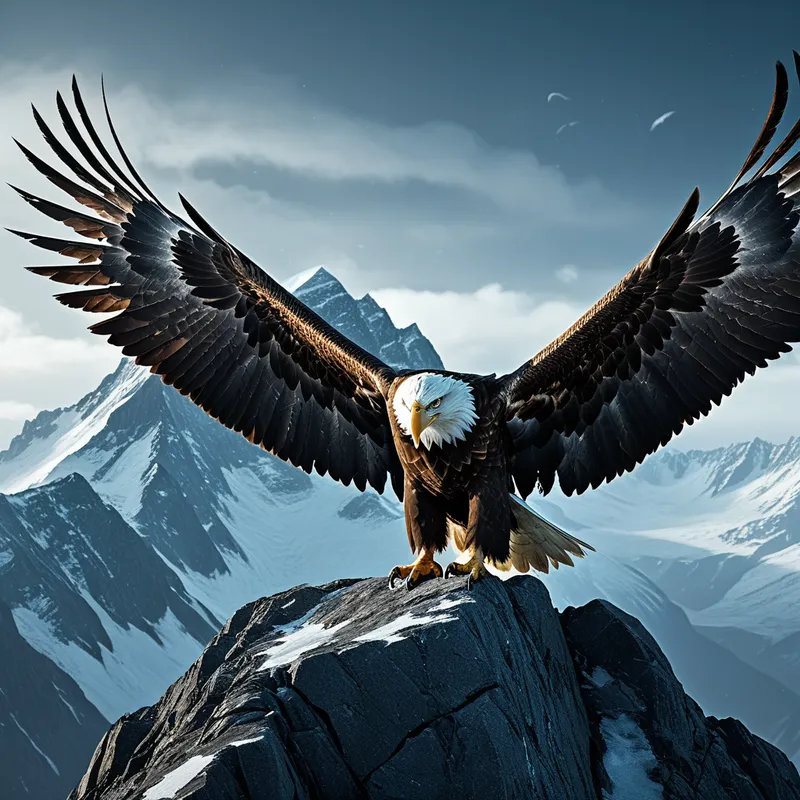
A giant eagle perched at the edge of the world whose beating wings are the source of all winds, a primal force of breath, change, and cosmic boundary.
The Tale of Hraesvelgr
Listen, and hear the breath of the world.
At the northernmost rim of all that is, where the roots of the Yggdrasil clutch at the void and the sky bleeds into the abyss, there sits a throne of ancient stone. It is not a seat for gods, but for a watcher. Here, at the very lip of creation, perches Hraesvelgr. He is a giant in the shape of an eagle, but his feathers are the grey of mountain mist and his eyes hold the chill of the primordial deep. He does not hunt; he watches. He gazes eternally outward, beyond the nine worlds, into the Ginnungagap—the yawning, silent chaos that existed before the first spark of fire met the first chip of ice.
His form is immense, a mountain range given wings. The winds do not come from the whims of the gods or the churning of the seas alone. They are born from him. When the world grows still and stagnant, when the air in the high halls of Asgard hangs heavy and the mists in Jotunheim cease their crawl, a deep restlessness stirs in the watcher.
A great sigh heaves from his breast, a sound like glaciers calving. Then, he spreads his wings. They are not feathered in the way of earthly birds, but are vast, leathern sails, patched with the storms of ages. With a slow, deliberate, world-shaping beat, he pushes against the stillness. The first gust is a whisper that rustles the highest leaves of Yggdrasil, a secret told to the eagle who sits in its branches. The second beat is a roar that scours the peaks of the mountains, driving snow before it. The third is a gale that fills the sails of Viking longships far below in Midgard, that whips the waves into white fury, that carries the scent of pine and salt and distant fires.
He is the bellows of the cosmos. His wings, rising and falling in rhythms older than the sun, draw the breath of the void across the worlds. This is his sole, eternal purpose: to perch at the edge and, by his very being, to set the air in motion. He is the boundary-dweller, the transformer of stillness into current, the silent cause of every storm and every breeze that kisses a mortal cheek. He does not speak; his language is the wind itself.

Cultural Origins & Context
The figure of Hraesvelgr is found in the Eddic poem Vafþrúðnismál (The Lay of Vafthrudnir) and is referenced in the later Prose Edda. In these sources, he is not the subject of a grand narrative saga but a piece of cosmic architecture—a fact of the universe revealed in the wisdom contests between Odin and the giant Vafthrudnir. This context is crucial. Hraesvelgr is not a character in a drama of love or war; he is an answer to a profound riddle about the nature of the world.
His myth was likely part of the deep cosmological knowledge preserved by skalds and wise men, explaining a fundamental, observable phenomenon: the origin of the wind. For a seafaring, agricultural culture like the Norse, the wind was not a mere meteorological event; it was a divine force, capricious and essential. It could mean the difference between a successful raid and a watery grave, between a good harvest and famine. By personifying its source as a giant-eagle at the world's edge, they located this vital, unpredictable power within a structured, meaningful cosmos. It was a way to comprehend the incomprehensible, to give a face and a place to the invisible forces that shaped their lives.
Symbolic Architecture
Hraesvelgr is a master symbol of the liminal—the threshold state. He exists at the absolute boundary between the ordered cosmos (the Nine Worlds) and the unformed chaos (Ginnungagap). His body is the interface itself.
He represents the necessary tension at the edge of being, where what is known meets the vast unknown, and from that meeting, energy is born.
Psychologically, he embodies the function of the transcendent function, a concept from depth psychology describing the psyche's capacity to generate a new, reconciling attitude from the tension of opposites. The stillness of the known world and the formless potential of the chaos are the opposites. Hraesvelgr, by his mere presence and action, is the process that mediates between them, producing the "wind"—the movement, the new thought, the inspiration, the change that sweeps through the internal landscape.
His name, often translated as "Corpse-Swallower," adds a chthonic, transformative layer. He does not just create movement; he consumes stagnation. The "corpse" can be seen as dead air, dead ideas, dead patterns. His action is one of psychic digestion, breaking down what is inert to fuel the breath of life and change. He is not a destructive storm, but the essential process that prevents the cosmos from becoming a closed, lifeless system.
The Dreamer's Resonance
To dream of Hraesvelgr is to dream from the very periphery of the self. Such dreams often carry an atmosphere of immense scale, solitude, and a powerful, impersonal force.
One might dream of standing on a high, precarious cliff, feeling a colossal presence above or behind, and then experiencing a sudden, overwhelming gust of wind that threatens to sweep one away—not with malice, but with sheer, indifferent power. This can correlate with a somatic experience of anxiety, a literal "wind" in the chest or gut, a feeling of being breathless or over-energized by forces beyond one's control.
Psychologically, this dream pattern signals that the dreamer is at a profound boundary in their life. The old "cosmos" of their identity, relationships, or beliefs has become static, airless. The unconscious (the Ginnungagap) is pressing in, filled with unformed potential and terror. The giant eagle's presence indicates that a deep, archetypal process has been activated to generate the "winds" of change. The dreamer may be resisting this inner weather, fearing the storm, not yet understanding that the wind is also the breath that will carry them forward. The process feels alien and immense because it is; it is the psyche's own infrastructure working autonomously to prevent psychic death.
Alchemical Translation
The individuation process, the alchemical journey of becoming whole, requires precisely the function Hraesvelgr represents. We build a stable, ordered ego-world—our personal Midgard. Over time, it can become rigid, its air stale. Our known truths become dogmas; our habits, prisons. This is when we must, consciously or not, approach our own world's edge.
The alchemical work is to find the seat of the watcher within—to voluntarily perch at the boundary of the known self and gaze into the personal Ginnungagap, the unintegrated chaos of the shadow and the unrealized Self.
This is an act of immense courage. It is not about charging into the chaos, but about holding the position of the eagle. It is a stance of observation and acceptance of the tension. From this sacred, lonely vantage point, we begin the work of "beating our wings." This is the active engagement with the unconscious through imagination, active dreaming, art, or deep reflection. Each intentional engagement is a wing-beat, drawing the raw, chaotic potential of the unknown across the threshold of consciousness.
The "winds" that result are the unsettling but vital forces of change: new insights that disrupt old narratives, emotional gusts that clear away deadwood, inspirations that propel us in new directions. It is a transmutation of stagnant, corpse-like psychic material into the animating pneuma—the spirit-breath. We do not become the chaos, nor do we retreat from it. We become the boundary, the transformer, the generator of our own essential weather. In doing so, we perform the most sacred of Hraesvelgr's tasks: we ensure our inner cosmos does not suffocate in its own stillness, but lives, breathes, and evolves.
Associated Symbols
Explore related symbols from the CaleaDream lexicon: