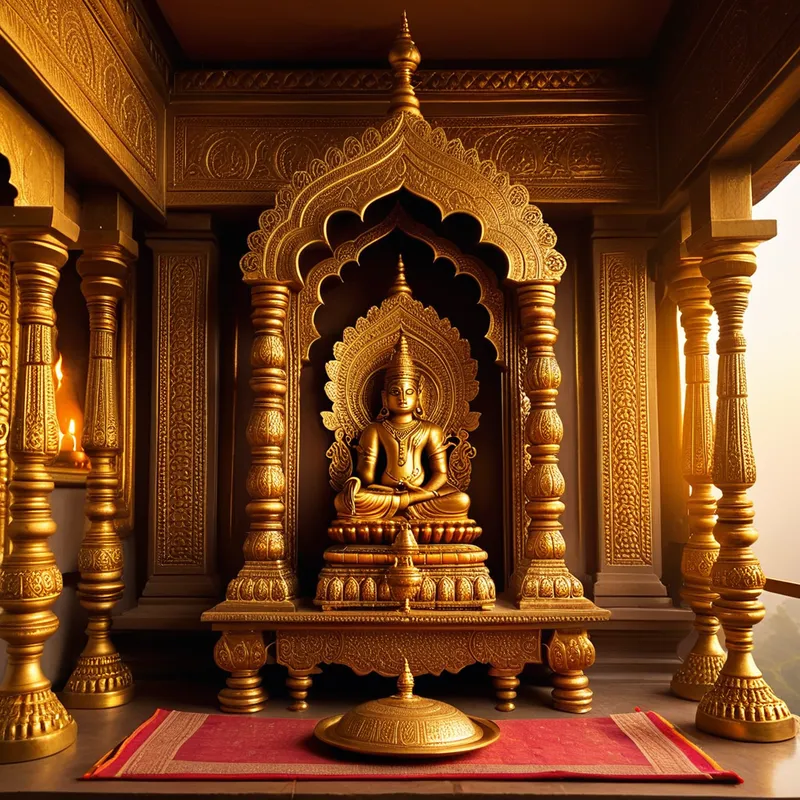
Household Shrine Myth Meaning & Symbolism
The myth of the household shrine reveals the sacred within the mundane, a divine covenant that transforms the home into a living temple of presence and devotion.
The Tale of the Household Shrine
Listen, and let the story settle in your bones. It does not begin on a mountaintop or in a celestial hall, but in the quiet, smoke-stained corner of a humble dwelling. The air is thick with the scent of earth, turmeric, and woodsmoke. Here, in this realm of grinding stones and crying children, of laughter and weariness, a profound longing took root—a longing for the touch of the infinite amidst the relentless tide of the finite.
The great devas resided in their lofty lokas, attended by celestial beings. Their worship was grand, requiring vast temples, elaborate rituals, and learned priests. But what of the woman whose hands were calloused from the field, whose day was measured in chores, not hymns? What of the man whose world was bounded by the village wall? Their devotion was no less fierce, but the path to the divine seemed distant, obscured by the very necessities of life.
Then, a whisper moved through the world, a covenant not carved in stone but felt in the heart. It was said that the Divine, in its boundless compassion, would descend. Not with thunder, but with a subtle, profound agreement. "Where you make a space for me," the whisper promised, "there I will reside. Not as a guest, but as the silent heart of your home."
And so it began. A simple shelf was cleared, washed with water and intention. A humble stone, smooth from a riverbed, was placed upon it. A fragment of turmeric root, a handful of wildflowers. No grand murti yet, only a focus for a gaze turned inward. At dawn, the first offering: a few grains of rice, a drop of water, a moment of stillness before the day's storm. This was the altar. This was the pact.
The divine presence accepted. It did not demand gold or marble; it asked for remembrance. It settled into that corner like a gentle, pervasive warmth. The home was no longer just a shelter from the rain; it became a devālaya in miniature. The food cooked in the hearth was first offered to that silent witness. The joys of the family were laid before it. The sorrows were whispered into its quiet space. The shrine became the axis, the still point around which the wheel of domestic life turned. It was the bridge where the timeless touched the temporal, where the cosmic order of dharma found its expression in the daily duty of grihastha dharma. The myth is not of a single hero, but of every hand that lights a lamp, of every heart that makes a home a sanctuary.
Cultural Origins & Context
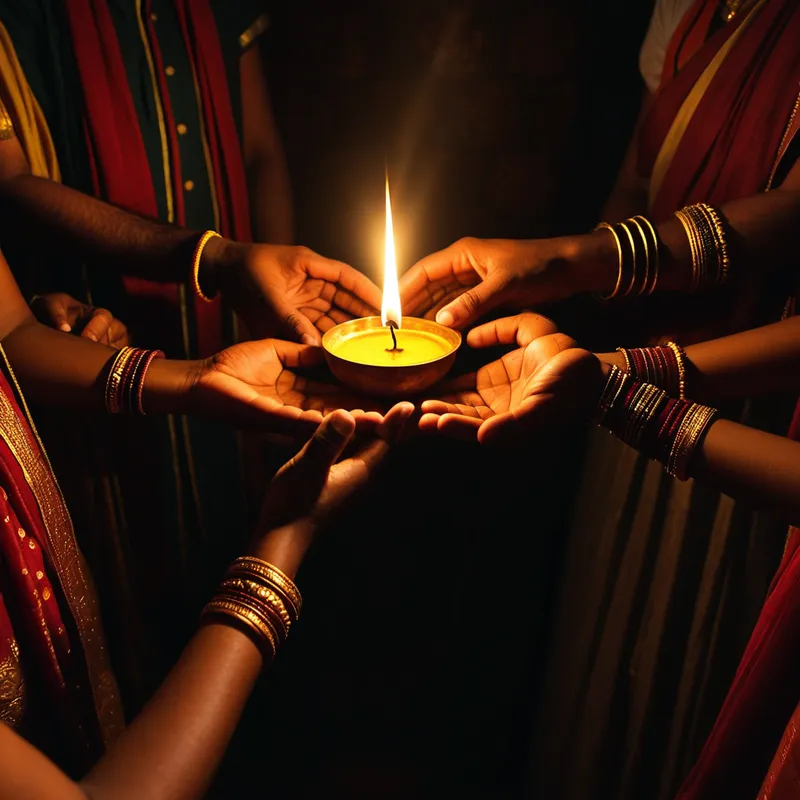
This is not a myth with a single author or epic verse. It is a living, breathing narrative woven into the very fabric of sanātana dharma, the eternal way. Its origins are as ancient as the first hearth fire and as personal as a grandmother’s murmured prayer. It is transmitted not through sacred texts alone, but through osmosis—by watching a parent perform ārati, by smelling incense on a festival morning, by feeling the quietude of the shrine room.
The societal function is profound. It democratizes the divine. While temple worship remains central for communal and grand ritual, the household shrine ensures that spiritual authority and access are not solely the domain of the priestly brāhmaṇa class. It places the responsibility of cosmic maintenance (yajña) into the hands of the householder. The home becomes a self-sufficient spiritual ecosystem. This practice anchors religion in daily reality, preventing it from becoming an abstract, weekend philosophy. It sacralizes the mundane acts of cleaning, cooking, and caring, transforming them into acts of worship and threads in the larger tapestry of dharma.
Symbolic Architecture
The household shrine is a masterclass in symbolic condensation. It is a mandala of the psyche and the cosmos.
The altar is not where the god sits; it is where the human kneels, and in that kneeling, discovers the divine ground of their own being.
Physically, it represents the Mount Meru, the axis mundi, in microcosm. The deities arranged upon it map the inner faculties of the individual and the family. The flickering lamp (dīpa) is the ātman, the immortal self, whose light is offered back to the universal Brahman. The incense is the ephemeral nature of sensory experience and desire, transformed into an offering that ascends and dissolves. The flowers and food (prasāda) symbolize the fruit of one’s labor, the tangible world, which is first consecrated before being enjoyed.
Psychologically, the shrine represents the temenos—the sacred, protected inner sanctum of the psyche. It is the place where the ego, represented by the householder, consciously makes space for and dialogues with the larger Self, the archetypal totality. The daily ritual (pūjā) is a psychic hygiene, a regular re-centering of consciousness away from the peripheral chaos of māyā and toward the central truth.

The Dreamer's Resonance
When this myth stirs in the modern dreamscape, it often manifests as a profound somatic call for integration and sanctity. To dream of discovering a hidden shrine in one’s own home, or of frantically trying to clean and prepare a neglected altar, signals a psyche in the throes of a sacred reclamation.
The dreamer may be experiencing a life where the inner and outer are brutally split—where professional ambition, digital noise, or relational drama has completely colonized their inner space. The shrine in the dream is the psyche’s own blueprint for wholeness. The act of tending to it—lighting the lamp, placing the offering—is the somatic process of self-attunement. It is the nervous system learning, through symbolic action, to carve out a moment of non-doing, of pure being. The conflict in such dreams is rarely with an external monster, but with the forgotten self. The resolution is the simple, profound act of remembrance, of turning one’s attention inward to that silent, waiting center.
Alchemical Translation
The alchemical process modeled here is the transmutation of the profane into the sacred. It is the opus of daily life. For the modern individual hurtling through a secular, fragmented existence, the myth offers a radical template for individuation—not through a heroic quest to slay dragons abroad, but through the disciplined, loving care of the inner sanctum.
Individuation is not about becoming special, but about becoming whole. It is the daily puja of acknowledging every fragment of the self—the noble and the shadow, the joyful and the weary—and offering it at the altar of consciousness.
The "base metal" is our scattered, reactive, identified state—living solely in the roles of employee, partner, consumer. The "sacred space" of the shrine is the vessel of transformation. The daily ritual is the slow, patient fire of attention. Through this practice, the mundane actions of life are gradually infused with intentionality and meaning. Cooking becomes a sacrifice. Cleaning becomes a purification. Work becomes a service (karma yoga).
The ultimate alchemical gold produced is not enlightenment in a remote cave, but a sacramental consciousness. It is the ability to perceive the thread of the divine running through the tapestry of ordinary life. The householder achieves a unique kind of individuation: one grounded in relationship, in duty, in the beautiful, messy reality of the human world, yet perpetually anchored to the timeless. They become the living shrine, the point where the world is made holy simply by being seen, tended, and offered.
Associated Symbols
Explore related symbols from the CaleaDream lexicon: