
Homer Myth Meaning & Symbolism
The blind poet who sang the tales of gods and heroes, becoming a vessel for the collective memory and soul of an entire civilization.
The Tale of Homer
Listen. The wind that scours the Aegean carries more than salt and the cry of gulls. It carries a voice. It is the voice of a man who saw the world not with eyes of flesh, but with the inner sight granted by the dark. They called him Homer. Some said he was born of a river nymph, others that he was a wandering spirit given form. But all agreed: when he sang, the world stopped to listen.
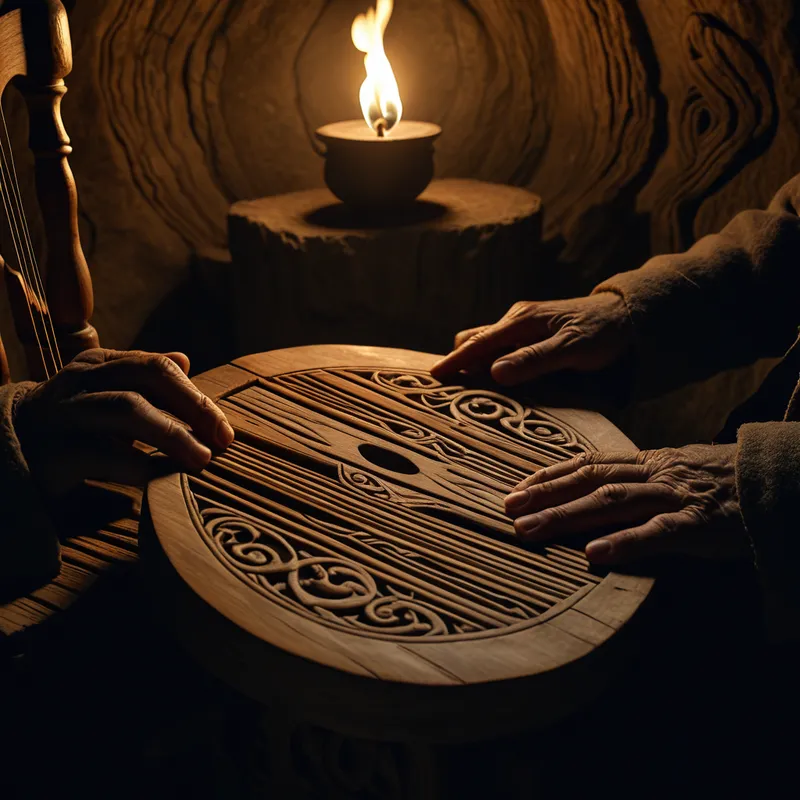
He would sit in the firelight of a great hall or under the sprawling branches of a sacred grove, his face a map of years, his eyes like polished stones that gazed into a distance only he could fathom. He would take up his phorminx, its wood smooth from a thousand journeys, and his fingers would find the strings. A hush would fall. The crackle of the fire became the only other sound.
Then, he would begin. Not with his own voice, but with an invocation: “Sing, Goddess, the rage of Achilles…” And as he sang, it was not a man who spoke. The air thickened with the scent of brine and blood. You could hear the thunder of Poseidon's chariot, the shriek of bronze on shield, the desperate gasp of a warrior falling on the plains of Troy. You saw the cunning glitter in Odysseus's eye as he conceived the wooden horse, felt the profound loneliness of his twenty-year journey home, heard the haunting song of the Sirens.
He sang of the wrath of gods and the fragility of men, of glorious kleos (glory) and bitter nostos (homecoming). He sang until the listeners were no longer in their own time and place. They were on the decks of black ships, in the halls of golden Zeus, in the bedchamber of weeping Helen. When the final note faded and the ordinary world rushed back in, they looked at the blind bard with a kind of holy terror. For he had not merely told a story. He had made them remember a past they had never lived, a memory buried deep in the blood and bone of their people. He was the vessel, and the Muses were the wine.
Cultural Origins & Context
The figure of Homer is a paradox at the heart of Greek civilization: a specific name given to a profoundly collective, anonymous process. Historically, he is placed in the 8th or 7th century BCE, a period emerging from the Greek Dark Ages. The epics attributed to him—the Iliad and the Odyssey—were not composed as written texts but as oral poetry, performed by generations of bards (aoidoi) who inherited and refined a vast tradition of formulaic phrases, themes, and story cycles.
Homer, whether a single master poet or a symbolic name for the tradition’s pinnacle, represents the moment this fluid oral tradition was crystallized into a definitive shape. His myths were not entertainment in a modern sense; they were the foundational curriculum. They provided a shared history (however mythologized), a code of ethics (honor, hospitality, fate), a theology (the capriciousness of the gods), and a linguistic standard. To be Greek was to know Homer. His verses were recited at festivals, studied by philosophers, and used to settle disputes. He was the “educator of Hellas,” the loom upon which the fabric of Greek identity was woven.
Symbolic Architecture
Homer, the blind seer, is the archetype of the vessel. His physical blindness is not a deficit but the precondition for a deeper vision. He does not observe the world; he is inspired by it—literally, breathed into by the divine pneuma of the Muses.
The true poet is not the maker of the tale, but the hollow reed through which the wind of memory sings.
Psychologically, Homer represents the connection to the collective unconscious. The stories he channels—of the hero’s rage, the wanderer’s longing, the interplay of human agency and divine whim—are not historical accounts but primordial patterns of the human psyche. The Iliad symbolizes the catastrophic, fiery eruption of the ego (Achilles’ wrath) and its necessary, tragic reintegration. The Odyssey is the long, circuitous journey of the <abbr title="The central organizing principle of consciousness, the sense of "I">ego through the perils of the unconscious (Cyclops, Scylla, Circe) in search of the authentic Self (represented by Ithaca and Penelope).
Homer himself, as the narrator, is the function of consciousness that can witness and give coherent form to these chaotic, archetypal forces. He is the psychic capacity for narrative meaning-making.
The Dreamer's Resonance
When the pattern of the Homer myth appears in modern dreams, it often manifests not as a literal image of a bard, but as an experience of being a channel. One might dream of hearing a powerful, disembodied voice dictating a story, of discovering an ancient text they feel compelled to read aloud, or of being in a vast library where books speak on their own.
Somatically, this can feel like a pressure in the chest or throat—the “wind” of the Muses seeking expression. Psychologically, the dreamer is likely at a point where personal experience is being subsumed by or connected to a larger, transpersonal pattern. They may be grappling with a fateful life event, a profound creative block, or a feeling that their personal story is part of a grander narrative they do not yet understand. The dream signals a process of downloading, of the psyche assembling fragments of personal and ancestral memory into a new, meaningful whole. The conflict is between the small, conscious self and the overwhelming tide of what seeks to be known and spoken.
Alchemical Translation
The alchemical process modeled by the Homer myth is the opus of distillation and transmission. The prima materia is the raw, chaotic mass of lived experience, ancestral memory, and archetypal imagery—the thousand ships, the countless deaths, the endless waves. Homer’s blindness is the nigredo, the necessary descent into darkness where external sight is voided to activate inner vision.
The journey from chaos to epic is the journey from identification with the hero to becoming the poet of one’s own life.
The lyre and the formulaic verse are the alembic, the structured container (the tradition, the craft) that shapes the volatile material. The invocation of the Muse is the crucial moment of coniunctio, the sacred marriage between human skill and divine influx. The resulting epic is the lapis philosophorum, the philosopher’s stone—not a physical object, but the perfected, enduring narrative that makes meaning out of suffering and pattern out of chaos.
For the modern individual, the “Homeric work” is the task of moving from being a passive character buffeted by fate (an Achilles in his tent, an Odysseus lost at sea) to becoming the author—or more accurately, the scribe—of one’s own myth. It is to listen inwardly for the larger story wanting to be told through your life, to craft the raw events of joy and trauma into a coherent narrative of becoming. It is to recognize that your personal struggles with rage, longing, cunning, and homecoming are verses in an ancient song. To individuate is not to invent a new story from nothing, but to discover how you, like the blind bard, are a unique vessel for the eternal tale.
Associated Symbols
Explore related symbols from the CaleaDream lexicon: