
Holy Anointing Oil Myth Meaning & Symbolism
A sacred, divinely-revealed recipe of spices and oil, consecrating priests, kings, and the tabernacle, marking the boundary between the profane and the holy.
The Tale of Holy Anointing Oil
Listen, and let the scent of the sacred carry you back. Not to a time of stone and scripture alone, but to the scent-laden air of the wilderness, where the divine breath spoke in formulas of fragrance.
The people were a nation of dust and longing, camped at the foot of the trembling mountain, Sinai. Above, the air crackled with the presence of the Unnameable. Below, in the heart of the camp, a space was being cleared—not for a palace, but for a tent. A dwelling not of man, but of the Holy. This was the Tabernacle, and it stood empty, a vessel waiting to be filled.
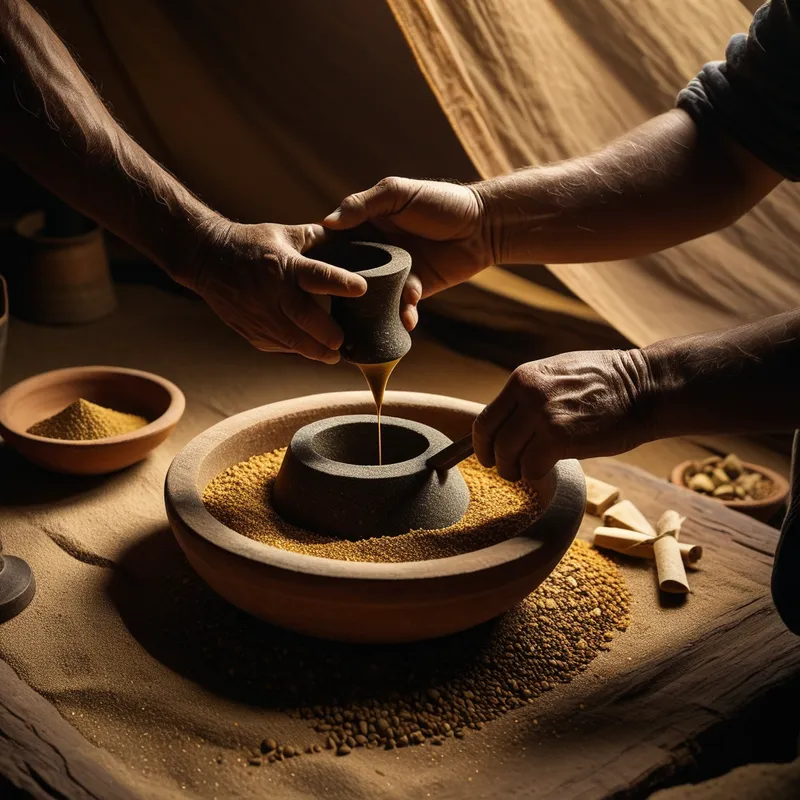
Then the Voice descended, not in thunder this time, but in a whisper of spice and sap. It spoke to Moses, not of law, but of alchemy. "Take the finest spices," it instructed, a recipe unfolding like a sacred map. "Five hundred shekels of flowing myrrh, half as much of sweet-smelling cinnamon, two hundred and fifty of aromatic cane, and five hundred of cassia." The measures were precise, a divine mathematics of aroma. These were to be ground, pulverized until they became a fine powder, a dust of heaven.
Then, the base: a hin of pure, first-press olive oil. Not just any oil, but oil of the beaten olive, clear and golden. Into this liquid light, the powdered spices were to be mingled. The command was absolute: this was to be a holy anointing oil, a perfume blended as by the art of the perfumer. Its purpose was singular and terrifying in its intimacy: to anoint.
First, the Tabernacle itself—its altar, its utensils, the very ark of the covenant. The oil was daubed upon wood and metal, transforming craft into consecration, object into oracle. Then, it touched skin. Aaron and his sons were brought forward. The oil was poured upon Aaron’s head, a golden river tracing the contours of his skull, dripping onto his beard, onto the collar of his sacred robes. The air grew thick with the scent—pungent myrrh, sweet cinnamon, earthy cassia—a smell that was now the smell of holiness itself. They were set apart, made sacred, their very bodies now a boundary between the people and the divine.
And the warning echoed like a bronze bell: "This shall be my holy anointing oil throughout your generations. It shall not be poured on the body of an ordinary person, and you shall not make any like it in composition. It is holy, and it shall be holy to you. Whoever compounds any like it or puts any of it on an outsider shall be cut off from his people."
The oil rested in its vessel, a silent, fragrant witness. It anointed kings, making shepherds into sovereigns. It marked prophets. It was the scent of authority, of divine election, of a terrifying proximity to the Source. It was the smell of the boundary itself—the thin, fragrant line where the human ended and the holy began.
Cultural Origins & Context
This myth originates from the priestly traditions of ancient Israel, meticulously preserved in the book of Leviticus and the latter chapters of Exodus. It is not a narrative of heroes and monsters, but a ritual text—a divine technical manual. Its tellers were the priestly caste, the Kohanim, for whom the precise recipe and its restricted use were matters of cosmic order and tribal identity.
In the ancient Near Eastern world, anointing with oil was a common practice for kings (as seen in Egypt and Mesopotamia). Israel’s innovation was its radical sacralization. This was not just oil; it was qodesh, "holy"—meaning set apart, charged with a dangerous, transformative power. Its societal function was foundational: it visually and olfactorily established the hierarchy of the sacred community. It answered the profound human question: "How does the infinite touch the finite?" The answer was not merely in words or laws, but in a sensory, material substance. The oil was the physical proof of the covenant, the glue that held the sacred architecture of society together—separating the priesthood from the populace, the sanctuary from the camp, the holy from the common.
Symbolic Architecture
At its core, the myth of the Holy Anointing Oil is a profound meditation on the principle of consecration—the act of dedicating something to a sacred purpose, thereby changing its essential nature.
The oil itself is a symbol of the mediated divine. The Tetragrammaton is utterly transcendent, a consuming fire. Yet, relationship requires a point of contact. The oil becomes that contact point, a divine essence "trapped" in material form (spices and oil), safe enough to handle, potent enough to transform. It represents the immanent aspect of the transcendent—the sacred that condenses into a form we can perceive with our senses.
The holy is not an idea to be thought, but a substance to be received. It must drip from the crown of the head into the beard of the soul.
The four spices are not arbitrary. Myrrh, used for burial and suffering, represents the mortificatio—the necessary death of the old, profane state. Cinnamon and cassia, warming and stimulating, symbolize the ignition of sacred fire and passion. Sweet cane offers the note of attraction and divine sweetness. Combined and dissolved into the neutral, illuminating olive oil (a classic symbol of spirit, wisdom, and peace), they create a holistic essence. The sacred is not one note, but a complex harmony of sacrifice, passion, delight, and illumination.
The strict prohibition against replication or common use underscores a critical psychological truth: not all spaces within the psyche are meant for everyday consciousness. There is an inner sanctum, a Holy of Holies, that must be approached with ritual care. To anoint everything is to consecrate nothing. The taboo protects the potency of the sacred by maintaining its boundary.

The Dreamer's Resonance
When this myth stirs in the modern unconscious, it often surfaces in dreams of potent liquids, sacred markings, or forbidden rituals. A dreamer might find a vial of iridescent oil and feel a compulsive, awe-filled need to anoint a doorway or their own forehead. They may dream of being chosen for a mysterious ceremony involving fragrant substances, or conversely, of being punished for using a "common" oil in a sacred context.
Somatically, this points to a process of psychic designation. The psyche is in the act of marking something as sacred and set apart. This could be a newfound talent that must be honored and developed with discipline (anointing a skill). It could be the establishment of a crucial psychological boundary—anointing the threshold of the self to protect a vulnerable, emerging identity. The feeling of awe or terror in the dream mirrors the ancient understanding of the holy as mysterium tremendum et fascinans—a fearful and fascinating mystery. The dreamer is encountering a power within themselves that is both immensely attractive and dangerously potent, requiring respect and proper "ritual" (conscious integration) to handle.

Alchemical Translation
For the modern individual navigating the path of individuation, the myth of the Holy Anointing Oil models the alchemy of vocation and integrity.
The first stage is the revelation of the recipe—the unique, personal formula for one's sacred purpose. This is not found in external expectations, but in the quiet "voice" of the Self. It is the discovery of one's own "finest spices": the blend of innate gifts (sweet cane), endured sufferings that have produced wisdom (myrrh), passionate drives (cinnamon), and grounding strengths (cassia).
The second is the rigorous compounding. These elements must be "ground fine"—honestly examined, accepted, and integrated. This is the hard work of self-knowledge, often a painful grinding down of pride and illusion. This powder of self-understanding is then dissolved into the oleum animae, the oil of the spirit—one's conscious life force and attention.
Individuation is the self-anointing. It is the act of taking the compounded essence of your experience and deliberately consecrating your own authority, your own center, as holy.
The resulting "oil" is then applied in the sacred act of self-consecration. This is where one anoints their own "priesthood"—their inner authority to guide their life. They anoint their "kingship"—their responsibility to rule their own domain (choices, time, energy) with sovereignty. They anoint the "tabernacle" of their daily life, infusing mundane routines with sacred intention.
The final, crucial translation is heeding the prohibition. The individuated person learns that this self-consecrated essence—their integrity, their core values, their hard-won wisdom—is not to be poured out promiscuously. It must be protected from "outsiders"—the inner critics, the draining demands, the forces that would profane the sacred space within. To misuse it is to be "cut off"—to experience the alienation of self-betrayal. Thus, the myth guides us not only to create our sacred essence but to establish the vigilant, loving boundaries that allow it to serve its true, transformative purpose.
Associated Symbols
Explore related symbols from the CaleaDream lexicon: