Hobgoblin Myth Meaning & Symbolism
A tale of the rough, helpful household spirit, where the offering of cream and bread transforms chaotic mischief into protective, earthy kinship.
The Tale of Hobgoblin
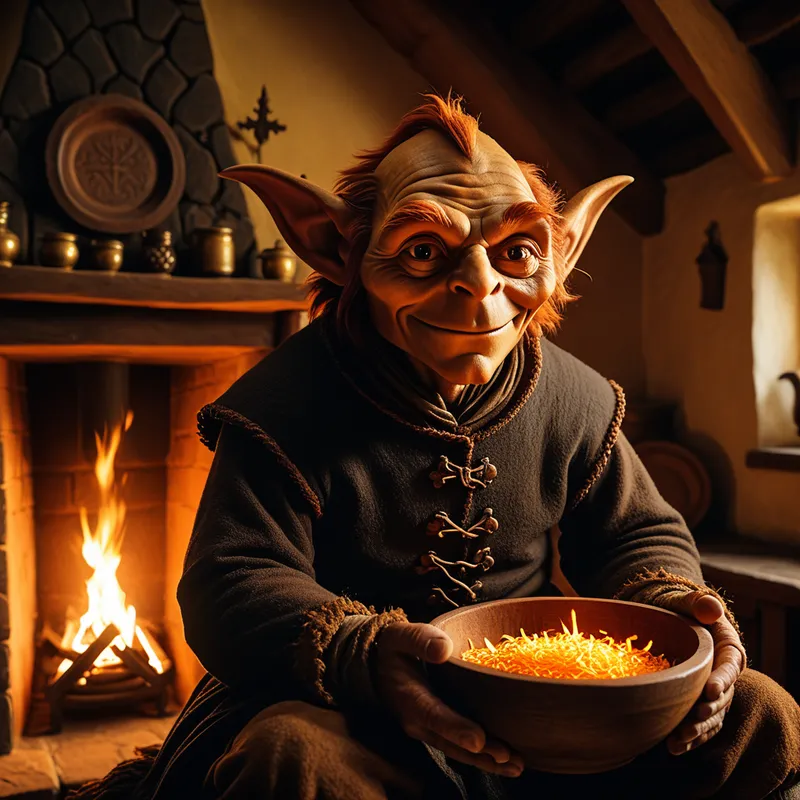
Listen, and let the peat-smoke carry you back. Not to grand halls or misty moors, but to the very heart-hearth of a place: the croft-house, where the fire’s breath is the only song against the vast, listening dark outside. Here, in the liminal space between the swept flagstone and the soot-blackened beam, dwells the other citizen of the home. He is not tall, nor fair. His name is whispered, not shouted: Hob. Hobgoblin.
He is knotted and gnarled as an old root, his skin the colour of good earth after rain. His eyes are like chips of flint that catch the fire-glow, knowing and sharp. He wears no fine cloth, but the patina of the place itself—a dusting of flour here, a smear of hearth-ash there. He is the genius of the hearth, but a genius with rough hands and a laugh like stones tumbling in a brook.
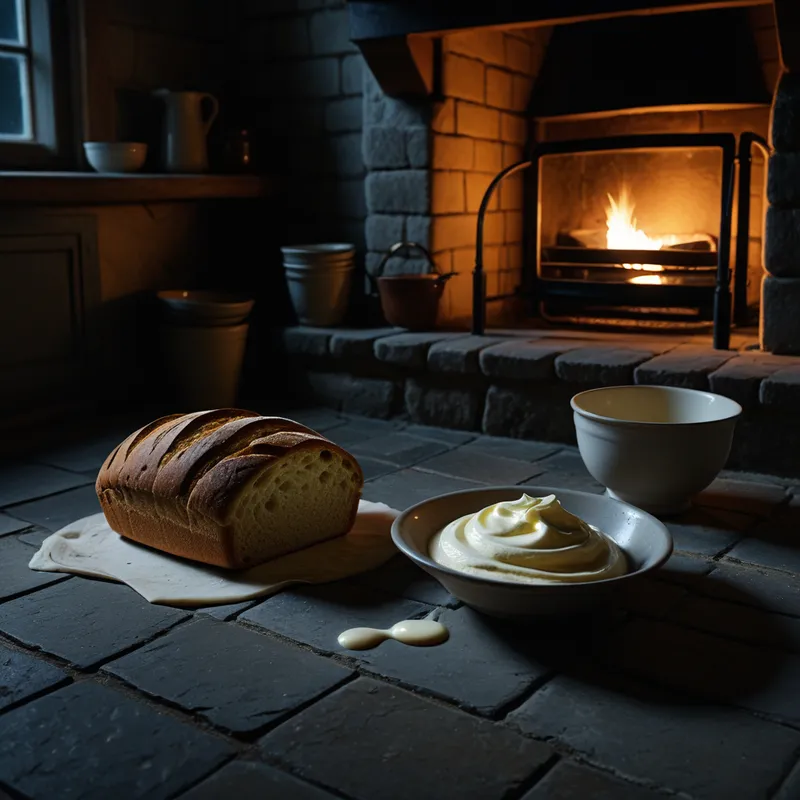
His work is seen, not him. Come morning, the weary farmer finds the churning done, the butter formed under a strength not his own. The forgotten fire is banked to a perfect, sleeping glow. The tools, left dull, are found honed and keen. For this, Hob asks no gold. His wage is simpler, profound: a bowl of the thickest cream, set by the hearthstone. A crust of the house’s bread, still warm from its heart. It is an offering of essence, of the home’s own bounty.
But let that bowl stand empty? Let the bread grow stale and forgotten? Then see the other face of Hob. The helpful hands become mischievous claws. He is the sudden cold draft that snuffs the candle. The milk that sours between one breath and the next. He is the tangle in the wool, the pebble in the shoe, the laugh that echoes from the empty chimney. He pinches the maid black and blue, hides the good spoon, and makes the ale foam over for spite. He becomes the embodied grumble of the neglected household, the poltergeist of ingratitude.
The resolution is not a battle, but a remembering. It is the weary housewife, sighing through her frustration, who finally places the chipped blue bowl, full to the brim, upon the exact stone. Who breaks the loaf and leaves half. In the silence that follows, a warmth returns to the stones. The mischief ceases. And sometimes, if you are very quiet and look not directly, you might see a small, shadowy shape curled in the ashes, content, a guardian once more. The pact is remade. The wild thing is welcomed home.
Cultural Origins & Context
The Hobgoblin is a creature of the English folk imagination, born from the intersection of the hearth and the untamed land just beyond the doorstep. Unlike the aristocratic fairies of courtly romance or the terrifying bogies of pure nightmare, Hob belongs firmly to the domestic sphere of the farming and labouring classes. His tales were not written in illuminated manuscripts but passed orally by firelight, from grandparent to child, servant to servant, as both warning and comfort.
He functioned as a folk explanation for the capricious nature of daily life. A successful churning, a fire that burned well against the damp—these were Hob’s blessings. Spilt milk, lost items, and minor household disasters were his rebukes. This personalized the chaos of a precarious existence, giving it a face and a logic: the logic of reciprocal relationship. The myth enforced a social and spiritual economy of attention and gratitude within the home. To care for Hob was to care for the spirit of the home itself, to acknowledge that the dwelling was a living partnership between the human and the unseen world.
Symbolic Architecture
Psychologically, the Hobgoblin is a magnificent representation of the shadow aspect of the archetype of the Caregiver. He embodies the unvarnished, often inconvenient truth that care is not a one-way stream of benign, selfless energy. True care—for a home, a relationship, a part of the self—has a rough, demanding, embodied quality.
The shadow of the hearth is not coldness, but the demand for fuel.
Hob’s helpfulness symbolizes the immense resource of instinctual, unconscious energy that supports our daily functioning—the autopilot that gets chores done, the intuition that warns us, the bodily wisdom that keeps the system running. His mischief, conversely, is the symptom of that energy being ignored or exploited without reciprocity. He is the somatic complaint that arises when we neglect self-care, the emotional outburst when our contributions go unseen, the creative block when we demand output without offering inspiration.
The core symbols are stark and alchemical. The hearth is the sacred center, the heart of the psychic system where transformation (cooking, warming, illuminating) occurs. The cream is the richest, most valued product of the system—our attention, our finest energy, our love. The bread is the staple, the daily substance of life—our consistent, grounding presence. Offering these is the ritual that transmutes the raw, chaotic Hob-energy into structured, protective power.
The Dreamer's Resonance
When the pattern of the Hobgoblin myth stirs in the modern dreamer, it often signals a crisis of psychic reciprocity. One may dream of a familiar yet neglected space—a childhood home, a first apartment—now in disrepair. Small, chaotic events unfold: taps won’t turn off, lights flicker, familiar objects are misplaced. There is a feeling of being sabotaged from within one’s own sanctuary.
Somatically, this can mirror feelings of low-grade irritation, unexplained fatigue, or a sense that one’s own home or body feels subtly hostile. The dream-ego is being “pinched” by its own neglected foundations. The Hobgoblin in the dream is the personified grievance of the parts of the self that do the unseen labour: the body that carries stress, the intuition that is dismissed, the need for rest that is overridden.
The dream is an invitation from the unconscious to identify what “cream and bread” have been withheld. Where in your life are you expecting the hearth to burn brightly while refusing to feed the fire? The resolution in the dream may be as simple as finding a dusty bowl and filling it, or hearing a raspy chuckle from the shadows that sounds not menacing, but satisfied. It marks the moment the psyche begins to re-negotiate its inner domestic treaty.

Alchemical Translation
The individuation process modeled by the Hobgoblin myth is the alchemy of turning a haunting into a housemate, a poltergeist into a protector. It is the work of integrating the domestic shadow.
The first stage is Nigredo, the blackening: the experience of Hob’s mischief. Life feels sabotaged; minor annoyances coalesce into a pattern of frustration. This is the necessary darkening, making visible the ignored imbalance. The second is Albedo, the whitening: the conscious realization of the pact. This is the insight that the chaos has a cause, a name, and a simple price. It is the washing of the bowl, the preparation of the offering—the act of conscious attention.
The offering is not a bribe, but a sacrament of recognition.
The final stage is Rubedo, the reddening: the integration. The mischievous energy, once acknowledged and fed, reveals its true nature as the foundational, caring force of the hearth. The Hobgoblin does not disappear; he is redeemed. He becomes the vigilant guardian of the threshold, the instinct that warns of true danger, the ingrained habit that maintains order. The individual learns that their wholeness depends not on banishing their rough, demanding, needy parts, but on setting a place for them at the hearth. The wild is welcomed into the home, and in doing so, the home becomes truly whole, a defended castle where the fire of consciousness burns bright, fed by the rich, dark fuel of the once-feared earth.
Associated Symbols
Explore related symbols from the CaleaDream lexicon: